

How badly did the Fed blow it?
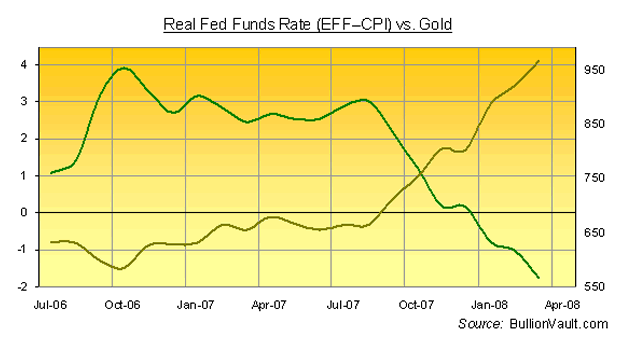
The purpose of easing rates was, ostensibly, to prevent a slowdown of the US economy. The effect of easing rates was to devalue the dollar and fuel a speculative bubble in commodities that has taken what few spare dollars consumers had left and literally burned them as fuel costs have jumped over 100% since they began cutting rates last year, costing American consumers $1,470,000,000 PER DAY in additional fuel prices and a similar increase in food prices for a whopping $547Bn a year tax on consumers to support a bail-out of the financials.
The financial institutions, ironically, have taken the Fed's low-interest money and invested in commodities, notably oil, the price of which has outstripped the rise in gold (pictured above) by 250% in one of the most ridiculous speculative bubbles ever created. You can see from THIS CHART that oil disconnected from gold (and all fundamentals) in March, when it broke over $100 per barrel.
Keep in mind that gold traders take into account the same global risks of terror, war, inflation and instability as well ad dollar valuation as oil supposedly does, the difference between the two is speculation, pure and simple. US demand for physical product is 2.5% lower than it was last year, a very big deal from the World's largest consumer of oil and the rest of the World is cutting back at a rapid rate.
So the Fed has made a gigantic mess of the economy as money is being sucked out of every US industry other than Food and Energy, both of which are consumables with no lasting value and, in energy's case, the vast majority of the $1,034,775,000,000 per year we are now spending on oil goes right out of this country, flooding the world with dollars in exchange for less physical oil than we bought last year for $500Bn, and that money – had the Fed not listened to Jim Cramer and bailed out his pals, could have stayed in this country and allowed people to pay their mortgages and buy IPhones and GM cars or whatever.
 THE FED TOTALLY BLEW IT! This economy has been assassinated in what has effectively been a disproportionate tax on the poor (since we all use about the same amount of gas and there are a lot more poor people) to bail out the rich people who got them to buy houses (the last runaway commodity bubble) at inflated prices by creating loans that made them "affordable," albeit for a brief period of time.
Whether these were intended or unintended consequences of the Bush administration I'll let history decide but let's remember who warned us of the "unintended" consequences of invading Iraq before he figured out how to make a few Billion dolllars doing it…
There is NOTHING wrong with this economy that $65 oil won't fix. It will put $500Bn back into the hands of US consumers, knock $500Bn off our trade imbalance, add $1.5Tn of spending power to global consumers and those numbers DOUBLE if other commodities follow suit and fall back to "normal" levels. "If regulators took the step of increasing cash requirements on oil futures contracts from the current 7.5 percent to 25 percent or more, oil prices would collapse" Chief Executive Officer of TrimTabs Investment Research Charles Biderman told The Washington Times.
A combination of cheap money and lax regulation has driven the price of oil to these heights, while increased global demand has played a part in oil price hikes, oil companies have estimated profit-oriented speculation in oil futures has doubled the price of oil above where market dynamics would have it, the Times reported. Congress is doing their part to reign in speculation, now it's time for the Fed to take away the punch bowl and send these drunken bastards home in a taxi!
Japan traded flat ahead of the Fed, recovering from a 200-point drop after what must have been a very good lunch. The Hang Seng rose 179 points after a cyclone-delayed open but they actually fell significantly from the gap up, dropping straight down into the close and, frankly, I don't know what to make of this chart. The Shanghai jumped 4% on the day as Wen Jiabao said China's economic and social situation has been "better than expected" despite the impact of domestic disasters and some major changes in the global economy.
Adding further insult to the massive injuries that have been heaped upon the American people over the past 7 years and 5 months, we are even losing our edge in creating millionaires according to MER's World Wealth report. The study indicates that the number of millionaires in the US grew at just 3.7%, the slowest growth since 2002 and very pathetic compared to a 19% growth rate in Brazil, Russia, India and China. Well those extra $1Tn that the Fed is having us ship out of the country have to end up somewhere don't they???
 So remind me, exactly what segment of the economy do these economic policies help? The more than $40 trillion held by the world's millionaires will move increasingly outside the U.S., since the new millionaires prefer to invest in their own countries. Investments by the world's millionaires in North America are expected to decline to 39% of all investments in 2009 from 42% in 2007, the report said.
Europe is trading even ahead of our open and ECB's Trichet signaled that the central bank may raise interest rates next month. Banking shares are rebounding as BCS's capital raise, which we talked about yesterday, was well received. Another UK mortgage lender, Bradford & Bingley is down 76% in the past year but is now the object of a bidding war as investors fight to put money INTO the company.
AXP reached an expected settlement with MA and picked up another $1.8Bn, but has other weak numbers that will hurt them today. Illinois is suing CFC for fraudulent lending practices, that should keep a lid on our lenders for a while even though a mortgage aid package that may refinance up to $300Bn worth of loans is quickly working it's way through Congress. Let's keep in mind that this was one of my key pillars required for a Q2 earnings recovery.
"There is nothing that is as important for this country at this moment as this bill," Senate Banking Chairman Christopher Dodd (D., Conn.) said during debate, describing the measure as a "tourniquet" to slow record numbers of foreclosures and declining home prices. A large number of Democrats and Republicans are expected to support the measure when the Senate votes, ignoring a veto threat from the White House in the face of growing concern about housing and the economy from constituents. "That's all rubbish, there's no bailout in this legislation," Dick Shelby (R – Alabama) told reporters following lawmakers' weekly caucus lunches.
The package combines a number of different housing-related measures, including long-sought reforms to the FHA, nearly $4 billion in block grants for local governments to deal with blight and other effects of foreclosures, and a regulatory overhaul of Fannie Mae, Freddie Mac, and the 12 Federal Home Loan Banks.
The centerpiece of the legislation is a program offering up to $300 billion of FHA-insured mortgages to help refinance struggling borrowers into affordable loans. The program would rely on lenders voluntarily writing down the value of a distressed loan for the homeowner to qualify for the new FHA-backed loan, and in return borrowers would have to share future price appreciation with the federal government. Our members may remember this as the plan I have been pushing since last year and recently outlined in April to save the housing industry. which was featured on CNBC's site on April 15th. Too bad another 400,000 homes were foreclosed since that day…
So I'm feeling pretty good about things at the moment and so are the markets, let's just hope the Fed doesn't screw it all up… again… as usual…
