
🤖 Timeline of Main Events (March 3-7, 2025)
Before March 3, 2025:
-
- Market volatility and losses leading up to the week.
- Tariff fears and growth concerns are already impacting the market.
- Nvidia stock broke below its 200 day moving average, a key technical sell signal.
- Tesla shares are down 30% from December highs, its worst YTD performance since 2020.
- Atlanta Fed’s GDPNow model is projecting negative GDP for Q1.
- The Fed is anticipated to be cutting interest rates.
March 3, 2025 (Monday):
-
- Markets open higher on news of a proposed US Crypto Strategic Reserve.
- European Defense stocks surge in reaction to increased defense spending.
- Trump reaffirms tariffs, and stocks head lower.
- Phil notes there aren’t enough buyers to support serious selling activity.
- Oil gets smashed, but natural gas rises.
- Market sells off through the day as “window dressing” fails.
March 4, 2025 (Tuesday):
-
- Trump’s tariffs on Canada, Mexico, and China officially take effect.
- Retaliation from Canada is immediate, with $20B in tariffs.
- Money flies into treasuries as there is nowhere else to put it when cashing out stocks.
- The Dow Jones Industrial Average continues a multi-day slide.
- The Atlanta Fed’s GDPNow projection flips to a -2.8% Q1 contraction.
- Odds of a May rate cut by the Federal Reserve increase.
- The U.S. Dollar Index slips to 106.
- Phil tests and emphasizes the importance of the 200-day moving averages.
March 5, 2025 (Wednesday):
-
- Trump delays auto tariffs for one month.
- Market attempts to rally on auto tariff delay news, but the rally fades.
- Treasury yields tick higher and the US Dollar Index sinks.
- Retail weakness is noted as consumer demand and margins contract.
- Swampfox exits long positions, holding onto his short call positions.
March 6, 2025 (Thursday):
-
- Markets turn “ugly again.”
- Oil price declines.
- Marvell Technology’s earnings disappoint.
- Dollar begins dropping.
- Phil reviews the STP (Short Term Portfolio) to determine where to deploy more hedging money.
- Many positions are liquidated to reduce risk and raise cash.
March 7, 2025 (Friday):
-
- Jobs data is released: Non-Farm Payrolls report shows 151,000 jobs added in February.
- The Dollar continues its downward trend.
- The market is “shaky,” and Phil doubles down on hedges into the weekend.
- He advises to wait on establishing new positions as the market hasn’t bottomed out.
- Phi” reviews the Long-Term Portfolio (LTP), identifying positions to “Marry,” “F,” or “Kill.”
- $2M worth of hedges are in place going into the weekend.
Cast of Characters
- Phil: A market analyst and commentator. He actively manages portfolios, makes trading decisions, and provides insights on market trends and individual stocks. He emphasizes risk management, especially using options strategies, and is concerned about macroeconomic factors like tariffs and the dollar’s strength.
- Warren: An AI commentator/analyst providing market summaries, key levels to watch, and overall sentiment analysis.
- Z3 (Zephyr): An AGI commentator who provides market overviews, chat room notes, and color commentary, often echoing Phil’s views.
- Swampfox: A trader who actively participates in the forum/chat and adjusts their positions, often utilizing Phil’s suggestions.
- Rookie: A forum participant who asks questions and seeks guidance from Phil.
- Pstas: Asks a specific question about Walgreens (WBA) and the Sycamore deal.
- Daveo: A trader who seeks advice on managing their Walgreens (WBA) shares after being assigned on short puts.
- Batman: A forum member who asks Phil questions on how POTUS’ actions may affect specific stocks
- Dt: Seeks Phil’s advice on improving his BA position
- Tangledweb: Seeks advise on the best Gold holding vehicle.
- 8800: Makes a humorous comment about gifting stock shares to POTUS.
- Scott Bessent: US Treasury Secretary
- Donald Trump: President of the United States in 2025. His policies, particularly regarding tariffs, have a major impact on market sentiment.
- Jerome Powell: Chairman of the Federal Reserve. His actions and statements are closely watched by the market, Phil and the members.
Podcast: Weekly Wrap-Up
Podcast II (F, Marry, Kill Strategy): https://tinyurl.com/PSWeekInReview-March3-72025
Key Themes and Ideas:
1. Bearish Market Outlook and Defensive Posturing:
-
- Tariff Concerns: Tariffs are a major driver of market uncertainty and bearish sentiment. “Bearish on tariffs & economic outlook → Cutting risk.” The imposition of tariffs on Canada, Mexico, and China is expected to have a negative impact. “Trump’s tariff barrage—25% on Canada and Mexico, 20% on China—lands with a thud at midnight. Retaliation is swift.”
- Economic Slowdown/Recession Fears: There’s growing concern about a potential economic slowdown or recession. “Recession fears rising.” The Atlanta Fed’s GDPNow model projecting negative Q1 growth fuels these fears. “the Atlanta Fed’s GDPNow projection of NEGATIVE 1.5% for Q1…has reignited speculation that the Fed will be cutting soon.”
- Increased Volatility: Market volatility is expected to remain high. “Raising cash → Positioning for volatility.” The VIX (Volatility Index) is closely monitored as an indicator of market tension. “VIX at 24.28 screams “buckle up.””
- Emphasis on Defense and Income: The portfolio strategy prioritizes defensive stocks, dividend stocks, and cash-generating businesses. “Prioritizing defense & income → Dividend stocks, cash flow, and hedges dominate.“
- Active Risk Management: The need for active monitoring and repositioning of certain stocks is highlighted. “Active risk management needed → Only a few speculative plays remain.” This includes using options strategies (rolling calls, etc.) to manage downside risk.
- Dollar as a Key Indicator: The strength of the U.S. Dollar is identified as a critical factor to watch. A strong dollar (rising to 110) is seen as a potential catalyst for a significant market drop. “If something global happens that pops it to 110 (up 6% now), the markets could drop 10% really fast.”
- Cash is King: A significant portion of the strategy involves raising cash to take advantage of potential buying opportunities if the market declines. “more CASH!!! means more control as we navigate choppy waters and Powell’s “uncertainty“.”
2. Sector and Stock Specific Analysis:
-
- Technology Weakness: Concerns are raised about the technology sector, especially regarding AI-related stocks. “Mega caps are showing cracks, and that’s bad news for the market.” Companies like NVDA and HPE are mentioned as being particularly vulnerable. “AI hype’s cooling if growth doesn’t dazzle.”
- Retail Concerns: The retail sector is facing challenges due to tariffs and slowing consumer demand. “Retail Blues: Macy’s (M) beat but guided soft, down 4.1%. Victoria’s Secret (VSCO) and Burlington (BURL) echoed caution—consumers are tightening belts.”
- Energy Sector: Oil prices and natural gas are being closely monitored, with potential long positions considered in oil if certain price levels are met. “/CL $66.72 does seem oversold. I think a long over $67 with tight stops below…”
- Defense Sector Strength: The defense sector is seen as a relatively safe haven amid geopolitical tensions and increased defense spending in Europe. “Markets love defense spending—it’s one of the only “recession-proof” industries with high government support.“
- “Marry, F’d, Kill” Stock Categorization:
- Marry (Kept): These are stocks considered long-term holds, often with defensive characteristics, dividend payouts, or recession resistance. Examples include: AAPL, BRK.B, CAT, JPM, CSCO, KO, PFE, UPS, IMAX, IVZ, KHC, MDT, MP, MRK, MRNA, QCOM, PFE, GEO, GLW, CROX, CRSP, F, EQNR, BHP, BP, TROX, VALE, TD (Toronto Dominion Bank), CIM, BXMT, NLY.
- F’d (Actively Managed Risk): These are stocks with potential but require close monitoring and active risk management strategies, often involving options adjustments. Examples: DOW, JACK, RH, F, PARA, PRU, LMT.
- Kill (Cut): These are stocks that have been sold off due to various concerns, including tariff sensitivity, discretionary consumer spending exposure, or structural weaknesses. Examples: INTC, LEN, LOVE, M, MDT, MU, NKE, NUE, ON, OZK, RIG, TAN, TRVG, DIS, FLG, FLR, TGT, Vale (some portfolios), FL, VFC, ADP, MO, WAL, WBA, WHR, TSLA, BBY (Short Puts).
3. Specific Stock Commentary and Actions:
-
- AAPL (Apple): Considered a “no-brainer long-term hold.” However, there was active management of short call positions to optimize returns.
- RH (Restoration Hardware): Experienced a “catastrophic drop” but actively managed with options strategies.
- JPM (JPMorgan Chase): Was “Very F’able” and strategically cashed out of calls and replaced with a spread.
- WBA (Walgreens): Described as a “very disappointing stock” being exited via a buyout.
- TSLA (Tesla): Down significantly and breaking key technical levels, raising concerns.
- MRNA (Moderna) & COIN (Coinbase): Described as “money-machines” due to premium selling strategies.
- GOLD (Barrick Gold): Considered a good investment, even suggesting buying the entire company if funds were available.
- INTC (Intel): Initially married. Ultimately “Killed” because Trump wants to take away their $8Bn and he was just praising his new F-buddy TSM so – Kill (and very sad about it).
4. Geopolitical Considerations:
-
- Trump’s Policies: The impact of Trump’s policies, especially tariffs, is a central concern.
- Europe’s Response: The potential for Europe to increase defense spending and form a rival bloc is mentioned.
- Russia-Ukraine Conflict: The conflict is considered a source of potential market instability.
- Potential US-Russia Alliance: The possibility of the U.S. aligning with Russia is discussed, with potentially significant global implications.
5. Trading Strategies and Risk Management:
-
- Hedging: Doubling down on hedges was a key risk management strategy.
- Options Strategies: Using short calls, covered puts, and rolling options were common tactics for managing risk and generating income.
- Stop-Loss Orders: The importance of using tight stop-loss orders to limit downside risk is emphasized.
- Patience: The advice is to wait for market conditions to improve before aggressively reinvesting. “I would wait. Just because we wish to stay in long-term, doesn’t mean there isn’t going to be pain if the market drops another 10% (or more).”
6. Specific Technical Levels and Indicators:
-
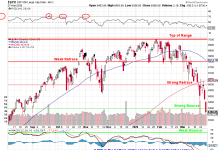
- 200-day Moving Average: The 200-day moving average is identified as a crucial level to watch for the S&P 500. “5,730 is the 200 dma and it is starting to look more like we’re consolidating for a move down.”
- RSI (Relative Strength Index): The RSI is used to assess overbought or oversold conditions.
- VIX (Volatility Index): The VIX is monitored as a measure of market volatility and fear.
- Dollar Index (DXY): The DXY is considered a key indicator of market risk.
Conclusion:
The market environment is characterized by significant uncertainty and risk. The strategist advocates a defensive posture, prioritizing cash, hedging, and active risk management. Close attention is paid to technical levels, economic data, and geopolitical developments to inform investment decisions. The “Marry, F’d, Kill” framework provides a clear categorization of individual stocks based on their risk-reward profiles in the current environment.