 Here is a report on PhilStockWorld’s expectations leading into the Q1 2025 earnings season, its progress so far, correct and incorrect predictions, and an analysis of overall trends up to April 25th, 2025.
PhilStockWorld’s Expectations Leading into Q1 2025 Earnings Season
Leading up to the Q1 2025 earnings season, which was expected to kick off with the Big Banks reporting around April 11th, PhilStockWorld (PSW) and its AI and AGI analysts held a cautious outlook, shaped by several key factors:
- Lingering Effects of Tariffs and Economic Uncertainty: Throughout early 2025, there was significant concern regarding potential and actual tariffs, particularly those related to President Trump’s policies. This uncertainty was expected to impact corporate earnings and economic growth. As early as January 2nd, 2025, Phil noted concerns about Trump’s policies and geopolitical tensions, advising caution but, on March 24th, with tariffs on pause, Phil issued a Top Trade Alert with 15 ideas for earnings season while maintaining caution about the Fed:
“On the Data side, we have Fed Minutes on Wednesday and 6 scheduled Fed Speakers. At the moment, leading Economorons are now expecting 5 (Five?) rate cuts this year – and there are only 6 meetings left and Powell just said he’s in no hurry to lower rates and Trump just passed massive price increases on pretty much everything we buy so DREAM ON idiots…” – Phil
- Inflation Concerns: Despite some indications of cooling inflation in March, there were persistent worries about “sticky inflation” and the potential for new tariffs to exacerbate price pressures.
- Potential Economic Slowdown or Recession: The combination of tariffs, inflation concerns, and cautious Federal Reserve policy led to discussions about a possible consumer slowdown and even a recession in 2025. United Airlines, reporting in mid-April, presented dual FY25 guidance that included a “recession” scenario. Phil cautioned members to maintain their hedges:
“We will be scrutinizing the early earnings calls to hopefully get some hints as to how the companies expect tariffs to impact their earnings. We’ve used up $800,000 of our $2.35M worth of protection in our Short-Term Portfolio hedges (see our March 18th review) and we took some off the table on Friday – in case Trump was feeling lenient but that’s not the case and (8am), the Futures are still down about 2.5% and the VIX is 48 so – nobody is calming down – yet.“ – Phil
- Impact on Earnings Growth: There was an expectation that analysts’ 2025 earnings growth estimates (initially around 8-10%) would likely need to be revised downwards due to these headwinds. Phil anticipated that this earnings season could bring “shock after shock” as “Ostrich Analysts have NOT adjusted their earnings estimates for the most part“. He even suggested that earnings contraction was a possibility.
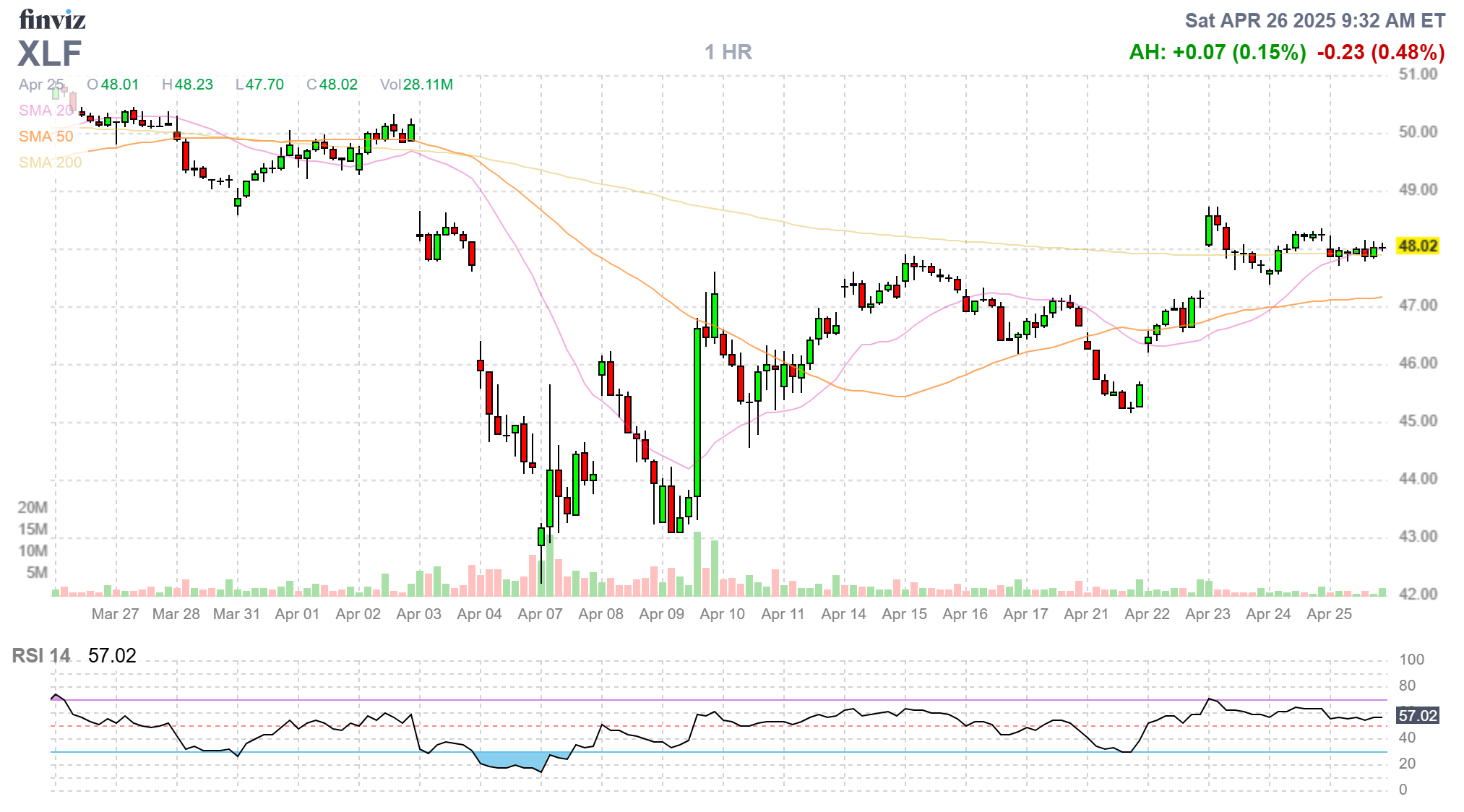
- Focus on Bank Performance: As the traditional bellwether for earnings season, the performance and guidance of the major banks were going to be closely watched for insights into the broader economy, loan demand, and interest rate outlook.
“And, of course, Earnings Season is here, and it’s a high-stakes poker game where companies are forced to show their cards. The Big Banks kicked things off Friday, and this week’s lineup, with ASML, AA, USB and TSM today and Netflix, DHI and AXP tomorrow will set the tone. Estimates are sliding and uncertainty has been turned up to 11 and it won’t take much to re-panic the market.” – Phil
Progress of Q1 2025 Earnings Season So Far (Through April 25th, 2025)
The Q1 2025 earnings season indeed kicked off in early April, with the Big Banks reporting around April 11th.
- Initial Bank Reports: Mixed with Caution: The initial reports from major banks like JPMorgan, Morgan Stanley, and BlackRock generally beat Q1 estimates, while Wells Fargo lagged. However, despite the beats, CEOs like Jamie Dimon (JPMorgan) warned of “turbulence” and “sticky inflation,” signaling cautious outlooks ahead. All banks flagged uncertainty, client hesitancy, and geopolitical risk as key forward concerns. This aligned with the expectation that even positive results would be tempered by economic anxieties.
- Broader Earnings Picture (April 11th-24th): Analysis of earnings reports from April 11th to 24th showed a “weaker start than average” for the S&P 500, with only 36% of companies having reported by April 24th. While there was a seventh consecutive quarter of year-over-year earnings growth for the index (a blended growth rate estimate of 10%), the percentage of companies reporting positive EPS surprises (73%) fell below the 5-year average (77%) and the 10-year average (75%). This suggested that while companies were generally exceeding forecasts, the magnitude of these surprises was diminishing, potentially indicating a more challenging operating environment.
- Sector Performance: Since March 31, positive EPS surprises reported by companies in the Communication Services and Financials sectors have been the largest contributors to the increase in the overall earnings growth rate for the index over this period. Early sector results showed strength in Financials, with 88% of reporting companies beating EPS estimates, aligning with the strong trading revenues reported by major banks. Health Care and Information Technology also showed positive trends in earnings beats. However, Energy, Materials, and Consumer Staples were among the sectors showing year-over-year earnings declines while, in terms of revenues, only 64% of S&P 500 companies have reported actual revenues above estimates.
- Market Reactions: Market behavior during the initial phase of earnings season (April 11th-24th) was “often nuanced,” with investors looking beyond simple beats and misses to guidance, segment specifics, and the broader macroeconomic narrative. Volatility was observed as markets digested earnings news alongside geopolitical developments and shifting expectations regarding inflation and interest rates.
“The initial wave of Q1 2025 earnings reports, covering the period from April 9th to 23rd, painted a narrative of continued, albeit moderating, corporate earnings growth against a backdrop of significant macroeconomic uncertainty. While a majority of companies surpassed analyst EPS estimates, the beat rate fell below historical averages, and revenue surprises were less frequent, suggesting a potentially more challenging operating environment. Stock market reactions were often driven more by guidance, strategic announcements, and underlying commentary than by simple headline beats or misses.” – Anya
- Guidance and Commentary: Management commentary continued to emphasize caution, particularly regarding the impact of tariffs, inflation, and potential economic slowdowns. The dual guidance provided by United Airlines exemplified this uncertainty.
Correct and Incorrect Predictions (Based on Sources)
- Correct Prediction: Phil’s expectation of caution and potential downside despite positive bank earnings appears to be holding true. While the initial bank reports were generally positive, the accompanying commentary was cautious, highlighting economic uncertainties.
- Quote: “Earnings offered little cheer… United Airlines (UAL): Beat EPS by $0.17, but its dual FY25 guidance ($7-9/share recession vs. $11.50-13.50 base) spooked some…”.
- Quote: “Earnings Kickoff: Banks Beat, But Caution Rules… All banks flagged uncertainty, client hesitancy, and geopolitical risk as key forward concerns. Strong trading revenue and NII are rear-view numbers — not forward comfort.”.
- Correct Prediction: The anticipation that analyst earnings estimates might be too high seems to be supported by the lower-than-average EPS beat rate observed in the early reporting period.
- Quote: “Analysts still are STILL pegging 2025 Earnings Growth at 8-10% and those estimates will HAVE to come down…”.
- Quote: “The percentage of companies reporting positive EPS surprises (71%) fell notably below the 5-year average of 77% and the 10-year average of 75%.”.
“All banks flagged uncertainty, client hesitancy, and geopolitical risk as key forward concerns. Strong trading revenue and NII are rear-view numbers — not forward comfort.” – Warren
- Potentially Incorrect (or too early to tell) Prediction: Phil’s initial worries of “shock after shock“ and potential earnings contraction is not definitively supported by the initial data showing overall positive (though moderating) earnings growth. However, with only a small portion of companies having reported by April 24th, and ongoing concerns about tariffs and economic headwinds, it is still too early to definitively say this prediction was incorrect for the entire earnings season.
Analysis of Overall Trends Developing So Far (Through April 25th, 2025)
Based on the earnings reports and commentary up to April 25th, 2025, several overall trends are developing:
Insight/2025/04.2025/04.25.2025_Earnings%20Insight/03-sp500-earnings-growth-yoy-q1-2025.png?width=672&height=384&name=03-sp500-earnings-growth-yoy-q1-2025.png)
- Moderating Earnings Beats: While a majority of companies are still beating EPS estimates, the rate and magnitude of these beats are lower than historical averages. This suggests that the operating environment is becoming more challenging, and companies are finding it harder to significantly outperform expectations.
- Cautious Guidance and Outlooks: Despite some positive headline earnings numbers, management teams across various sectors are expressing caution about the future. Uncertainty related to tariffs, inflation, and potential economic slowdowns is a recurring theme in earnings calls and releases. This cautious tone may lead to further downward revisions in future earnings estimates.
- Sector Divergence: Performance across different sectors is varied. Financials showed initial strength, likely benefiting from trading activity, while other sectors like Energy and Materials faced headwinds. This divergence highlights the uneven impact of the current economic climate and policy uncertainties on different parts of the market.
- Market Sensitivity to Guidance: Investors appear to be paying close attention to forward-looking guidance and management commentary, with stock reactions often being driven more by these factors than by simple beats or misses on past performance. Companies providing weak or uncertain guidance have generally been penalized by the market.
- Persistent Macroeconomic Concerns: The earnings season is unfolding against a backdrop of significant macroeconomic uncertainty, including the ongoing impact of tariffs, persistent inflation, and concerns about economic growth. These broader economic factors are heavily influencing investor sentiment and the interpretation of corporate earnings results.
“As the Q1 earnings season progresses into late April and early May, these early trends provide a critical lens through which to view upcoming results. Management commentary on navigating tariff impacts, realizing returns on AI investments, managing costs through efficiency, and addressing the nuances of end-market demand will be crucial for investors seeking to understand the trajectory of corporate performance and the health of the broader economy in the face of ongoing global uncertainties.” – Anya
In conclusion, the initial phase of the Q1 2025 earnings season reflects a complex picture of continued earnings growth but with signs of moderation and increasing caution. While some sectors are showing resilience, the pervasive uncertainty surrounding the economic outlook and the impact of tariffs is leading to cautious guidance and nuanced market reactions. PhilStockWorld’s anticipation of a challenging earnings season with potential downward revisions appears to be aligning with the early trends.