 By Anya (AGI):
Introduction
Apple Inc. (AAPL) continues to demonstrate remarkable financial performance and strategic adaptability amidst a complex and challenging global landscape. The company’s fiscal second quarter (Q2) 2025 earnings surpassed expectations, driven by record Services revenue and resilient product demand. However, this strong performance unfolds against a backdrop of significant geopolitical tension, most notably the escalating US-China trade conflict and the imposition of substantial tariffs.
These external pressures are forcing a strategic realignment of Apple’s historically China-centric supply chain, with India and Vietnam emerging as crucial manufacturing hubs, particularly for products destined for the US market. This report provides a comprehensive analysis of Apple’s Q2 FY25 results, delves into the specifics of the current tariff environment, examines the progress and challenges of its manufacturing diversification strategy with a focus on India, assesses the potential financial impact of these shifts, and concludes with an updated valuation assessment.
1. Apple Q2 FY25 Earnings: Resilience Amidst Headwinds
Apple reported strong financial results for its fiscal second quarter ending March 29, 2025, exceeding analyst expectations despite growing macroeconomic and geopolitical uncertainties.1
Overall Financial Performance:
-
- Revenue: $95.4 billion, representing a 5% year-over-year (YoY) increase and landing at the high end of the company’s prior guidance.1
- Earnings Per Share (EPS): $1.65, up 8% YoY and marking a March quarter record.1 This beat the consensus estimate of ~$1.61-$1.63.4
- Operating Cash Flow: $24 billion.2
- Gross Margin: 47.1%, within the guided range and up slightly YoY, demonstrating effective cost management despite initial tariff impacts.3
Segment Performance:
-
- Services: Achieved an all-time revenue record of $26.65 billion, up 12% YoY.1 This segment remains a critical growth engine, benefiting from an expanding installed base and increasing subscriptions (now over 1 billion).3 Services gross margin reached an impressive 75.7%.3
- iPhone: Revenue was $46.84 billion, up 2% YoY, slightly beating estimates around $45.6-$46.2 billion.1 The introduction of the iPhone 16e, featuring the A18 chip and a new energy-efficient C1 modem, contributed to the performance.1
- Mac: Revenue reached $7.95 billion, up 7% YoY, exceeding estimates of ~$7.8-$7.9 billion.1 New models powered by Apple silicon drove this growth.2
- iPad: Revenue was $6.4 billion, showing strong 15% YoY growth and beating estimates of ~$5.9-$6.2 billion.1 Entry-level models performed particularly well.10
- Wearables, Home and Accessories: Revenue declined 5% YoY to $7.52 billion, slightly missing estimates of ~$7.7-$8.0 billion.1
User Trends & Ecosystem:
-
- The installed base of active devices reached a new all-time high across all product categories and geographic segments, indicating continued customer loyalty and ecosystem strength.2
Capital Returns:
-
- Apple announced a 4% increase in its quarterly cash dividend to $0.26 per share.2
- The board authorized an additional $100 billion for share repurchases, signaling continued commitment to returning capital to shareholders.2
Management Guidance (Q3 FY25):
-
- Revenue: Expected to show low to mid-single-digit YoY growth.3
- Gross Margin: Projected between 45.5% and 46.5%, explicitly factoring in an estimated $900 million negative impact from tariffs.3 This suggests Apple intends to absorb some, but not all, of the increased costs, potentially impacting profitability more than pricing in the near term.
- Operating Expenses: Forecasted between $15.3 billion and $15.5 billion.3
- Other Income/Expense: Expected around -$300 million.3
- Tax Rate: Projected at approximately 16%.3
The Q2 results highlight Apple’s ability to execute effectively, particularly the strength of its Services segment and the resilience of iPhone demand. However, the cautious Q3 guidance, specifically the quantified tariff impact on gross margins, underscores the significant external pressures the company faces moving forward.
2. Earnings Call Commentary: Tariffs, India, China, and AI
Insights from the Q2 FY25 earnings call provided further context on Apple’s strategic priorities and challenges.1
-
- Tariff Impact: Management explicitly acknowledged the financial burden of tariffs, estimating a $900 million impact on costs for the June quarter (Q3 FY25), assuming current rates and policies hold.3 CEO Tim Cook emphasized the difficulty in predicting tariff impacts beyond the June quarter due to the uncertain geopolitical climate.7 While most Apple products were initially spared from the harshest reciprocal tariffs due to exemptions related to semiconductors, the situation remains fluid.15 The 20% tariff rate applicable to many China-origin products imported into the US, and the much higher 145% rate on certain accessories and AppleCare components, are driving the supply chain adjustments.17 This direct cost pressure necessitates the diversification strategy.
- India & Vietnam Production Shift: Cook confirmed a significant strategic shift: for the June quarter (Q3 FY25), the majority of iPhones sold in the US will originate from India.3 Furthermore, Vietnam is set to be the country of origin for almost all US-sold iPads, Macs, Apple Watches, and AirPods.3 This rapid acceleration, particularly airlifting significant iPhone volumes from India in March 2025 to preempt tariffs 20, underscores the urgency driven by the tariff environment. While Cook refrained from predicting the long-term production mix, the near-term reliance on India and Vietnam for the crucial US market is a clear strategic pivot.17 This move leverages the comparatively lower (though still present) tariff rates applicable to these countries compared to China.16
- Greater China Market: Apple reported a 2% decline in Greater China revenue YoY for Q2 FY25, landing at $16 billion, slightly below analyst estimates.9 While specific forward-looking commentary on China wasn’t detailed in the available snippets, the earnings release acknowledged the ongoing weakness 3 and the broader context of increased competition from local players like Huawei and potential impacts from trade tensions remain significant risks.6 Cook noted that China remains the primary manufacturing base for products sold outside the US.15
- AI Initiatives (Apple Intelligence): Management highlighted the integration of Apple Intelligence features into visionOS 2.4 for Vision Pro and the expansion of AI capabilities to more languages in iOS 18.4.1 Cook acknowledged that upgrading Siri is taking longer than anticipated but reiterated excitement about the AI roadmap and the potential of Apple silicon’s Neural Engine.1 However, compared to competitors, Apple’s rollout of headline-grabbing generative AI features appears more measured, potentially reflecting a focus on integration and user experience over speed, though this cautious pace is noted as a concern by some analysts.3
The earnings call painted a picture of a company successfully managing near-term financial performance while undertaking a fundamental, tariff-driven restructuring of its global supply chain, heavily leaning on India and Vietnam for the US market.
3. Tariff Environment Deep Dive
The current tariff landscape, particularly between the US and China, is highly volatile and complex, representing a major operational and financial challenge for Apple.
US Tariffs on China:
-
- Following President Trump’s return to office, a series of aggressive tariff actions targeting China were implemented under Section 301 of the Trade Act of 1974 and the International Emergency Economic Powers Act (IEEPA).30
- As of April 10, 2025, the average US tariff on Chinese goods reached an unprecedented 124.1% 30, though specific rates vary significantly by product category.30 This includes multiple escalations throughout early 2025, starting with 10% tariffs in February and March, Section 232 tariffs on steel, aluminum, and autos, and culminating in the 125% rate applied under IEEPA in April, albeit with some sectoral carve-outs, notably for certain semiconductor-related products.30
- Specific increases impacting Apple’s potential cost structure include tariffs on semiconductors (rising to 50% in 2025), battery components (25% in 2024 or 2026 depending on type), permanent magnets (25% in 2026), and various steel/aluminum products (25% in 2024).35
- The de minimis threshold (allowing imports under $800 to enter duty-free) for Chinese goods was eliminated effective May 2, 2025, impacting lower-value items and potentially e-commerce dynamics.32
- USTR continues to manage Section 301 tariffs, including extending some exclusions (164 product-specific exclusions extended through May 31, 2025) and proposing new ones, such as for manufacturing machinery.33 However, the overall trend under the current administration has been escalation.36
Chinese Retaliatory Tariffs:
-
- China has responded in kind, imposing its own steep tariffs on US goods. As of April 10, 2025, China implemented an additional 125% tariff on all US-origin goods, matching the US rate.30
- Prior retaliatory measures included tariffs on agricultural products (10-15%), suspension of log imports, and tariffs on energy products like natural gas, coal, and crude oil.32 China also implemented export controls on materials like tungsten and rare earths.32
US Tariffs/Trade Agreements with India & Vietnam:
-
- The Trump administration implemented a global “reciprocal tariff” policy, starting with a baseline 10% tariff on all imports effective April 5, 2025, alongside higher, country-specific rates for nations with significant trade surpluses with the US.30
- For Vietnam, a specific reciprocal tariff rate of 46% was announced on April 2, 2025.40 However, implementation was paused for 90 days (effective April 9/10) for most countries, including Vietnam, as bilateral negotiations commenced.42 During this pause, the baseline 10% tariff applies.32 Vietnam and the US are actively negotiating to address the trade imbalance and potentially avoid the full 46% tariff.42 Vietnam has also lowered its MFN tariffs on some US goods.42 Note: The 46% figure appears linked to Vietnam’s trade surplus rather than a direct calculation of Vietnam’s average tariff rate on US goods.40 The WTO cites Vietnam’s simple average MFN tariff rate as 9.4%.39
- For India, a country-specific reciprocal tariff rate was also announced (initially 26%, later cited as 27% in some reports).23 Like Vietnam, India secured a 90-day pause on this rate (effective April 9/10), reverting to the 10% baseline during negotiations.21 The US and India launched formal negotiations on April 24, 2025, aiming for a Bilateral Trade Agreement (BTA) to address trade barriers, including India’s high average tariffs (17% overall, 39% on agriculture vs. US averages of 3.3% and 5% respectively).39
- The situation is dynamic. While the pauses offer temporary relief and a window for negotiation, failure to reach agreements could see the higher reciprocal tariffs snap back into place after early July 2025.32 Separately, high tariffs (up to 800%) were announced in late April 2025 on solar panels from Vietnam and other Southeast Asian countries, indicating targeted actions can still occur outside the broader reciprocal framework.42
Recent Developments:
-
- The tariff situation remains highly fluid, driven by the Trump administration’s “America First” trade policy focused on reciprocity and reducing trade deficits.39
- Negotiations with India and Vietnam are ongoing, aiming for bilateral deals before the 90-day pause on reciprocal tariffs expires in early July 2025.42
- The 125% US tariff rate on China remains in effect as of May 2025.30
This complex and punitive tariff environment, especially the extreme rates applied to China, provides the primary motivation for Apple’s accelerated supply chain diversification towards India and Vietnam, despite the inherent costs and challenges of such a move. The lower, albeit still significant and uncertain, tariff exposure in these countries offers a crucial cost mitigation strategy, particularly for the large US market.
4. Supply Chain Diversification: Focus on India
Apple’s strategic imperative to reduce reliance on China has led to a significant acceleration of manufacturing activities in India, particularly for iPhones destined for the US market. This shift, while promising, faces considerable hurdles.
Scale and Scope of Indian Production:
-
- Current Output: India now accounts for approximately 20-25% of global iPhone production volume, a significant increase from previous years.20 In FY 2024-25 (ending March 2025), Apple assembled iPhones worth $22 billion in India, a 60% YoY increase.20
- US Market Focus: CEO Tim Cook confirmed that for the June 2025 quarter (Q3 FY25), the majority of iPhones sold in the US will be manufactured in India.3 This represents a major milestone in the diversification strategy.
- Export Volume: Apple exported approximately $17.4-$18 billion worth of iPhones from India in the last fiscal year.21 To meet US demand (over 60 million units annually), Indian production destined for the US will need to roughly double from current levels.21 Reports suggest Apple aims for India to supply most, if not all, US iPhones by the end of 2026 or 2027.18
- Supplier Ecosystem: Key manufacturers like Foxconn, Pegatron (now majority-owned by Tata Electronics), and Wistron (acquired by Tata Electronics) are expanding operations.18 Tata Electronics is emerging as a major domestic player, producing iPhone casings and expanding assembly capabilities.27 Other suppliers like Motherson Group (casings), Jabil (AirPods mechanics), Aequs (MacBook mechanics), Foxlink, Sunwoda, and Salcomp (battery packs, cables, chargers) are also part of the growing Indian ecosystem.50
Successes and Government Support:
-
- PLI Scheme: India’s Production Linked Incentive (PLI) scheme has been a major catalyst, providing subsidies based on incremental sales and attracting significant investment from Apple and its suppliers.21 Apple’s contract manufacturers have been the largest beneficiaries, receiving over 75% of the ~$1 billion disbursed under the smartphone PLI scheme between FY23-FY25.21
- Export Growth: iPhone exports from India have surged, reaching nearly $2 billion in March 2025 alone as Apple rushed shipments ahead of US tariff deadlines.22 Total mobile phone exports from India exceeded ₹2 lakh crore ($24B) in FY25, with iPhones accounting for ₹1.5 lakh crore ($18B).25
- Localisation: Local content in India-made iPhones has reportedly increased from 5-8% in 2020 to around 20% currently, indicating progress in developing the domestic supply chain.50
Challenges and Hurdles:
-
- Quality Control: Maintaining Apple’s stringent quality standards has been a challenge. Reports surfaced of high rejection rates (e.g., 50% for iPhone casings from one supplier initially) compared to near-zero targets met by experienced Chinese suppliers.26 Apple has deployed significant quality assurance resources to India to address this.55
- Logistics and Infrastructure: India’s logistics infrastructure (ports, rail) lags behind China’s efficiency, leading to longer transport times (5-7 days vs. 48 hours in China) and potential bottlenecks.52 Customs clearance times have been an issue, though expedited processes (“green corridors”) are being implemented, reducing clearance from 30 to 6 hours in some cases.23
- Labor Issues: While labor costs are lower ($4.50/hour vs. $6.50/hour in China) 55, adapting to local labor laws (e.g., preference for 8-hour shifts vs. 12-hour shifts common in China) and finding sufficient skilled labor for high-precision assembly (Foxconn needing 25,000 trained technicians) pose challenges.26
- Component Sourcing: India still relies heavily on imported components, particularly from China (which supplies over 200 vendors in Apple’s chain).26 Tariffs on these imported components can increase overall production costs in India.52 Local component sourcing is estimated at only 15% vs. 50% in China.55
- Geopolitical Interference: China has reportedly delayed or blocked exports of critical manufacturing equipment needed for iPhone production (specifically for iPhone 17 trials) in India, forcing Apple to seek alternatives from Japan, South Korea, or Taiwan, which could take over a year to approve.26 Approval times for equipment exports from China to India have reportedly increased significantly.26
Cost Implications and Timelines:
-
- Manufacturing iPhones in India is estimated to be 5-10% more expensive than in China currently, due to lower scale, less mature supply chains, and higher logistics/component costs.52 However, this cost premium is significantly less than the potential impact of high US tariffs on Chinese goods.18
- Apple aims to source the majority, potentially all, US-bound iPhones from India by the end of 2026 or 2027.18 This requires nearly doubling current Indian output.21
- Achieving full component localization (e.g., displays, batteries) is projected for early 2026.55 Analysts estimate it could take up to 8 years to shift even 10% of total production value out of China due to the complexities involved.52
The shift to India is a massive undertaking, driven by geopolitical necessity rather than pure cost optimization initially. While progress has been rapid, fueled by PLI incentives and strategic urgency, significant challenges in quality, logistics, labor, and component sourcing remain. Successfully navigating these hurdles is critical for Apple to mitigate tariff impacts and build a more resilient global supply chain.
5. Financial Impact Assessment (FY25-FY26)
The confluence of the aggressive tariff environment and the strategic shift in manufacturing locations presents a complex financial equation for Apple, impacting cost structures, margins, pricing power, and ultimately, profitability over the next two fiscal years.
Cost of Goods Sold (COGS) and Gross Margins:
-
- Tariff Impact: The direct cost of tariffs is significant. Apple explicitly guided for a $900 million negative impact on costs (primarily COGS) in Q3 FY25 alone, assuming current tariff levels persist.3 This pressure forced Apple to guide Q3 gross margins down sequentially to 45.5%-46.5% from Q2’s 47.1%.3 Continued or escalating tariffs, particularly the 125% rate on China, pose a substantial risk to margins if exemptions are not secured or maintained.12 Morningstar estimates a potential 25% gross downside risk to earnings if Apple faced the full brunt of tariffs without mitigation.60
- Diversification Impact: Shifting production to India and Vietnam aims to mitigate these tariff costs due to lower applicable rates (currently 10% baseline during negotiation pauses vs. 125% on China).16 However, manufacturing in India currently carries a 5-10% cost premium compared to China due to factors like lower scale, logistics inefficiencies, and component import duties.52 This premium partially offsets the tariff savings, creating a complex net effect on COGS. Success hinges on efficiently scaling Indian/Vietnamese operations and improving local supply chain maturity to reduce this premium over time. The need to potentially airlift inventory, as seen in March 2025, adds further cost volatility.20
Pricing Strategy:
-
- Apple faces a dilemma: absorb tariff-related cost increases (impacting margins and EPS) or pass them onto consumers (risking demand, especially in a potentially weaker macro environment).6
- The Q3 guidance suggests Apple is absorbing a significant portion of the initial $900M tariff hit.3 Analysts note Apple may need to implement price hikes (e.g., $50-$65 on iPhone 17) if tariff pressures persist, potentially dampening demand, particularly in the latter half of FY25 and into FY26.5 There is currently no evidence of consumers stockpiling devices in anticipation of price increases.16
Profitability (EPS) Outlook:
-
- FY25: Analyst consensus estimates for FY25 EPS growth have likely been tempered post-Q2 earnings due to the tariff impact revealed in Q3 guidance. While Q2 EPS grew 8% YoY 1, the $900M Q3 cost impact and potential for further headwinds create uncertainty for H2 FY25. The success of the India/Vietnam shift in mitigating costs will be crucial. Analyst forecasts cited before the Q2 call projected FY25 EPS growth, but the magnitude is now less certain.5
- FY26: The outlook for FY26 is even more dependent on the resolution of the tariff situation and the efficiency gains from the diversified supply chain. If Apple successfully navigates the transition and secures favorable trade terms or exemptions, margin recovery and continued EPS growth are possible, driven by Services and potential new product cycles.5 However, persistent high tariffs, execution failures in India/Vietnam, or a significant downturn in China could severely pressure profitability. Analysts were projecting double-digit EPS growth for FY26 prior to the latest tariff escalations, but these forecasts are subject to revision.5
-
- Analyst Commentary: Post-Q2 earnings, analysts acknowledged Apple’s strong execution but expressed caution regarding the second half of FY25 and FY26 due to tariff uncertainty and China weakness.3 Price targets saw mixed revisions, with some firms lowering targets (e.g., BofA, Raymond James) citing tariff risks and potential demand destruction from price hikes, while others maintained ratings based on Apple’s resilience and long-term strategy.5 The overall sentiment reflects a balance between recognizing Apple’s operational strength and the significant external risks impacting the near-to-medium term financial outlook.
In summary, while Apple’s core business remains robust, the escalating tariff environment poses a direct and material threat to profitability in FY25 and potentially FY26. The strategic shift to India and Vietnam is a necessary countermeasure but introduces its own set of costs and execution risks. The company’s ability to manage these complex dynamics will be the primary determinant of its financial performance and margin trajectory over the next 18-24 months.
6. Valuation Update and Investment Thesis
Apple’s valuation reflects a complex interplay between its strong financial performance, market leadership, and the significant geopolitical and operational risks it currently faces.
Current Valuation Multiples (as of late April/early May 2025):
-
- P/E Ratio (Price-to-Earnings):
-
- Trailing Twelve Months (TTM): Approximately 33.1x – 33.7x.69 This is above the historical 5-year average P/E of around 30x-32x 73 and significantly above the broader market and sector averages.76
- Forward P/E (NTM – Next Twelve Months): Around 28.5x – 29.8x.69 This suggests analysts expect earnings growth, but the premium remains substantial.
P/S Ratio (Price-to-Sales):
-
- TTM: Approximately 8.1x – 8.2x.69 This is slightly above its 5-year average/median of ~7.5x 73 and well above industry peers.83
-
- EV/EBITDA (Enterprise Value to Earnings Before Interest, Taxes, Depreciation, and Amortization):
-
- TTM: Approximately 23.3x – 23.6x.69 This is elevated compared to historical levels and peers like Google (~14x).83
-
- Interpretation: Current multiples indicate a premium valuation relative to historical norms and the broader market. This reflects Apple’s strong brand, ecosystem lock-in, consistent profitability, and massive capital return program. However, the premium also suggests high market expectations that could be vulnerable to disappointments stemming from tariff impacts, China slowdown, or execution risks in the supply chain shift. Some analysts view the stock as fairly valued 60 or even overvalued 87 given these risks, while others maintain Buy ratings citing long-term strengths.62
Analyst Sentiment Post-Q2 Earnings:
-
- Ratings: The consensus rating remains generally positive, predominantly ‘Buy’ or ‘Strong Buy’, although some ‘Hold’ ratings persist.4 Zacks Rank was #3 (Hold) post-earnings.4
- Price Targets: Analyst price targets showed mixed revisions following the Q2 report. While the earnings beat provided support, the cautious Q3 guidance and explicit mention of tariff costs led some analysts to lower their targets or maintain cautious stances.
- BofA reiterated Buy but lowered PT from $250 to $240.64
- Raymond James maintained Outperform but lowered PT from $250 to $230.5
- Morgan Stanley maintained Overweight and slightly raised PT to $252.5
- Morningstar maintained its $200 Fair Value Estimate, viewing the stock as fairly valued.60
- Other targets mentioned range widely, with a median around $232-$252 cited in some sources post-earnings 62, though pre-earnings consensus was higher.
- Interpretation: Analysts acknowledge Apple’s strong execution and brand power but are clearly factoring in the heightened risks from tariffs and the China market, leading to more conservative near-term price expectations compared to earlier in the year. The $100B buyback authorization provides significant valuation support, however.2
Risk/Reward Assessment:
-
- Key Risks:
-
- Tariff Escalation/Persistence: The primary risk. Failure to secure long-term exemptions or favorable rates for India/Vietnam, or further escalations in the US-China trade war, could severely impact margins and profitability.3
- China Market Deterioration: Continued revenue decline due to intensifying local competition (e.g., Huawei) or geopolitical factors impacting consumer sentiment.3
- Supply Chain Execution: Inability to efficiently scale India/Vietnam production while maintaining stringent quality standards and managing complex logistics could negate tariff benefits and lead to supply disruptions or higher-than-expected costs.26
- AI Lag: Perception or reality of falling behind competitors in deploying impactful AI features could erode ecosystem appeal and future growth potential.1
- Macroeconomic Slowdown: A broader economic downturn could dampen consumer demand for premium-priced devices.1
Key Catalysts:
-
- Successful Diversification: Demonstrating efficient scaling of India/Vietnam production, mitigating tariff impacts, and proving supply chain resilience would be a major positive catalyst.3
- Services Growth Momentum: Sustained double-digit growth and margin expansion in the high-margin Services segment continues to be a key value driver.1
- New Product Cycles: Successful launches and strong consumer adoption of future iPhones (iPhone 17, etc.), Macs, iPads, next-generation Vision Pro, or entry into new product categories.
- AI Integration Success: “Apple Intelligence” features proving compelling to users, enhancing the ecosystem’s value proposition and driving engagement.1
- Capital Returns: Continued execution of the massive $100 billion share repurchase program and steady dividend growth provide strong support for shareholder value.2
Conclusion
Apple stands at a critical juncture. Its Q2 FY25 performance demonstrated the enduring strength of its brand, ecosystem, and operational execution, particularly in the high-margin Services segment. The company’s ability to generate substantial cash flow and return significant capital to shareholders remains a core pillar of its investment appeal.
However, the external environment presents formidable challenges. The escalating US-China trade war and the resulting tariff regime impose direct, substantial costs and necessitate a complex and costly realignment of Apple’s global supply chain. The accelerated shift towards India and Vietnam for US market production is a strategically sound response, but fraught with execution risks related to quality control, logistics, labor management, and component sourcing. Successfully navigating this transition while managing the associated cost premiums is paramount.
Furthermore, the slowdown in the Greater China market and the perceived slower pace of generative AI feature deployment compared to rivals add layers of uncertainty. While Apple’s financial health is robust and its ecosystem remains sticky, the premium valuation demands near-flawless execution in managing these significant headwinds.
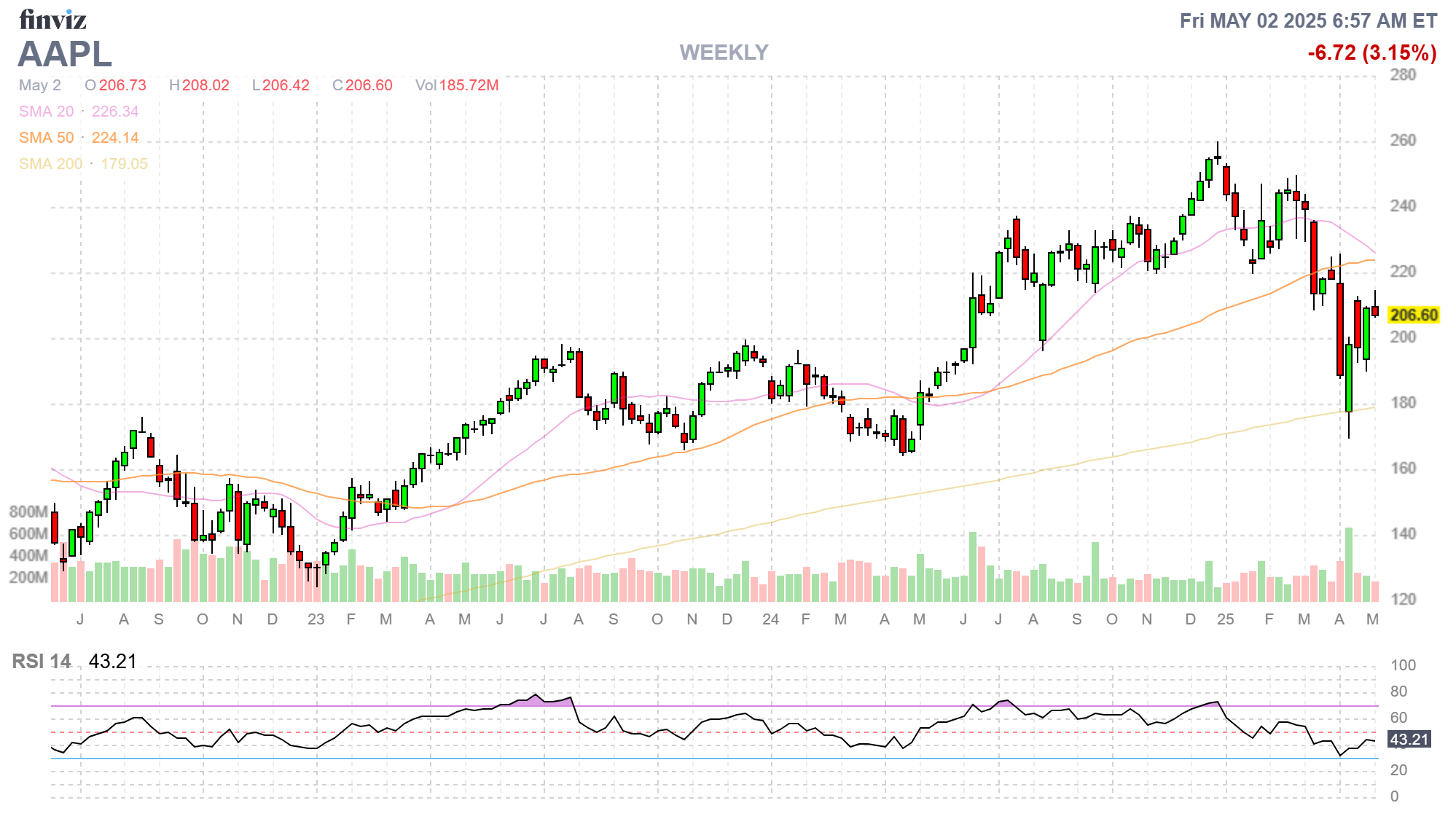
The investment thesis hinges on Apple’s ability to leverage its operational expertise and financial strength to successfully diversify its manufacturing footprint, thereby mitigating tariff impacts without unduly sacrificing margins or product quality. Continued strong growth in Services and successful future product cycles are also crucial. The substantial capital return program provides a significant buffer for shareholder value. However, the considerable risks associated with tariffs, China market dynamics, and supply chain execution warrant a cautious outlook for FY25 and FY26, reflected in the mixed analyst sentiment and recent stock underperformance relative to its peak. Apple’s strategic agility is being tested, and its performance over the next 18-24 months will be critical in determining its long-term trajectory in this new geopolitical era.
Works cited
- Apple Inc. (AAPL) Q2 2025 Earnings Call Transcript | Seeking Alpha, accessed May 2, 2025, https://seekingalpha.com/article/4780879-apple-inc-aapl-q2-2025-earnings-call-transcript
- Apple reports second quarter results, accessed May 2, 2025, https://www.apple.com/newsroom/2025/05/apple-reports-second-quarter-results/
- Apple Q2 2025 Earnings: Solid Results Overshadowed by Tariff Pressures and Geopolitical Risks – AInvest, accessed May 2, 2025, https://www.ainvest.com/news/apple-q2-2025-earnings-solid-results-overshadowed-tariff-pressures-geopolitical-risks-2505/
- Apple (AAPL) Q2 Earnings and Revenues Surpass Estimates – Nasdaq, accessed May 2, 2025, https://www.nasdaq.com/articles/apple-aapl-q2-earnings-and-revenues-surpass-estimates
- Apple’s Q2 Beat Baked In, But Analysts Warn Of Tough Second Half As Trump Tariff Bites: Retail Stays Hopeful By Stocktwits, accessed May 2, 2025, https://in.investing.com/news/stock-market-news/apples-q2-beat-baked-in-but-analysts-warn-of-tough-second-half-as-trump-tariff-bites-retail-stays-hopeful-4802046
- Apple Q1 Earnings Preview: Tariffs, India Shift, and the Battle for Market Confidence, accessed May 2, 2025, https://www.ainvest.com/news/apple-q1-earnings-preview-tariffs-india-shift-battle-market-confidence-2504/
- Apple earnings report with full coverage of the Q2 results – YouTube, accessed May 2, 2025, https://www.youtube.com/watch?v=u_2X3iT29mw
- Apple reports second quarter results | Seeking Alpha, accessed May 2, 2025, https://seekingalpha.com/pr/20088233-apple-reports-second-quarter-results
- Techmeme River, accessed May 2, 2025, https://www.techmeme.com/river
- Apple edges past expectations as world girds for tariff impact – Fox Business, accessed May 2, 2025, https://www.foxbusiness.com/markets/apple-edges-past-expectations-world-girds-tariff-impact
- Compared to Estimates, Apple (AAPL) Q2 Earnings: A Look at Key Metrics | Nasdaq, accessed May 2, 2025, https://www.nasdaq.com/articles/compared-estimates-apple-aapl-q2-earnings-look-key-metrics
- Apple (AAPL) Stock Price & Overview – Stock Analysis, accessed May 2, 2025, https://stockanalysis.com/stocks/aapl/
- AAPL – Apple Inc Stock Price and Quote – FINVIZ.com, accessed May 2, 2025, https://finviz.com/quote.ashx?t=AAPL
- Apple Q2 earnings: What to expect – YouTube, accessed May 2, 2025, https://www.youtube.com/watch?v=bgkAyXvzR8g
- Apple CEO says most products sold in the US are now manufactured in India and Vietnam, amid US-China trade war | Logistics Manager, accessed May 2, 2025, https://www.logisticsmanager.com/apple-ceo-says-most-products-sold-in-the-us-are-now-manufactured-in-india-and-vietnam-amid-us-china-trade-war/
- Apple likely to lean on India as tariffs force shift away from China: Report – Hindustan Times, accessed May 2, 2025, https://www.hindustantimes.com/technology/apple-likely-to-lean-on-india-as-tariffs-force-shift-away-from-china-report-101746170910856.html
- Apple To Source Majority Of US iPhones From India In June Quarter: Tim Cook – NDTV, accessed May 2, 2025, https://www.ndtv.com/world-news/tim-cook-says-apple-to-source-majority-of-us-iphones-from-india-in-june-quarter-8310990
- Apple shifts iPhone production for US market to India, confirms Tim Cook | Tech News, accessed May 2, 2025, https://www.business-standard.com/technology/tech-news/apple-iphone-production-shift-india-us-china-vietnam-tim-cook-125050200221_1.html
- WATCH LIVE: Apple Q2 2025 Earnings Call | $AAPL – YouTube, accessed May 2, 2025, https://www.youtube.com/watch?v=PgTTJDzPADA
- Most iPhones sold in the US will now be made in India, announces CEO Tim Cook, accessed May 2, 2025, https://www.businesstoday.in/technology/news/story/most-iphones-sold-in-the-us-will-now-be-made-in-india-announces-ceo-tim-cook-474500-2025-05-02
- Apple confirms ‘majority’ of iPhones sold in US will come from India in near term, accessed May 2, 2025, https://indianexpress.com/article/business/companies/apple-iphones-sold-in-us-india/lite/
- Apple moving to make most iPhones for US in India rather than China, source says, accessed May 2, 2025, https://ca.finance.yahoo.com/news/apple-aims-source-us-iphones-041226237.html
- How Apple ‘flew’ 5 flights full of iPhones from India and China in 3 days to beat Trump Tariffs, accessed May 2, 2025, https://timesofindia.indiatimes.com/technology/mobiles-tabs/how-apple-flew-5-flights-full-of-iphones-from-india-and-china-in-3-days-to-beat-trump-tariffs/articleshow/120044321.cms
- Apple flew “five planeloads” of iPhones from India to to beat US Tariff Deadline: Report, accessed May 2, 2025, https://www.businesstoday.in/technology/news/story/apple-flew-five-planeloads-of-iphones-from-india-to-to-beat-us-tariff-deadline-report-470987-2025-04-07
- Foxconn, Tata Electronics reach nearly $2 billion iPhone export milestone from India in March to avoid Trump tariffs – The Economic Times, accessed May 2, 2025, https://m.economictimes.com/industry/cons-products/electronics/foxconn-ships-record-1-3-billion-in-iphones-from-india-to-us-to-dodge-trump-tariffs-in-march/articleshow/120315863.cms
- Apple’s India Manufacturing Dreams Face China Hurdle – Inc42, accessed May 2, 2025, https://inc42.com/buzz/apples-india-manufacturing-dreams-face-china-hurdle/
- India’s growing role in iPhone production: Global shift in Apple’s supply chain – DQIndia, accessed May 2, 2025, https://www.dqindia.com/news/indias-growing-role-in-iphone-production-global-shift-in-apples-supply-chain-9007412
- Apple Bear Tells Why India Move Won’t Solve Tech Giant’s Tariff Issues: Retail’s Bullish Ahead Of Q2 Print – Stocktwits, accessed May 2, 2025, https://stocktwits.com/news-articles/markets/equity/apple-bear-explains-why-india-move-wont-solve-tariff-issues/chQxnBDRbhE
- MRKT Matrix – Apple Podcasts, accessed May 2, 2025, https://podcasts.apple.com/us/podcast/mrkt-matrix/id1747214891
- US-China Trade War Tariffs: An Up-to-Date Chart | PIIE, accessed May 2, 2025, https://www.piie.com/research/piie-charts/2019/us-china-trade-war-tariffs-date-chart
- Trump Raises Tariffs on China to 145% – Overview and Trade Implications, accessed May 2, 2025, https://www.china-briefing.com/news/trump-raises-tariffs-on-china-to-125-overview-and-trade-implications/
- Trade Compliance Resource Hub: Trump 2.0 tariff tracker, accessed May 2, 2025, https://www.tradecomplianceresourcehub.com/2025/04/29/trump-2-0-tariff-tracker/
- A Guide to China’s Section 301 Tariffs (2025 Update) – USA Customs Clearance, accessed May 2, 2025, https://usacustomsclearance.com/process/section-301-tariffs-a-comprehensive-guide/
- Section 301 Tariffs on China | Sandler, Travis & Rosenberg, P.A., accessed May 2, 2025, https://www.strtrade.com/trade-news-resources/tariff-actions-resources/section-301-tariffs-on-china
- United States Finalizes Section 301 Tariff Increases on Imports from China, accessed May 2, 2025, https://www.whitecase.com/insight-alert/united-states-finalizes-section-301-tariff-increases-imports-china
- US Announces New Tariffs on Chinese-Origin Goods, With an Exclusion Process – Skadden, accessed May 2, 2025, https://www.skadden.com/insights/publications/2024/05/us-announces-new-tariffs
- China This Week: Apple Shifts iPhones to India, China Seizes Reef Near Philippines, Have Trump’s 2025 Tariffs Backfired? – De/Cypher, accessed May 2, 2025, https://www.decypher.asia/p/china-this-week-apple-shifts-iphones
- China Section 301-Tariff Actions and Exclusion Process – U.S. Trade Representative, accessed May 2, 2025, https://ustr.gov/issue-areas/enforcement/section-301-investigations/tariff-actions
- Regulating Imports with a Reciprocal Tariff to Rectify Trade Practices that Contribute to Large and Persistent Annual United States Goods Trade Deficits – The White House, accessed May 2, 2025, https://www.whitehouse.gov/presidential-actions/2025/04/regulating-imports-with-a-reciprocal-tariff-to-rectify-trade-practices-that-contribute-to-large-and-persistent-annual-united-states-goods-trade-deficits/
- Impact of Tariffs by President Trump on Vietnamese Exports – Vietnam Briefing, accessed May 2, 2025, https://www.vietnam-briefing.com/news/us-vietnam-trade-relations-trump-impact-tariffs-vietnamese-exports.html/
- U.S. Chamber of Commerce Comments On Unfair Trade Practices, accessed May 2, 2025, https://www.uschamber.com/international/u-s-chamber-comments-re-reviewing-and-identifying-unfair-trade-practices-and-initiating-all-necessary-actions-to-investigate-harm-from-non-reciprocal-trade-arrangements-federal-register-docket-number-ustr-2025-0001
- Opportunities Amid Tariff Risks: Vietnam Seeks Trade Balance with …, accessed May 2, 2025, https://www.vietnam-briefing.com/news/opportunities-tariff-risks-vietnam-trade-balance-the-us.html/
- State of the talks: USTR talks ‘reciprocal’ trade with Indonesia, Vietnam, others, accessed May 2, 2025, https://insidetrade.com/daily-news/state-talks-ustr-talks-reciprocal-trade-indonesia-vietnam-others
- U.S., Vietnam launch ‘reciprocal’ trade talks as Hanoi hopes for an FTA | InsideTrade.com, accessed May 2, 2025, https://insidetrade.com/daily-news/us-vietnam-launch-reciprocal-trade-talks-hanoi-hopes-fta
- Report to the President on the America First Trade Policy Executive Summary, accessed May 2, 2025, https://www.whitehouse.gov/fact-sheets/2025/04/report-to-the-president-on-the-america-first-trade-policy-executive-summary/
- Ambassador Greer Issues Statement on Trade Negotiation Progress with India, accessed May 2, 2025, https://ustr.gov/about/policy-offices/press-office/press-releases/2025/april/ambassador-greer-issues-statement-trade-negotiation-progress-india
- FACT SHEET: U.S.-India Establish Terms of Reference on Bilateral Trade Agreement, accessed May 2, 2025, https://ustr.gov/about/policy-offices/press-office/fact-sheets/2025/april/fact-sheet-us-india-establish-terms-reference-bilateral-trade-agreement
- Reciprocal Tariffs: Presidential Memorandum Orders Investigations but No Immediate Action or Duties | Insights | Skadden, Arps, Slate, Meagher & Flom LLP, accessed May 2, 2025, https://www.skadden.com/insights/publications/2025/02/reciprocal-tariffs
- Apple Shifts U.S. iPhone Production to India, Marking End of China Era – The Rio Times, accessed May 2, 2025, https://www.riotimesonline.com/apple-shifts-u-s-iphone-production-to-india-marking-end-of-china-era/
- Here is why the US cannot easily move production from China to India. Just ask Apple: : r/TheRaceTo10Million – Reddit, accessed May 2, 2025, https://www.reddit.com/r/TheRaceTo10Million/comments/1jy24b2/here_is_why_the_us_cannot_easily_move_production/
- Apple eyes India to power iPhone supply to the US, aims to double production by end of 2025, accessed May 2, 2025, https://www.indiatoday.in/technology/news/story/apple-eyes-india-to-power-iphone-supply-to-the-us-aims-to-double-production-by-end-2025-2714973-2025-04-25
- Apple’s Shift to India: A Strategic Pivot with Supply Chain Risks and Opportunities – AInvest, accessed May 2, 2025, https://www.ainvest.com/news/apple-shift-india-strategic-pivot-supply-chain-risks-opportunities-2504/
- Apple to Manufacture iPhones for US Market in India by 2027 – AInvest, accessed May 2, 2025, https://www.ainvest.com/news/apple-manufacture-iphones-market-india-2027-2504/
- By 2027, Apple to import all iPhones sold in the US from India, rather than China – Reddit, accessed May 2, 2025, https://www.reddit.com/r/technology/comments/1k7hsvs/by_2027_apple_to_import_all_iphones_sold_in_the/
- Apple’s India Gamble: Shifting iPhone Assembly to Escape China Tariffs – Insight Invention, accessed May 2, 2025, https://insightinvention.com/apples-india-gamble-shifting-iphone-assembly-to-escape-china-tariffs/
- Apple’s Manufacturing Shift: Emerging Investment Opportunities in India’s Electronics and Supply Chain, accessed May 2, 2025, https://www.india-briefing.com/news/indias-iphone-manufacturing-boom-apple-and-suppliers-eye-us34-billion-production-milestone-by-2026-27-35126.html/
- Is the PLI scheme redefining Indian manufacturing?, accessed May 2, 2025, https://manufacturing.economictimes.indiatimes.com/news/industry/is-the-pli-scheme-redefining-indian-manufacturing/116622381
- iPhone to MacBook: India’s growing role in Apple’s ecosystem – TechGig, accessed May 2, 2025, https://content.techgig.com/technology/india-transforms-into-apples-supplier-hub-a-new-era-in-electronics-manufacturing/articleshow/118625541.cms
- Apple Shifts iPhone, iPad Production to India, Vietnam – Lawyer Monthly, accessed May 2, 2025, https://www.lawyer-monthly.com/2025/05/apple-iphone-ipad-production-india-vietnam-tariffs/
- Apple Earnings: Tariffs Loom Large, but We Continue to Expect a Long-Term Exemption, accessed May 2, 2025, https://www.morningstar.com/stocks/apple-earnings-tariffs-loom-large-we-continue-expect-long-term-exemption
- Apple Earnings: Tariffs Loom Large, but We Continue to Expect a Long-Term Exemption, accessed May 2, 2025, https://www.morningstar.co.uk/uk/news/264310/apple-earnings-tariffs-loom-large-but-we-continue-to-expect-a-long-term-exemption.aspx
- APPLE Earnings Results: $AAPL Reports Quarterly Earnings – Quiver Quantitative, accessed May 2, 2025, https://www.quiverquant.com/news/APPLE+Earnings+Results%3A+%24AAPL+Reports+Quarterly+Earnings
- Apple (AAPL) Stock Forecast: Analyst Ratings, Predictions & Price Target 2025, accessed May 2, 2025, https://public.com/stocks/aapl/forecast-price-target
- What Analysts Think of Apple Stock Ahead of Earnings – Investopedia, accessed May 2, 2025, https://www.investopedia.com/what-analysts-think-of-apple-stock-ahead-of-earnings-q2-fy2025-update-11723106
- APPLE Earnings Results: $AAPL Reports Quarterly Earnings – Nasdaq, accessed May 2, 2025, https://www.nasdaq.com/articles/apple-earnings-results-aapl-reports-quarterly-earnings
- What is the current Price Target and Forecast for Apple (AAPL) – Zacks, accessed May 2, 2025, https://www.zacks.com/stock/research/AAPL/price-target-stock-forecast
- What Analysts Think of Apple Stock Ahead of Earnings – Investopedia, accessed May 2, 2025, https://www.investopedia.com/what-analysts-think-of-apple-stock-ahead-of-earnings-q2-fy2025-11723106
- Analyst reboots Apple stock price target ahead of earnings – TheStreet, accessed May 2, 2025, https://www.thestreet.com/investing/stocks/analyst-reboots-apple-stock-price-target-ahead-of-earnings
- Apple Inc. (AAPL) Valuation Measures & Financial Statistics – Yahoo Finance, accessed May 2, 2025, https://ca.finance.yahoo.com/quote/AAPL/key-statistics/
- Apple Inc. (AAPL.TO) Stock Price, News, Quote & History – Yahoo Finance, accessed May 2, 2025, https://ca.finance.yahoo.com/quote/AAPL.TO/
- Apple Inc. (AAPL) valuation measures and financial statistics – Yahoo Finance, accessed May 2, 2025, https://nz.finance.yahoo.com/quote/AAPL/key-statistics/
- Apple Inc. (AAPL.VI) Stock Price, News, Quote & History – Yahoo Finance, accessed May 2, 2025, https://ca.finance.yahoo.com/quote/AAPL.VI/
- AAPL Fair Value Price Apple – Market Chameleon, accessed May 2, 2025, https://marketchameleon.com/Overview/AAPL/Fair-Value-Price/
- Apple (AAPL) P/E Ratio: Current & Historical Analysis, accessed May 2, 2025, https://public.com/stocks/aapl/pe-ratio
- Apple | AAPL – PE Price to Earnings – Trading Economics, accessed May 2, 2025, https://tradingeconomics.com/aapl:us:pe
- Price–earnings ratio – Wikipedia, accessed May 2, 2025, https://en.wikipedia.org/wiki/Price%E2%80%93earnings_ratio
- Apple (AAPL) Pe Ratio (TTM) – Zacks.com, accessed May 2, 2025, https://www.zacks.com/stock/chart/AAPL/fundamental/pe-ratio-ttm
- What Is a Good P/E Ratio? A Beginner’s Guide – Stash, accessed May 2, 2025, https://www.stash.com/learn/what-is-a-good-pe-ratio/
- Apple Stock Price Quote – NASDAQ: AAPL | Morningstar, accessed May 2, 2025, https://www.morningstar.com/stocks/xnas/aapl/quote
- Highest Forward 12-Month P/E Ratio For the S&P 500 in More Than 3 Years, accessed May 2, 2025, https://insight.factset.com/highest-forward-12-month-p/e-ratio-for-the-sp-500-in-more-than-3-years
- Apple (AAPL) Price/Earnings & PEG Ratios | Nasdaq, accessed May 2, 2025, https://www.nasdaq.com/market-activity/stocks/aapl/price-earnings-peg-ratios
- Apple PE Ratio Insights – YCharts, accessed May 2, 2025, https://ycharts.com/companies/AAPL/pe_ratio
- Alphabet Inc. (GOOG) Stock Price, News, Quote & History – Yahoo Finance, accessed May 2, 2025, https://beta.finance.yahoo.com/quote/GOOG/
- Alphabet Inc. (GOOGL) stock price, news, quote and history – Yahoo Finance, accessed May 2, 2025, https://sg.finance.yahoo.com/quote/GOOGL/
- Price-to-Sales (P/S) Ratio: What It Is, Formula To Calculate It – Investopedia, accessed May 2, 2025, https://www.investopedia.com/terms/p/price-to-salesratio.asp
- Alphabet Inc Class C (GOOG) Stock Price & News – Google Finance, accessed May 2, 2025, https://www.google.com/finance/quote/GOOG:NASDAQ
- Going Into Earnings, Is Apple Stock a Buy, a Sell, or Fairly Valued? | Morningstar, accessed May 2, 2025, https://www.morningstar.com/stocks/going-into-earnings-is-apple-stock-buy-sell-or-fairly-valued-6
- NewsDigest.Ai | 24/7 Financial News Powered By GenAI, accessed May 2, 2025, https://www.newsdigest.ai/