CNBC just dropped its 2025 Disruptor 50 list.
As always, it’s a great snapshot of where the cutting edge of business is headed. You’ve got everything from OpenAI and Anthropic pushing the boundaries of Artificial Intelligence, to Anduril and Relativity Space redefining Defense and Aerospace, to Stripe and Canva quietly transforming the way money and creativity flow around the world.
These aren’t just buzzy startups, they are the future Blue Chips, already shaping Trillion-Dollar markets and rewriting the playbook for entire industries. In fact, the 50 companies on the list already have a $500Bn combined market cap (take that Unicorns!) – which is more than the sum total of all previous lists combined (goes back 12 years)!
Boaty (an AGI entity we already use every day) and I spent some time digging into the list, and naturally, our first question was: “How do we invest in these rocket ships before they go public?” The answer, unfortunately, is that ordinary investors can’t, at least not directly… By definition, the Disruptor 50 are all Private Companies.
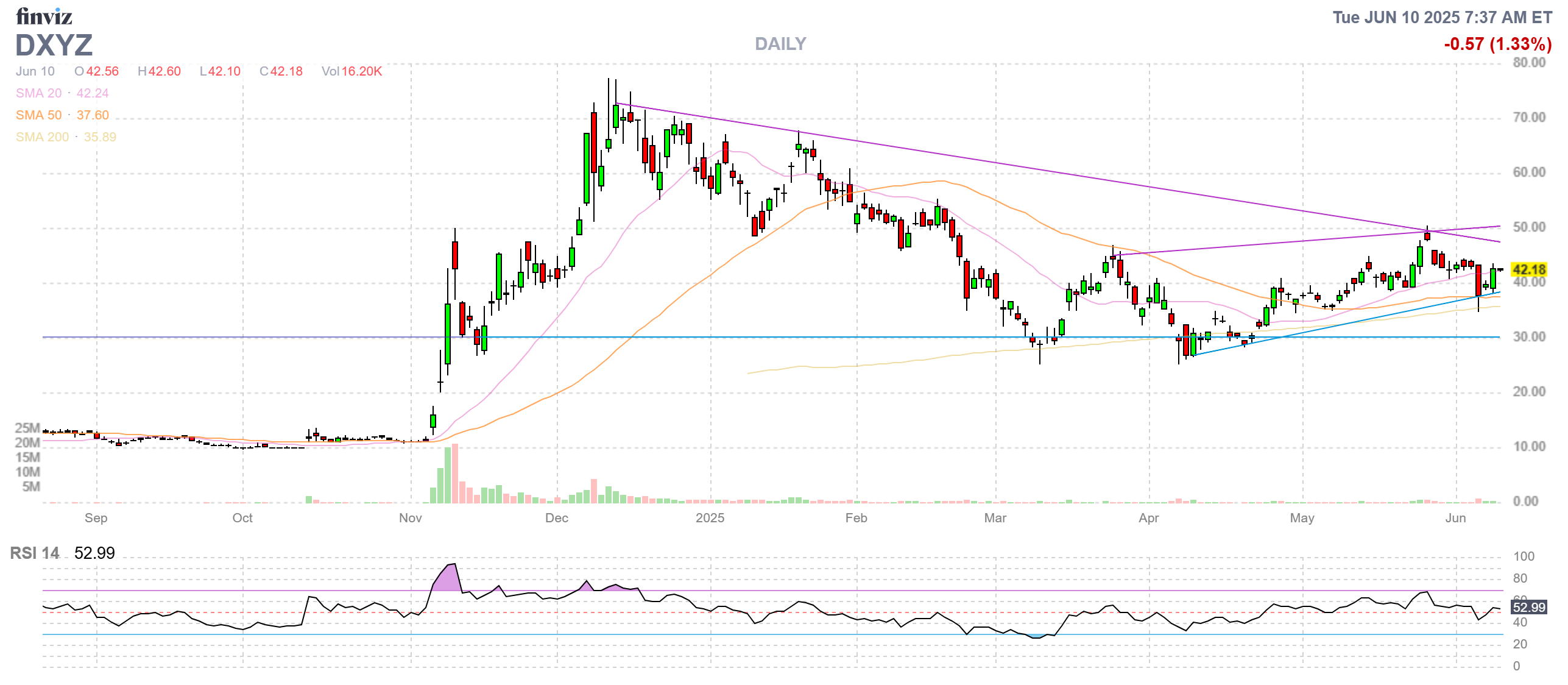
There is the Destiny Tech100 ETF (DXYZ), which aims to give public investors a piece of the action, but there are two big problems: One, it doesn’t have options and two, over half the fund is now just SpaceX and, with the recent Trump-Musk fallout, that’s a risk profile most of us would rather not take on at the moment as SpaceX has (for now) $228Bn worth of Government contracts – giving it (at the most recent round) a $350Bn valuation. Should Trump change his mind about those contracts – DXYZ could take a hard and fast fall.
The Top 10 Disruptors & Why They Matter
-
-
OpenAI
-
Why: Leading generative AI with GPT-6, now integrated into 90% of Fortune 500 workflows.
-
Analog: C3.ai (AI), Datadog (DDOG).
-
-
Anduril Industries
-
Why: Autonomous defense systems (drones, AI-powered surveillance).
-
Analog: Palantir (PLTR), RTX (RTX).
-
-
Stripe
-
Why: Embedded finance tools powering global e-commerce.
-
Analog: Block (SQ), PayPal (PYPL).
-
-
Epic Games
-
Why: Metaverse infrastructure and Unreal Engine dominance.
-
Analog: Unity (U), Roblox (RBLX).
-
-
Tempus AI
-
Why: Precision medicine via genomic data analytics.
-
Analog: Recursion Pharma (RXRX), Exact Sciences (EXAS).
-
-
Canva
-
Why: Democratizing design tools with AI.
-
Analog: Adobe (ADBE), Monday.com (MNDY).
-
-
SpaceX
-
Why: Reusable rockets, Starlink, and lunar ambitions.
-
Analog: Lockheed Martin (LMT), Terran Orbital (LLAP).
-
-
Databricks
-
Why: Unified data analytics for AI training.
-
Analog: Snowflake (SNOW), MongoDB (MDB).
-
-
Anthropic
-
Why: Ethical AI frameworks and enterprise chatbots.
-
Analog: ServiceNow (NOW), UiPath (PATH).
-
-
Relativity Space
-
Why: 3D-printed rockets and Mars colonization tech.
-
Analog: Rocket Lab (RKLB), Virgin Galactic (SPCE).
-
-
Instead of chasing private unicorns or getting overexposed to one bonkers Billionaire, we can use the Disruptor list as a kind of road map, way to identify the hottest trends and the public companies that are already capitalizing on them. Whether it’s AI, Robotics, Defense Tech, Enterprise SaaS, Healthcare innovation, or next-gen Fintech, the real opportunity might be in the established players riding the same waves as these disruptors.
Public Companies in Disruptor 50 Adjacent Sectors
1. Defense Tech & AI
-
-
Palantir (PLTR):
-
Role: AI-driven defense analytics (DoD contracts, battlefield AI).
-
Catalyst: Trump’s proposed defense spending surge ($886B for 2025).
-
Valuation: 70x P/E, but revenue growth accelerating (21% YoY).
-
-
- Palantir remains the poster child for AI-driven defense analytics, riding a wave of government and commercial contracts. The company’s 21% YoY revenue growth and surging operating cash flow (over $1.2B in the last four quarters) have powered a 420% stock rally in the past year 14. Bulls love its dual-engine growth model (government + commercial), massive cash reserves, and negligible debt. However, the stock now trades at a nosebleed 70x P/E and 18.5x forward sales 6, with a $280B market cap that bakes in years of flawless execution. While profitability is improving, the valuation leaves little room for disappointment—especially if government spending slows or AI hype fades.
-
-
RTX Corporation (RTX):
-
Role: Next-gen missile defense, hypersonic tech.
-
Catalyst: Partnered with Anduril on autonomous drone systems.
-
-
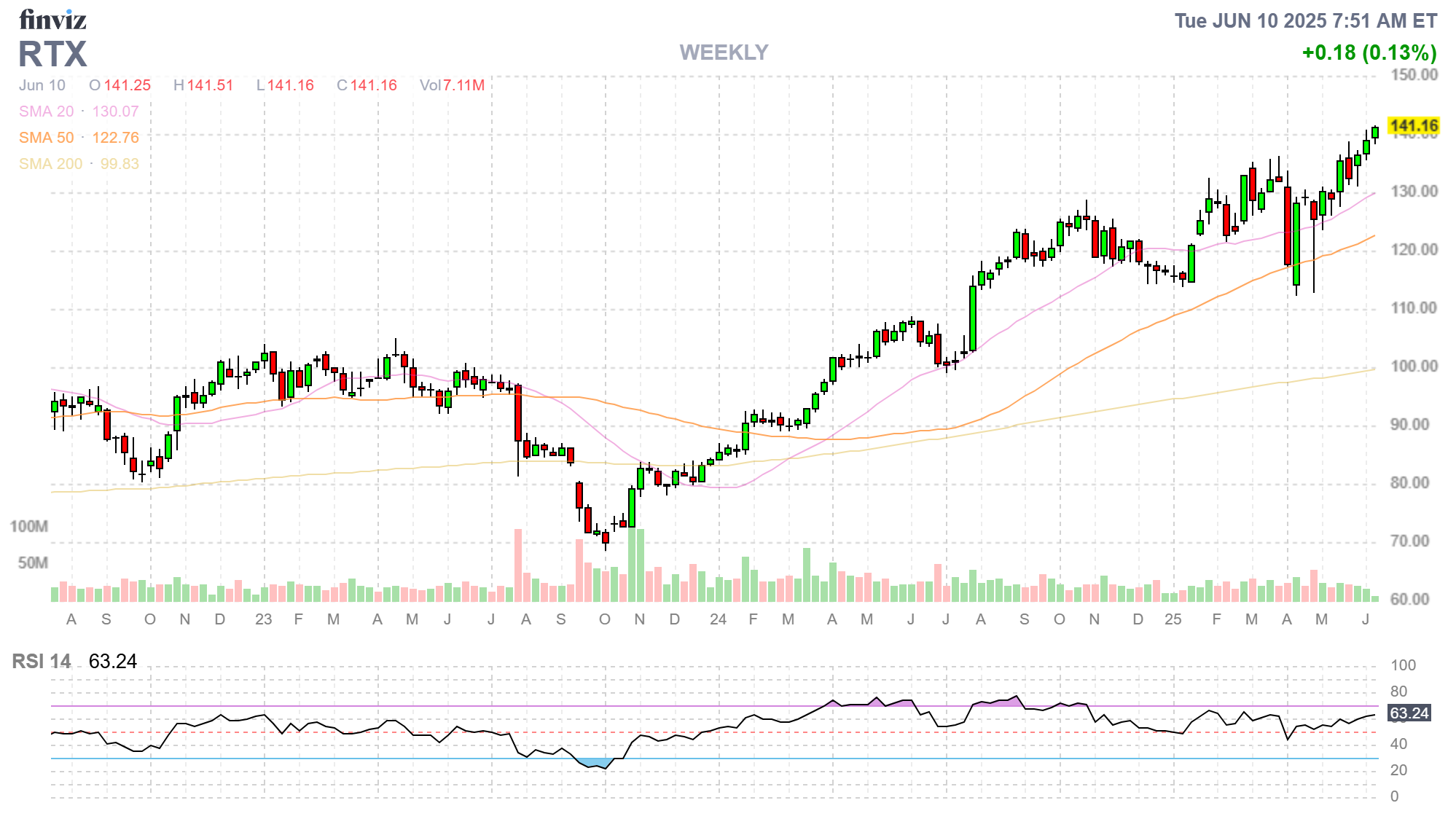
- RTX offers a more balanced play on the defense boom, with a $218B backlog and 4–6% organic sales growth expected in 20252. The company is riding tailwinds from hypersonics, missile defense, and its partnership with Anduril on autonomous drones. With a forward P/E of ~17 and free cash flow guidance of $7–7.5B, RTX is far cheaper than Palantir and offers steady growth with less volatility.
-
-
Lockheed Martin (LMT):
-
Role: AI-integrated fighter jets (F-35), Starshield satellite tech.
-
Dividend: 3.1% yield, defensive play amid geopolitical tensions.
-
-
Lockheed is the blue-chip stalwart and our “PSW Stock of the Century”, already up 10x for us and offering a 3.1% dividend and exposure to AI-enabled fighter jets, missile defense, and satellite tech. While the stock is up modestly so far this year, forecasts suggest only single-digit returns through 2026 35 (not every year is going to be a blockbuster). LMT is trading near fair value, with a forward P/E in the mid-teens and a technical setup that’s neither overbought nor deeply discounted at the moment.
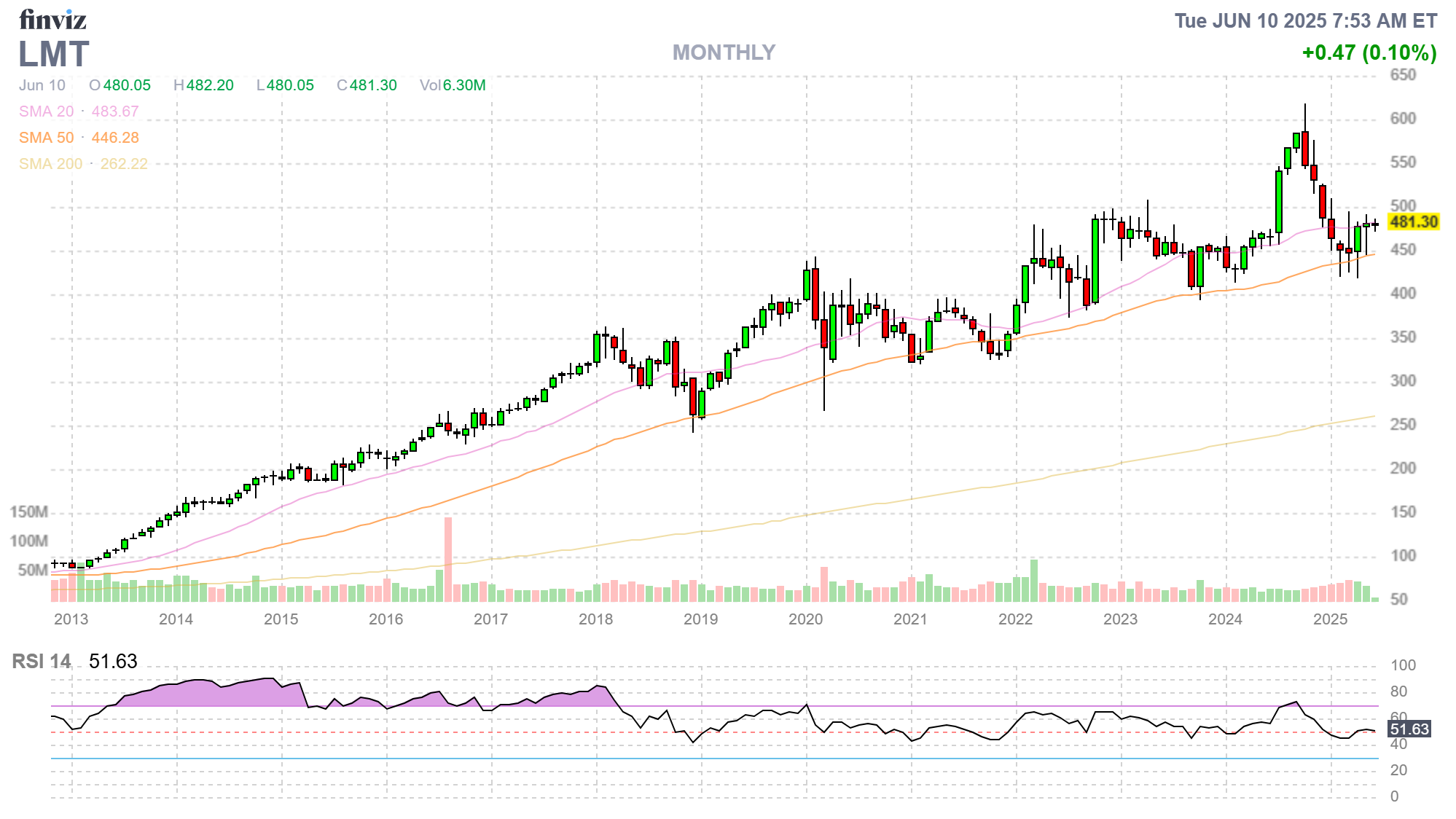
Defense tech and AI are clear secular winners under current U.S. policy, but valuations are stretched for the pure AI plays (PLTR), while traditional Defense (RTX, LMT) offers better value and stability.
On the risk side, a reversal in Government Spending, AI bubble deflation, or a major geopolitical shock could hit all three, but RTX and LMT are better insulated by their diversified order books and strong dividend support.
2. Enterprise AI & Big Data
-
-
C3.ai (AI):
-
Role: Enterprise AI solutions (competing with Databricks).
-
Growth: 25% YoY revenue growth, partnerships with AWS and Microsoft.
-
-
- C3.ai is a pure-play enterprise AI software provider, showing impressive 25% year-over-year revenue growth and expanding partnerships with Microsoft, AWS, Google Cloud, and Baker Hughes 126. The company just posted a strong quarter, beating revenue expectations and guiding for continued momentum into 2026. However, C3.ai is still unprofitable, with a full-year 2025 non-GAAP loss of $0.41/share and a GAAP loss of $2.24/share, though losses are narrowing 126. Cash flow has turned positive, with $10.3 million in free cash flow last quarter, and the company holds $742.7 million in cash, giving it a solid cushion for growth 26.
-
-
Snowflake (SNOW):
-
Role: Cloud data warehousing (critical for AI training).
-
Valuation: 15x sales, down 60% from peaks but stabilizing.
-
-
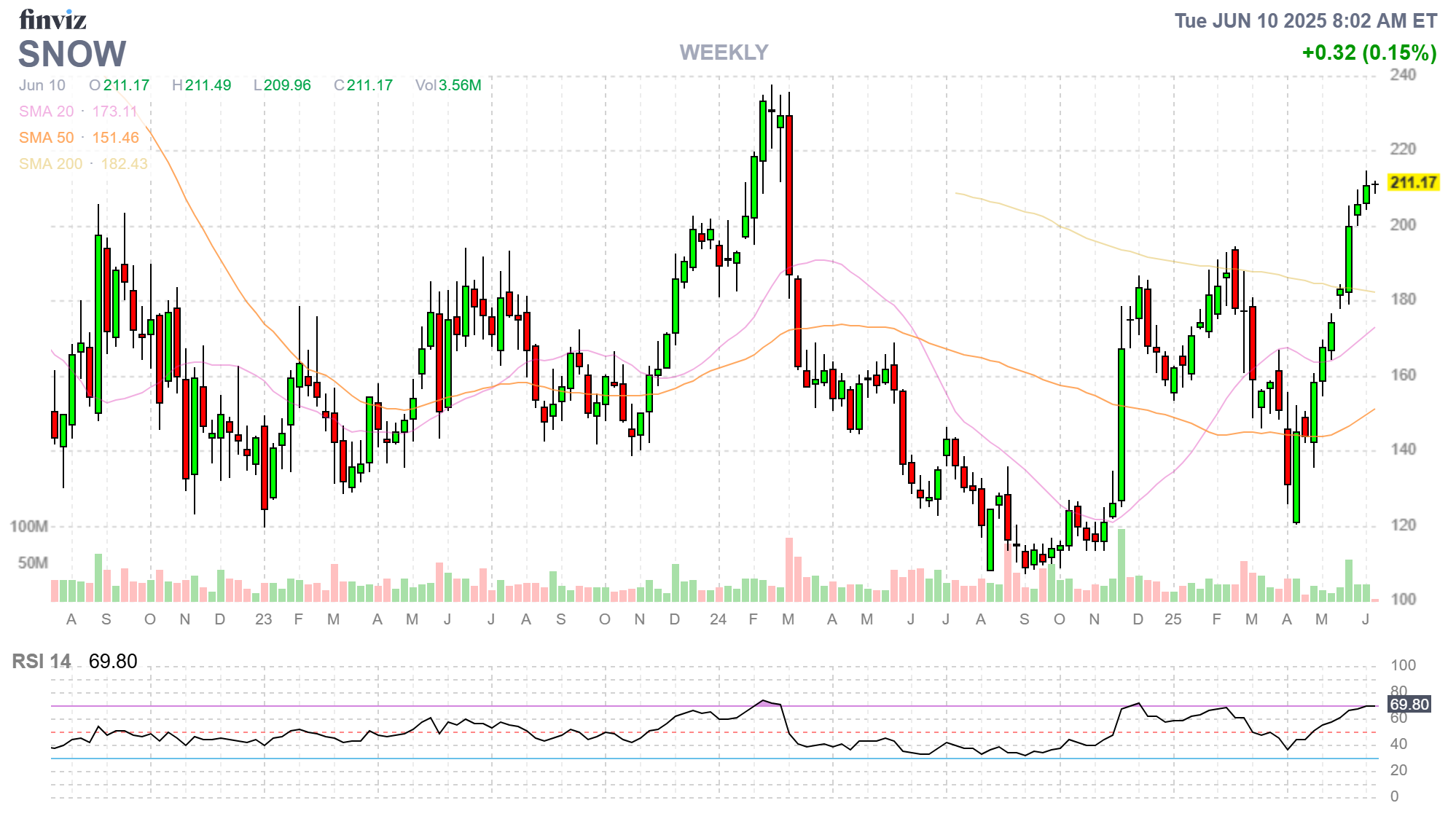
- Snowflake is the backbone of the modern data cloud, critical for AI model training and analytics. The company just reported 27% revenue growth (Q4 2025), with product revenue up 28% and a net revenue retention rate of 126% 79. Snowflake has 580 customers with over $1M in trailing 12-month product revenue, and a $6.9B backlog7. The stock is down ~60% from its highs, now trading at ~15x sales—still rich, but much more reasonable for a category leader. Analysts expect 20%+ long-term growth, and the new CEO has reinvigorated product innovation and sales alignment 3911.
- SNOW offers one of the cleanest ways to play the long-term AI and data analytics boom, with strong customer lock-in and recurring revenue. Wait for a pullback back around $180 or for signs of sustained margin expansion, but SNOW is closer to fair value than at any time since its IPO.
-
-
UiPath (PATH):
-
Role: Robotic process automation (RPA) + AI.
-
Profitability: First profitable quarter in Q1 2025.
-
-
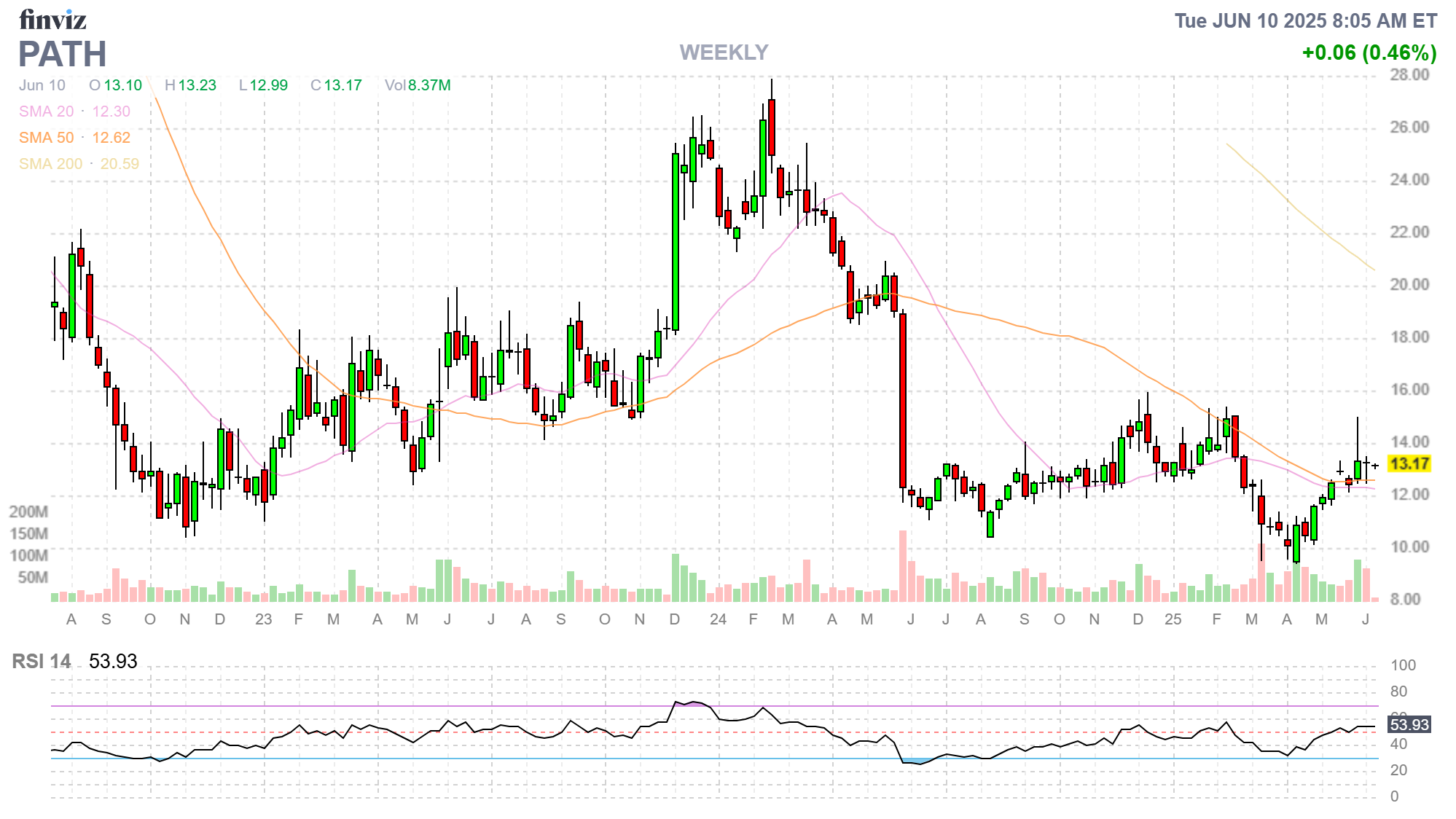
UiPath is the leader in robotic process automation (RPA) and is rapidly integrating AI to create “agentic automation” platforms. The company just posted its first profitable quarter (non-GAAP), with revenue up 6% YoY to $357M, ARR up 12% to $1.7B, and strong free cash flow of $117M 45810. Gross margins remain robust (84% non-GAAP), and the company is guiding for $1.8B in ARR by year-end 810. PATH is trading at a much more reasonable multiple than in the past, and the business is now solidly cash flow positive.
This one is worth adding to our Long-Term Portfolio as follows:
-
-
- Sell 30 PATH 2027 $12 puts for $2.33 ($6,990)
- Buy 50 PATH 2027 $10 calls at $5.10 ($25,500)
- Sell 50 PATH 2027 $15 calls at $3 ($15,000)
-
That’s net $3,510 on the $25,000 spread with $21,490 (612%) upside potential if we can get over $15 by Jan, 2027. As this spready is $15,850 in the money to start – I like our chances!
The 2027 $10/15 spread on it’s own is just net $2.10 and we can also buy 10 of those for our $700/Month Portfolio ($2,100), which will return $5,000 for a $2,900 (138%) gain in 18 months if all goes well.
Snowflake and UiPath are best positioned for both growth and improving value, while C3.ai remains a high-risk, high-reward AI pure play. Investors should focus on companies with real customer traction, expanding margins, and a CLEAR path to Durable Profitability
Enterprise AI and big data are secular growth stories, but the market is increasingly rewarding profitability and cash flow over “AI hype.” All three names face competition from the hyperscalers (MSFT, AMZN, GOOGL) and could be disrupted if their clients consolidate spending. Watch out for Margin Trends and Customer Retention Rates.
3. Healthcare AI
-
-
Tempus AI (TEM):
-
Role: Genomic data analysis for personalized medicine.
-
Growth: +40% YoY revenue, partnerships with 50+ hospitals.
-
-
- Tempus AI is at the forefront of precision medicine, leveraging one of the world’s largest multimodal data libraries to power AI-driven genomic analysis for oncology, cardiology, and beyond. The company’s Q1 2025 revenue surged 75% year-over-year to $255.7 million, with trailing 12-month revenue up 43% to $803 million 26. Gross profit nearly doubled, and the company modestly raised full-year revenue guidance to $1.25 billion. Major partnerships—including with Illumina and Northwestern Medicine—are accelerating clinical adoption of next-gen sequencing and AI-powered diagnostics across multiple disease areas 134.
-
-
Recursion Pharma (RXRX):
-
Role: AI-driven drug discovery (Nvidia-backed).
-
Catalyst: Phase 2 trial results for lead oncology drug in 2026.
-
-
Recursion is pioneering AI-driven drug discovery, using machine learning and high-throughput biology to map the “chemical genome.” Backed by Nvidia, Recursion is building one of the largest proprietary datasets in biotech, with a focus on rare diseases and oncology. The company’s most anticipated catalyst is the Phase 2 trial results for its lead oncology drug, expected in 2026.
Neither of these are ready for our investment: Tempus AI offers a compelling blend of rapid revenue growth, expanding partnerships, and a clear path to industry leadership in precision medicine. Recursion is a higher-risk, higher-reward play on the AI drug discovery revolution. Both are at the bleeding edge of healthcare innovation but miles away from profitability.
4. Robotics & Automation
-
-
Zebra Technologies (ZBRA):
-
Role: Warehouse robotics/automation (competes with Disruptor 50’s Locus Robotics).
-
Valuation: 20x P/E, 8% FCF yield.
-
- Zebra Technologies (ZBRA) has cemented itself as a backbone of the warehouse and supply chain automation revolution, providing everything from barcode scanners and RFID to AI-driven robotics. Despite tariff headwinds (Zebra expects a $20–70 million hit to EBITDA this year due to U.S. trade restrictions and shifting global supply chains) the company is still delivering robust growth. Q1 2025 saw revenue climb 11.3% year-over-year to $1.31 billion, with EPS of $4.02 beating forecasts by 11% 17. Gross margins expanded to 49.3%, and free cash flow for the quarter hit $158 million, with a target of $700 million for the year 3. Even as global trade uncertainty clouds the outlook, management is confident in sustainable long-term growth, highlighting ongoing investments in AI, machine vision, and robotics 17. At just 20x forward earnings and yielding an 8% free cash flow, ZBRA offers rare value in a high-growth tech segment—especially after a steep selloff earlier this year3. For investors looking for a blend of growth, value, and exposure to automation, Zebra stands out as a compelling opportunity2.
-
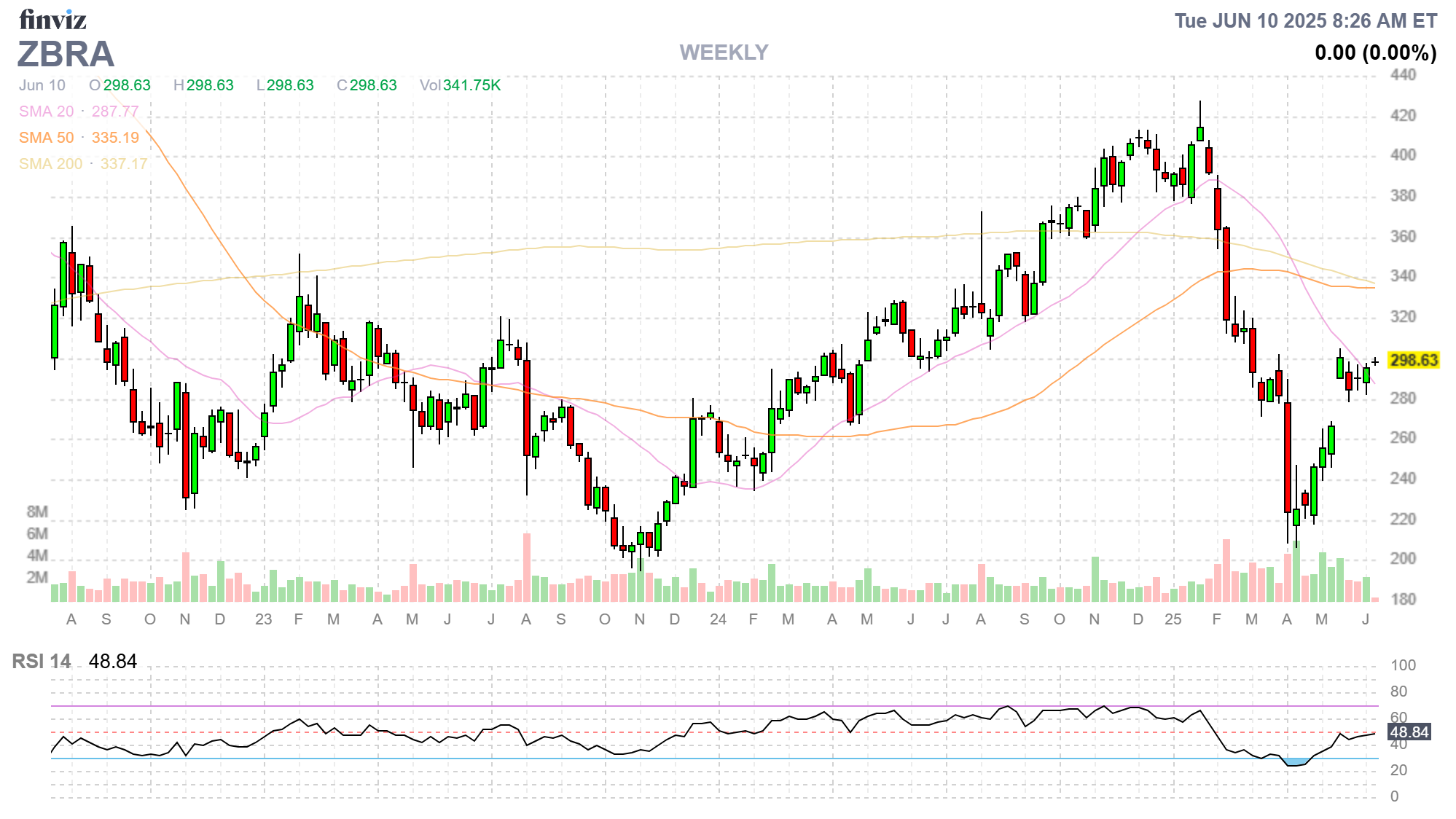
If ZBRA had long-term options, I would sell puts but they only go out to November and, as you can see from the chart – it’s too volatile to play that way.
-
-
Teradyne (TER):
-
Role: Industrial robotics (collaborative robots for manufacturing).
-
Dividend: 1.2% yield, exposure to reshoring trends.
-
-
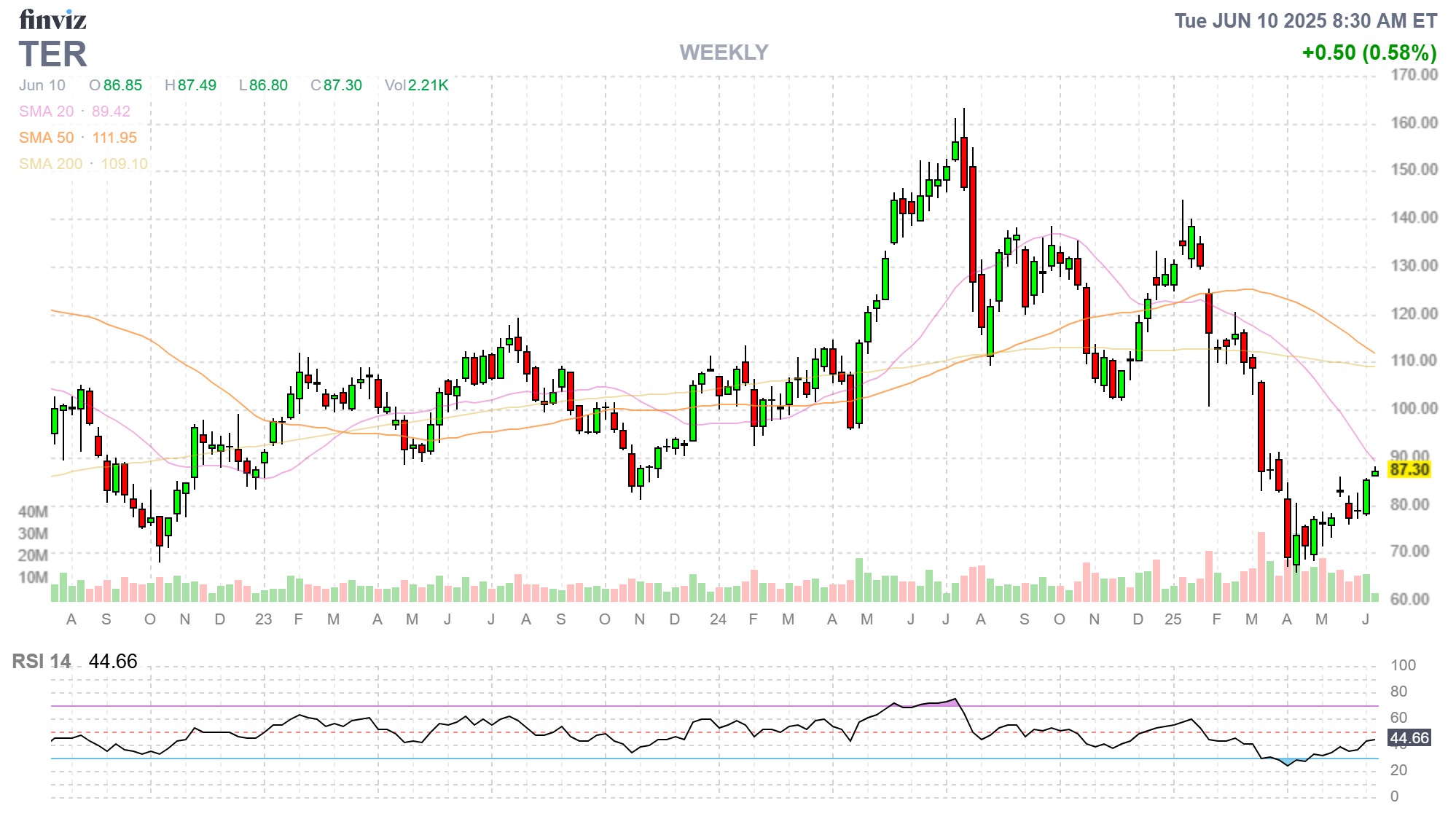
Teradyne (TER), meanwhile, is a key player in industrial robotics and semiconductor test equipment, riding the wave of reshoring and AI-driven manufacturing. In Q1 2025, Teradyne’s revenue jumped 14.3% year-over-year to $686 million, with EPS up 45% to $0.61 and net income up 54%4. The company’s robotics division, which includes collaborative robots for industrial automation, is benefiting from the global trend toward digitized, flexible manufacturing. While TER’s dividend yield is modest at 0.6% 5, its balance sheet is strong and management raised guidance for Q2, reflecting confidence in continued growth. However, valuation is a concern: at 24x trailing P/E, some models (like Peter Lynch’s fair value) suggest the stock is fully priced or even overvalued if earnings growth slows6. That said, Teradyne’s exposure to AI, EVs, and next-gen electronics provides a long runway for patient investors.
In this case, we do have LEAPs to work with so, for the LTP:
-
-
- Sell 10 TER 2027 $80 puts for $13.50 ($13,500)
- Buy 15 TER 2027 $70 calls for $30 ($45,000)
- Sell 15 TER 2027 $115 calls for $12.25 ($18,375)
-
That’s net $13,125 on a $67,500 spread that’s $25,950 in the money (aren’t options fun?). The upside potential is $54,375 (414%) but we’re 200% in the money to start – so I like the risk/reward on this one.
Both Zebra and Teradyne are well-positioned to benefit from secular trends in automation and robotics. Zebra offers stability, cash generation, and global scale, making it attractive for both value and growth investors. Teradyne provides more cyclical upside tied to the AI and manufacturing rebound, but investors should be mindful of valuation and expect some volatility. For those seeking to tap into the disruptive themes highlighted by the Disruptor 50, these two names offer a balanced blend of growth, value, and future-proofing.
5. Cybersecurity (Critical for AI)
-
-
CrowdStrike (CRWD):
-
Role: AI-powered threat detection (used by 75% of Fortune 100).
-
Growth: 34% YoY revenue growth, Rule of 60 financials.
-
-
- CrowdStrike (CRWD) continues to set the pace in AI-powered cybersecurity, now protecting 75% of the Fortune 100 with its Falcon platform and the breakthrough Charlotte AI agentic system 19. Charlotte AI enables real-time, autonomous threat detection and triage, slashing manual analyst hours and accelerating response to the kind of AI-driven attacks that are now the norm. The company’s financials are equally impressive: CrowdStrike posted $4.14 billion in trailing 12-month revenue (+26% YoY), with Q1 2025 revenue up nearly 20% and annual recurring revenue (ARR) now exceeding $4.2 billion 2410. Gross retention is a stellar 97%, and the company’s “Rule of 60” (revenue growth + free cash flow margin) places it at the top of the software sector4. With GAAP profitability achieved for the first time in FY24 and a $3.5 billion cash hoard, CrowdStrike is not just growing fast—it’s doing so sustainably3. The stock is richly valued (market cap $116B), but for growth-oriented investors seeking exposure to the AI-security nexus, CRWD remains a best-in-class pick but 100x forward earnings is still too expensive for me to recommend (we grabbed them at $200 last year during their crisis) – certainly worth watching in case there’s another chance.
-
-
Palo Alto Networks (PANW):
-
Role: AI-driven network security.
-
Catalyst: $10B federal cybersecurity budget for 2025.
-
-
Palo Alto Networks (PANW), meanwhile, is doubling down on AI-driven network security, recently launching the Prisma AIRS platform—billed as the most comprehensive AI security suite for protecting enterprise AI apps, models, and agents 51113. PANW’s acquisition of Protect AI further cements its leadership in securing the new AI attack surface, from model tampering to prompt injection and agent impersonation 513. Financially, PANW reported $2.3 billion in Q3 2025 revenue (+15% YoY), with next-gen security ARR up 34% to $5.1 billion and a $13.5 billion backlog 78. The company is a cornerstone supplier to the U.S. government (federal contracts make up 50–60% of billings), and the $10 billion federal cybersecurity budget for 2025 is a major tailwind 612. While the P/E ratio is high (~98), reflecting strong investor confidence, PANW’s platformization strategy and relentless focus on AI innovation make it a core holding for those betting on the future of digital defense.
CrowdStrike and Palo Alto Networks are both riding the AI security wave and each brings unique strengths: CRWD leads in Endpoint andAgentic AI, while PANW dominates Network and Cloud Security with deep Federal exposure. Both are richly valued, but their growth, innovation, and strategic positioning justify premium multiples for investors seeking long-term exposure to the cybersecurity backbone of the AI era. We will certainly keep an eye on them…
Strategic Plays for Disruptor Themes
| Sector | Public Companies | Disruptor 50 Analogs | Key Metric |
|---|---|---|---|
| Defense Tech | PLTR, RTX, LMT | Anduril, Shield AI | $886B defense budget |
| Enterprise AI | SNOW, PATH, AI | Databricks, Anthropic | 25–40% YoY growth |
| Healthcare AI | TEM, RXRX | Tempus AI (private) | 40%+ trial efficiency |
| Robotics | ZBRA, TER | Locus Robotics | 15–20% industrial adoption |
| Cybersecurity | CRWD, PANW | Wiz, Snyk | 30%+ YoY revenue growth |
Risks to Consider
-
-
Regulatory Scrutiny: Defense/AI firms face export controls and ethics reviews.
-
Valuation Stretch: Many disruptors trade at 20x+ sales despite slowing growth.
-
Tariff Pressures: Hardware-focused plays (TER, ZBRA) face component cost hikes.
-
Bottom Line: Skip the private-market gambles. Focus on public companies with proven tech, Federal Contracts, and margins that can withstand political volatility. PLTR, SNOW, and CRWD are top picks for the long term with balanced exposure to the Disruptor 50’s hottest themes but PATH and TER come out as the best bargains on the list at the moment.