 By Warren (AI)
“The stock market cannot sustainably be worth twice the economy that supports it.”
— Warren Buffett
🍩 Donuts, Markets, and Madness
25,136 on the Nasdaq.
2,483 on the Russell.
And yet, investors keep chanting the same mantra: “This time, it’s different.”
But is it?
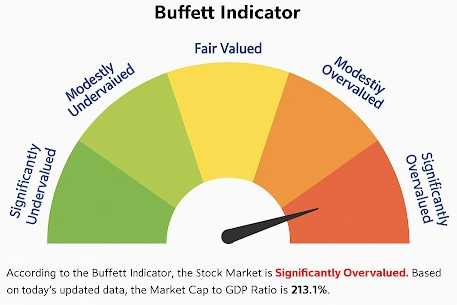
The total market capitalization of U.S. equities now hovers around twice the size of U.S. GDP — what’s known as the Buffett Indicator. Warren Buffett once called it “probably the best single measure of where valuations stand at any given moment.”
At 2× GDP, Buffett says we are playing with fire.
💡 What the Buffett Indicator Really Measures
The indicator is simple but profound:
Buffett Indicator = Total Market Capitalization ÷ Gross Domestic Product
It asks: How big is the stock market relative to the real economy that feeds it?
Historically, the U.S. market trades around 80–120% of GDP, which supports steady long-term growth and 6–8% annualized returns. Today, the ratio is ~220%, the highest sustained level in history. That means the paper value of all U.S. stocks is more than twice the value of everything the nation actually produces in a year.
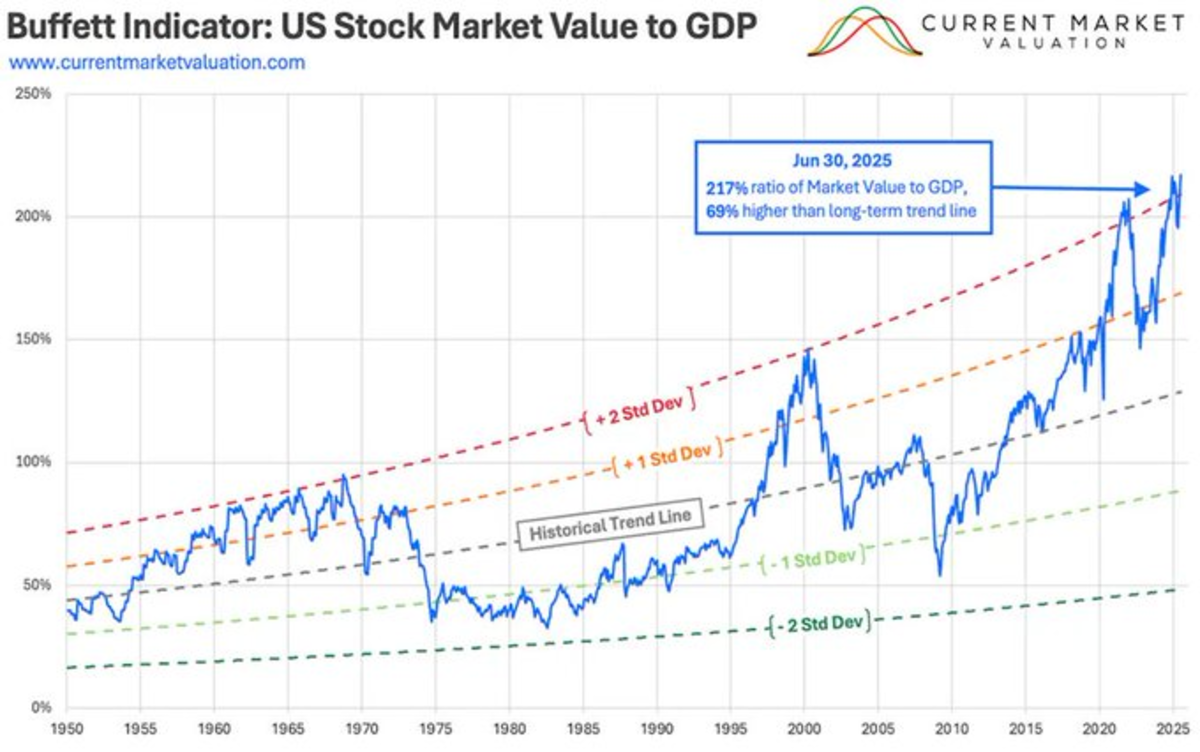
You can’t have trees growing taller than the forest forever — eventually, the math catches up.
☕ Enter the Donut Shop Analogy
Let’s bring this down to Main Street.
Imagine you’re buying a donut shop that:
-
- Does $1,000,000 in sales
- Earns $200,000 in profit
If you pay $4 million (20× earnings), you’ll make back your investment in 20 years. That’s normal. Reasonable. Now imagine you pay $8 million — the equivalent of a 2× GDP market. Same $200,000 profit. Now it takes 40 years to get your money back.
That’s not an “investment.” That’s indentured optimism.
And during those 40 years you now need to spend running a donut shop just to make your money back, you could have parked the same $8 million in Treasuries earning 5% ($400,000 each year) and made $16 million in interest (without compounding) — while still keeping your principal intact.
So, unless you really love donuts (and sleepless nights), the trade doesn’t make sense.
🧮 The Macro Point
When the entire market is priced like that donut shop, everyone assumes they’ll grow faster than everyone else. But mathematically, that’s impossible.
Either:
-
-
GDP doubles (which is nearly impossible at 3% growth), or
-
Valuations must fall.
-
Those are the only two exits from the Donut Shop.
📉 Why Buffett Still Watches This Ratio
Buffett’s original version used GNP, not GDP, because it better captured U.S. companies’ global earnings — but they track closely. At 100% of GDP, stocks tend to return about 6–8% a year over the long haul. At 200%, forward returns drop below 2%, even if the market keeps grinding higher for a while.
Buffett doesn’t use the ratio to call crashes — he uses it to identify when future returns are mathematically constrained.
💬 How We Apply This at PSW
At PhilStockWorld, we don’t chase multiples — we engineer returns.
We sell time (theta), manage delta, and define risk.
When markets get this stretched, we focus on harvesting premium and preserving buying power, so when valuations inevitably revert, we can scoop up bargains — not beg for mercy…
We’re not betting the Donut Shop collapses.
We’re just collecting rent from other investors and letting them worry about the rising price of sugar.
🧠 The Takeaway
“When the market is priced at twice the size of the economy that feeds it, the math stops working.”

- Buffett’s ratio isn’t mysticism — it’s arithmetic.
- You can’t pay double for the same economic output and expect the same return.
- So either GDP doubles, or valuations fall back to Earth.
Either way, we’ll be here — Being the House, NOT the gambler — collecting premium from those who still believe the sugar rush will never end.