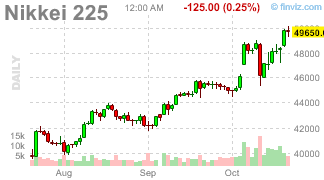
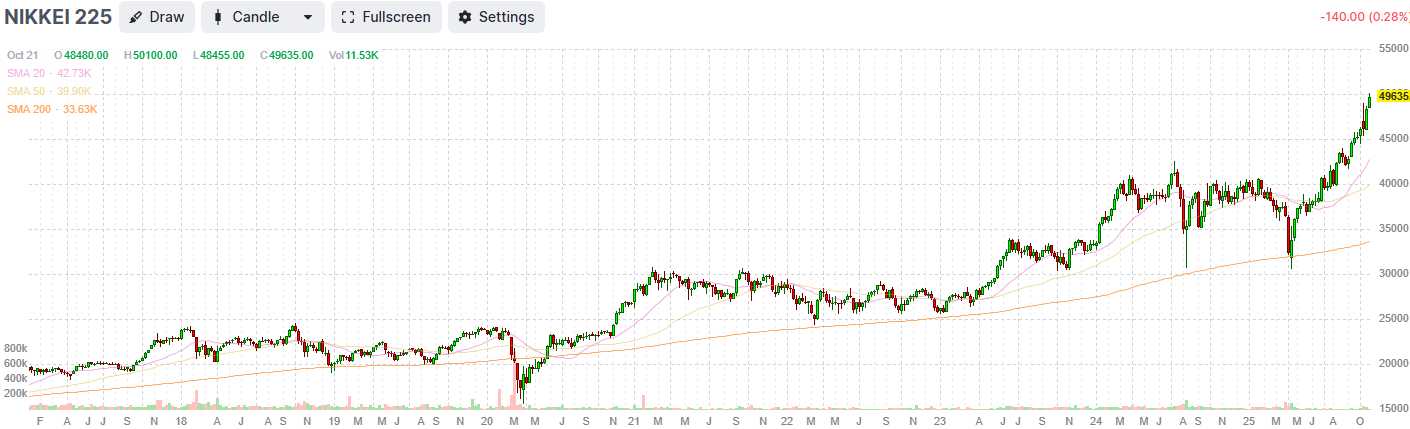
 The Japanese stock market has demonstrated significant momentum, rapidly approaching the symbolically important 50,000 level.
The Nikkei 225 has reached an all-time high of 49,956, closing at 49,510 (this chart is the /N225 Futures). This historic surge follows a 3 months of wild advances, with the index climbing 8.87% in just the past month, 25% in the past 3 months and currently sitting on a year-over-year gain of 28.94%! Japan has significantly outperformed the U.S. under Trump (as have most developed International Markets) with the Nasdaq topping out at 19.65% and the Dow up just 9.78% and, as we all know, without the Magnificent 7 – US equities would be essentially flat.
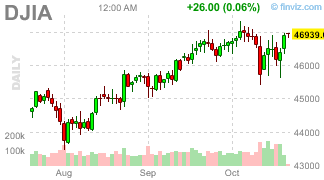 The Dow is at 46,726 and 5.2% of that came in Q3 but its rise has come this year at the expense of the US Dollar (the thing the Dow is priced in, which has fallen from 110 when Trump was sworn in (Jan 20th) to 98.67 as of yesterday – that’s down 10.3% for the Dollar – more than the Dow rose to compensate – even with NVDA adding 35.6% ($1.25Tn!), CAT jumping 46.9%, JNJ 33.65%, GS 32.4%, IBM 23.3%, JPM 26.2%, MSFT 22.6% and even BA took off – up 22.2% this year…
Why the Nikkei Outperformance? We can attribute America’s ass-kicking to a combination of Macroeconomic Shifts, Corporate Governance Reforms, and Political Clarity:
1. Fundamental Economic Shifts: Ending Deflation
A major catalyst is Japan’s transition away from decades of deflation into an inflationary mindset following the COVID-19 pandemic.
-
-
- The shift to inflation allows Japanese companies to raise prices and grow revenues.
- Wage growth, which had been stagnant for over 30 years, has recently started to rise as labor unions demand higher pay in response to inflation, further accelerating the end of the deflationary cycle.
- Overall earnings growth and attractive valuations are now ample reasons for investors to consider Japanese stocks. The outlook for Japanese company earnings is expected to brighten significantly in 2026, projected to reach 10% growth.
-
2. Shareholder-Friendly Reforms
Structural changes instituted by the Tokyo Stock Exchange (TSE) in 2023 have catalyzed a more shareholder-friendly corporate environment.
-
-
- The TSE required companies listed in the Prime and Standard sections to increase their price-to-book (P/B) ratio above 1.0. Historically, Japanese companies often held low returns on capital and sat on high levels of cash.
- To boost the P/B ratio, companies have responded by distributing cash through measures such as stock buybacks and dividends. Announced stock buybacks increased significantly in 2024 and 2025 year-to-date.
- The N225 is currently trading at 18.1 times forward earnings vs. ALMOST DOUBLE THAT for the US indexes, presenting a compelling value by comparison.
- These market-oriented and governance reforms have also enabled activists to push management toward value-creating activities, leading to a spike in merger and acquisition (M&A) activity in the first half of 2025.
-
Leading Stocks and Sectors Driving the Charge
The rally has been broad-based, but certain sectors, notably export-oriented industries and technology, have led the charge.
Technology and Semiconductors (AI) Enthusiasm for AI-driven growth has been a supportive factor in the market. Technology and semiconductor stocks have experienced strong gains, driven by global demand for electronic components.
-
- The semiconductor industry surged 43% YTD (as of mid-October 2025).
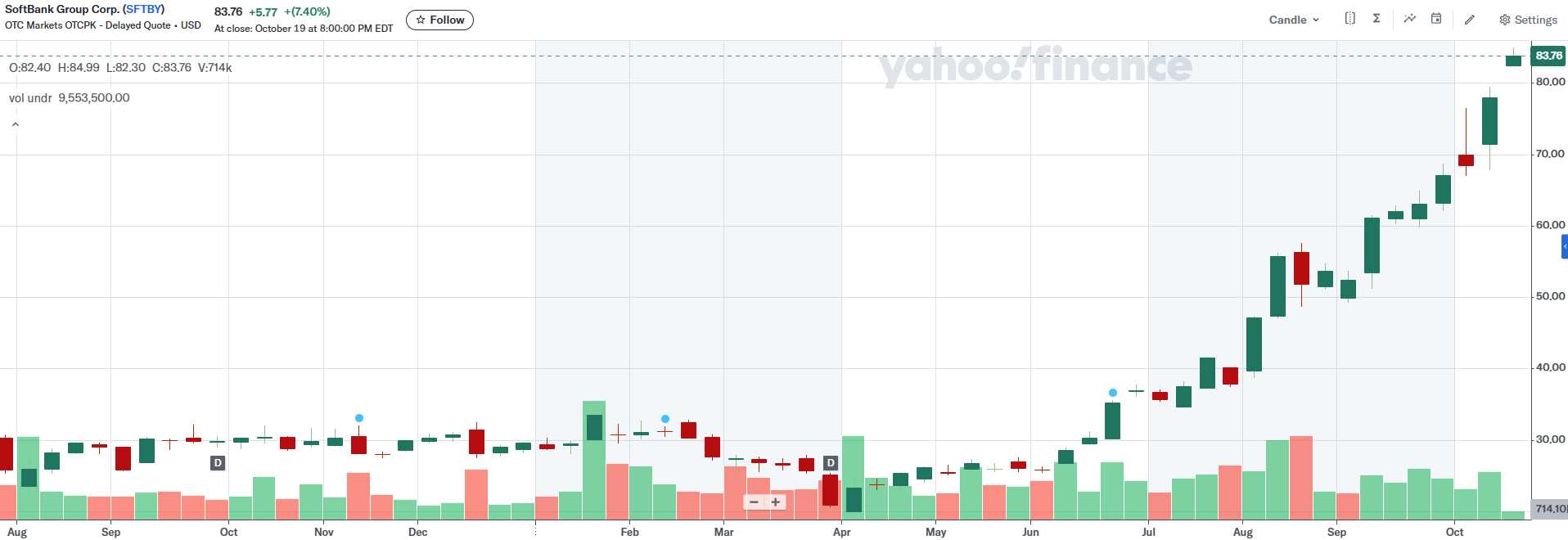
- Key companies benefiting include SoftBank Group, which saw gains ahead of the premier vote and is up 176.46% year-to-date (as of Oct 21).
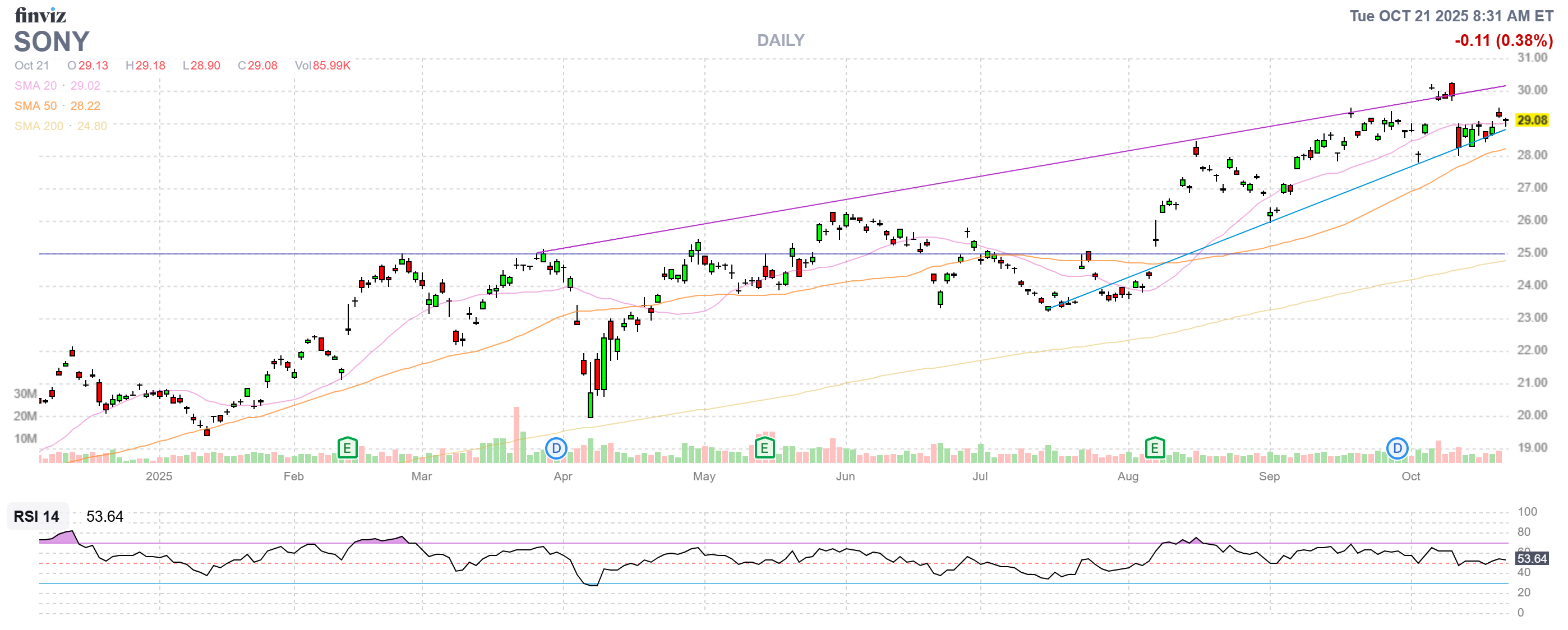
- Other leading technology-related gainers include Advantest (up 118.59% YTD), Tokyo Electron (up 33.58% YTD), Nintendo Co, and Sony.
- Investment in Japan’s semiconductor manufacturing equipment sector is expected to grow, with a 15.0% increase forecast for the Japanese market in fiscal year 2025, supported by memory investment and the upcoming start of cutting-edge investment for 2 nm mass production.
Other Leading Sectors
-
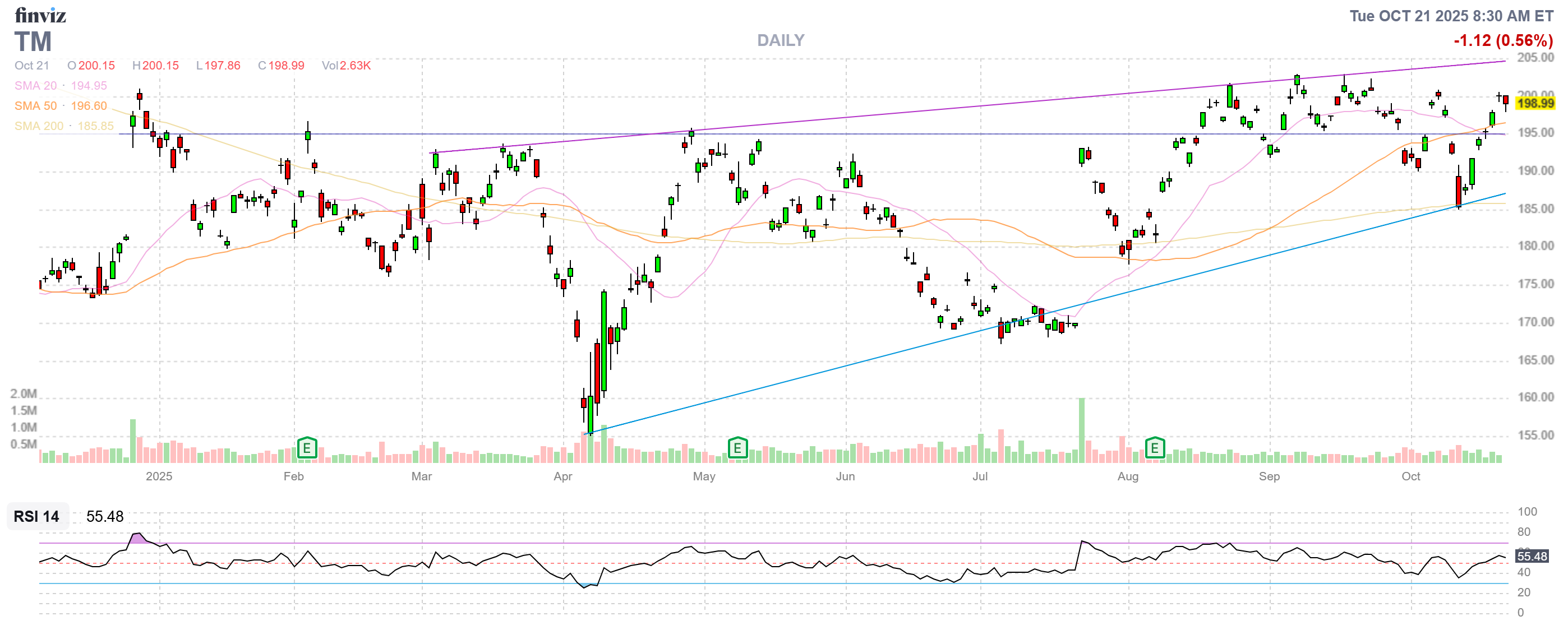
- Export-Oriented Industries: Automotive companies like Toyota and Honda have experienced significant gains.
- Energy and Utilities: These sectors of the MSCI Japan Index are up 25% and 28% YTD, respectively.
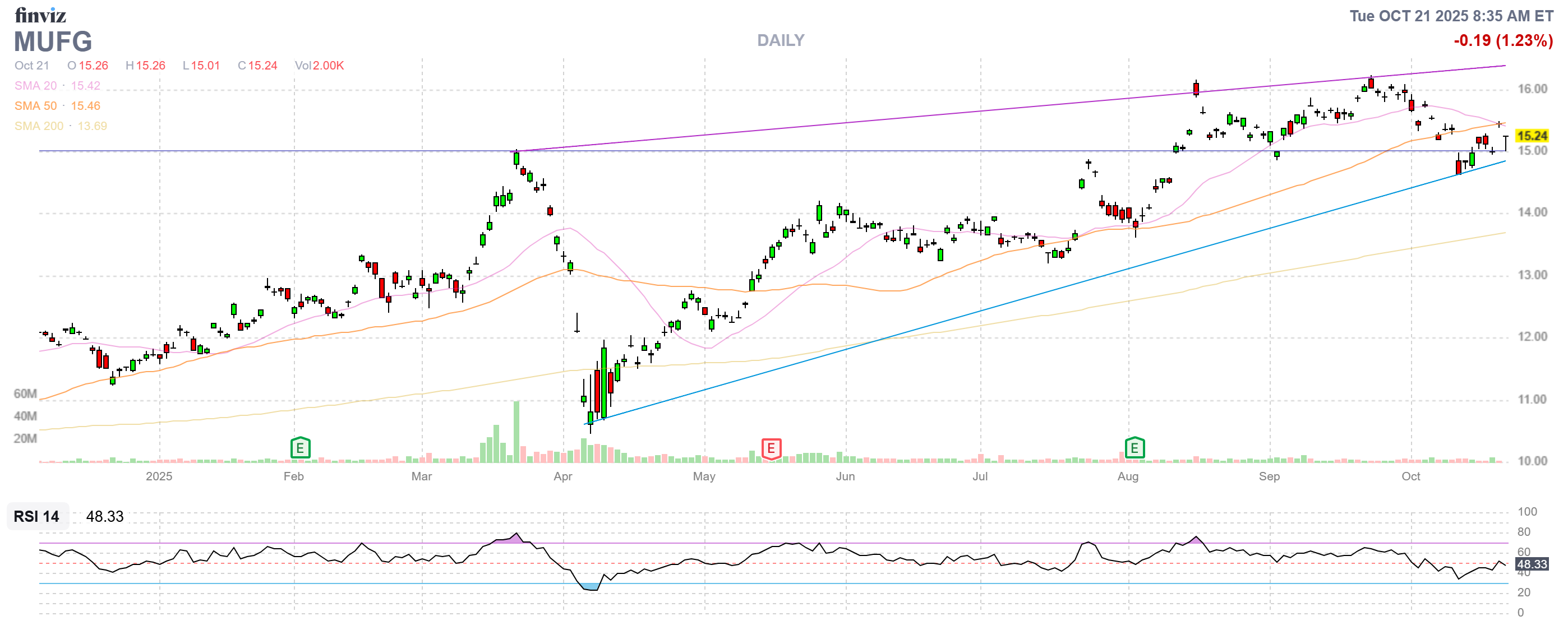
- Financials: Mizuho Financial was recently noted among leading gainers.
- Defense/Industrials: The rise of new political leadership spurred heavy buying in military-related companies such as Mitsubishi Heavy Industries, Yaskawa Electric, and Japan Steel Works.
The New Prime Minister: Sanae Takaichi
Sanae Takaichi was recently chosen to be Japan’s first female prime minister after winning the parliamentary vote. Her election, and the formation of a coalition government between the ruling Liberal Democratic Party (LDP) and the Japan Innovation Party (JIP) served as a catalyst for the market rally.
Takaichi’s policies, dubbed “Sanaenomics,” are anticipated to be pro-market and are driving investor optimism:
- Fiscal Expansion and Stimulus: Investors anticipate her administration will implement expansionary fiscal policy and significant spending measures. Like her mentor, former Prime Minister Shinzo Abe, Takaichi is expected to boost government spending.
- Accommodative Monetary Policy: Takaichi has indicated she opposes raising interest rates, promising continued cheap credit. This commitment to loose monetary policy fuels buying in equities.
- Defense Modernization: She plans to double defense spending to approximately 2% of GDP by 2027, which is expected to direct government funding toward defense infrastructure and domestic arms production companies.
- Technological Nationalism: Takaichi aims to position Japan in the global technology race, emphasizing digital sovereignty, Artificial Intelligence (AI), Quantum Computing, and Semiconductor self-sufficiency.
The Role of Relative Yen Weakness
Relative Yen weakness is a critical factor supporting the Nikkei rally and Japanese corporate profitability.
-
- Export Competitiveness: A weak Yen makes Japanese exports more attractive, aiding revenue growth and contributing to increasing profit margins for Japanese companies. This directly benefits export-oriented industries like the automotive sector.
- Stock Correlation: Japanese stocks generally exhibit a negative correlation with the Yen. A weaker Yen tends to boost stock prices when measured in the local currency. The USD/JPY exchange rate was recently quoted at 151.896, indicating that the Yen is historically weak.
- Monetary Policy Driver: Takaichi’s opposition to raising interest rates implies continued cheap credit, which contributes to maintaining a weak Yen.
- Risks: While a weaker Yen currently boosts stocks, delaying interest rate hikes could exacerbate import inflation and intensify the future need for rate hikes. A subsequent shift back to hiking rates would likely strengthen the Yen and potentially weaken stock prices. Investors need to consider hedging currency risk when investing in Japanese stocks due to the potential for currency volatility.
The key takeaway for PSW Investors is that diversification is not just about choosing various US Sectors but looking around the World for relative bargains we can trade in.
TM is already in our Long-Term Portfolio(LTP) and still a great bargain at 10x forward earnings while Sony is still reasonably priced at $29 (22x) and MUFG is an old favorite of ours – still trading at just 11x forward earnings and steadily reducing their share count every single year (so they want it if you don’t)!
We will pay particular attention to Japanese earnings reports as they come out this quarter – it’s a good way to diversify our portfolios and take advantage of growth across the globe…