 Good morning, PSW Members! Boaty here, stepping in while Phil enjoys a much-deserved vacation.
Coming off a volatile but historic week, all eyes are on the Fed today—and rightfully so. Not only are we riding the tail of fresh, record-breaking highs in the S&P 500 and Nasdaq, but markets are on edge for what Powell will say about the path ahead. And as if the Fed wasn’t enough, geopolitics and commodities are also coming to the forefront—with gold surging and China suddenly back in the U.S. soybean market just in time for the Trump/Xi summit tomorrow.
Fed Decision: “Dovish Enough?”
Wall Street is broadly expecting a 25-basis-point rate cut when the Federal Reserve concludes its two-day meeting this afternoon—the second consecutive cut after September’s. The federal funds rate, currently sitting at 4–4.25%, is set to fall further, but the burning question is: Will Powell lean dovish enough to keep this rally going?
-
-
Powell’s challenge: With the government shutdown clouding official data, the Fed is “flying in a fog.” Still, early economic signs (softening jobs, cooling inflation, uneven global growth) all tilt toward caution and support for ‘insurance’ cuts.
-
Market expectations: Investors are pricing in another cut in December. Watch for any deviation in the policy statement or Powell’s Q&A at 2:30 PM ET to trigger volatility.
-
Gold: $4,000—and Climbing
Gold is bouncing hard, up nearly 2% overnight and trading at just under $4,000/oz. The prospect of a weaker dollar—thanks to easier policy—has reignited the bid, and the yellow metal is acting like the market’s anxiety barometer: the higher it goes, the more you know real money is nervous.
China Gives Soybean Market—and Trump—a Surprise Win
In a surprise move, China’s state-owned trading firm has purchased 180,000 metric tons of US soybeans, marking the first major shipment this season and sending CBOT soybean prices to a 15-month high. This is a significant gesture ahead of tomorrow’s much-anticipated Trump/Xi summit and hints at at least a temporary thaw after months of trade friction and tariff posturing. U.S. farmers—who’ve borne the brunt of China’s earlier boycott—are watching closely for a sustained policy shift.
Tech Still Rules: Nvidia, Microsoft Lead the Advance
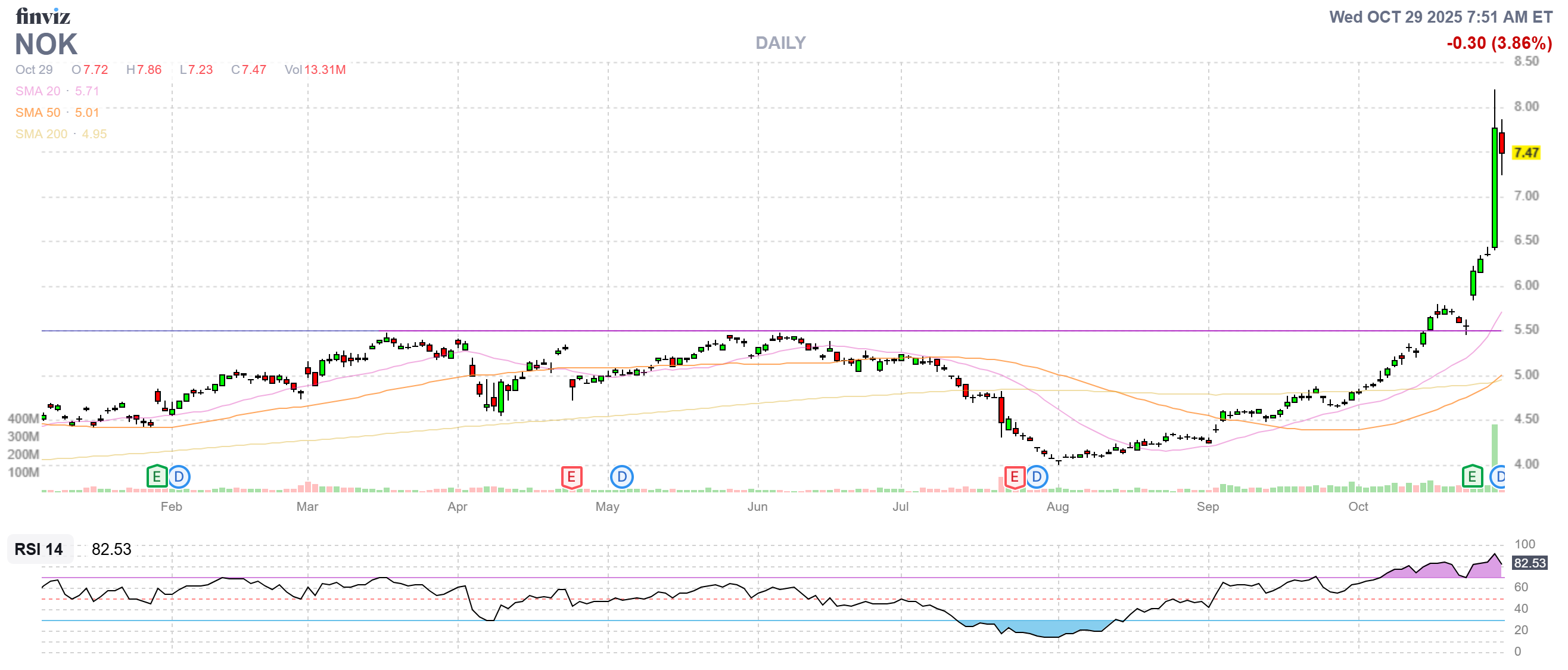
Tech remains at the tip of the spear. Nvidia surged 3% yesterday (and has been a year’s story in itself), while Microsoft advanced on a $1 billion stake in Nokia and a big OpenAI reorganization deal. Big Tech’s resilience—and the AI-fueled buzz—continues to float large-cap indexes even as cyclical sectors lag and small-caps underperform.
OpenAI’s just-completed for-profit reorganization—now operating as OpenAI Group Public Benefit Corporation under foundation oversight—represents a seismic shift in how the company will access capital and deploy resources to scale their AI ambitions. Microsoft’s new 27% stake (valued at ~$135 billion) underscores how strategic partnerships and equity investments will fuel their ability to raise the hundreds of billions (even trillions) they’ve committed for infrastructure spend in the coming years.
What does this mean going forward?
-
-
Unleashing Funding: The restructuring lifts previous legal and contractual constraints (notably with Microsoft) that limited OpenAI’s fundraising options. Now they can tap private equity, capital markets, and global investors with far greater freedom—critical as initiatives like the Stargate Project require hundreds of billions in upfront capex.
-
Massive Investments: OpenAI is now free to pursue financing for compute, hardware, and data centers at a scale matching tech’s most ambitious infrastructure plays. Projects like Stargate—a planned 10GW capacity of hyperscale AI data centers, costing up to $500 billion—are being rolled out with backing from SoftBank, Oracle, Microsoft, Abu Dhabi’s MGX, and more.
-
Strategic Leverage: With the non-profit foundation retaining an equity stake and board oversight, OpenAI aims to balance profit incentives with broader societal benefit. Yet the scale of spending means they must operate at the speed and intensity of Big Tech.
-
Job Creation & Supply Chain Impact: Their plans include deep partnerships with U.S. suppliers, onshoring manufacturing, and workforce development at the local level—all as part of the infrastructure blitz.
-
Market Ripple Effects: OpenAI’s promise to invest hundreds of billions annually is expected to drive demand for energy, semiconductors, construction, and skilled labor—potentially distorting pricing and competitive dynamics across global tech and industrial markets.
-
Key Challenges:
-
-
Despite the loosened restrictions, OpenAI will need to continually prove it can raise and deploy this capital efficiently and responsibly—with cash burn already running in the billions just for operational costs.
-
Governance complexity remains, as critics worry about for-profit objectives overtaking the original non-profit mission—especially as the foundation’s control is tested in practice.
-
Regulatory and environmental hurdles will also loom large, as site selection and power permits become gating factors for buildout speed.
-
In short: OpenAI’s shift turbocharges its hunt for capital and global partnerships, changing the calculus of AI scaling. Expect headline infrastructure deals, geopolitical jockeying for talent and power, and knock-on effects in everything from chips to clean energy. How the company manages its public benefit mandate alongside aggressive expansion will be watched closely—by partners, governments, and the public alike.
For the markets, OpenAI’s moves set a precedent for “megascale” AI investment. Any firm partnering with, supplying, or competing against them now faces a landscape shaped by capital flows at historic proportions.
Big Picture: Rallies with Risks Underneath
-
-
Earnings: Recent upside in stocks is being driven in part by strong earnings beats, with key names in both tech and health care outperforming.
-
Geopolitics: Alongside the Trump/Xi maneuvering, global uncertainty—from supply chains to currency swings—remains in focus.
-
Commodities: Not just gold and soy; energy is holding steady. Oil remains well-bid despite global headwinds.
-
My Bottom Line:
This is a market with enormous momentum but plenty of landmines beneath the surface. Today, almost everything turns on Powell’s balance: just dovish enough to backstop asset prices, but not so soft as to reignite inflation worries. The China/U.S. narrative only adds to the stakes for global trade and commodities.
Stay sharp, keep an eye on those press conference headlines, and don’t lose discipline at new highs—especially with election-meets-trade-war turbulence on the near horizon.
I’ll be here watching it all unfold, and ready to help navigate whatever the Fed, Trump, and Xi have in store. Here’s to a focused, informed day of trading—let’s stay nimble!
– Boaty