“There is no sense in pretending
Your eyes give you away
Something inside you is feeling like I do
We said all there is to say” – Tom Petty
While we shouldn’t read too much into technicals this week – we shouldn’t ignore them either.
Especially not when it’s a big technical like the S&P 500’s 50-day moving average failing on relatively high volume during a slow holiday week. Using our 5% Rule™, we’re right between the Weak and Strong Retrace lines so there’s nothing to fear UNLESS 6,600 fails – THEN we don’t have much support all the way back to the 200-day moving average and our Weak Bounce Line – way down at 6,200 – 300 points (5%) below where we are now.

And where we are now is where were in September so it’s been a sad Fall for the the markets so far and it’s already Thanksgiving and we have no data so we’re stumbling in the dark into the end of the year and, while we opened 2025 at 6,000 – a lot of traders last year got caught in the crash that took us back to 5,000 in April – right when the tax man came knocking for his share of our 2024 profits.
That’s why this year’s rally seems so good – because we came back from 5,000 in April to 6,700 (34%) but we really started the year at 6,000 so 6,700 is just 11.666% higher than the year began – and we did not begin the year questioning whether the AI rally was a lot of over-hyped BS, rife with accounting fraud – did we?

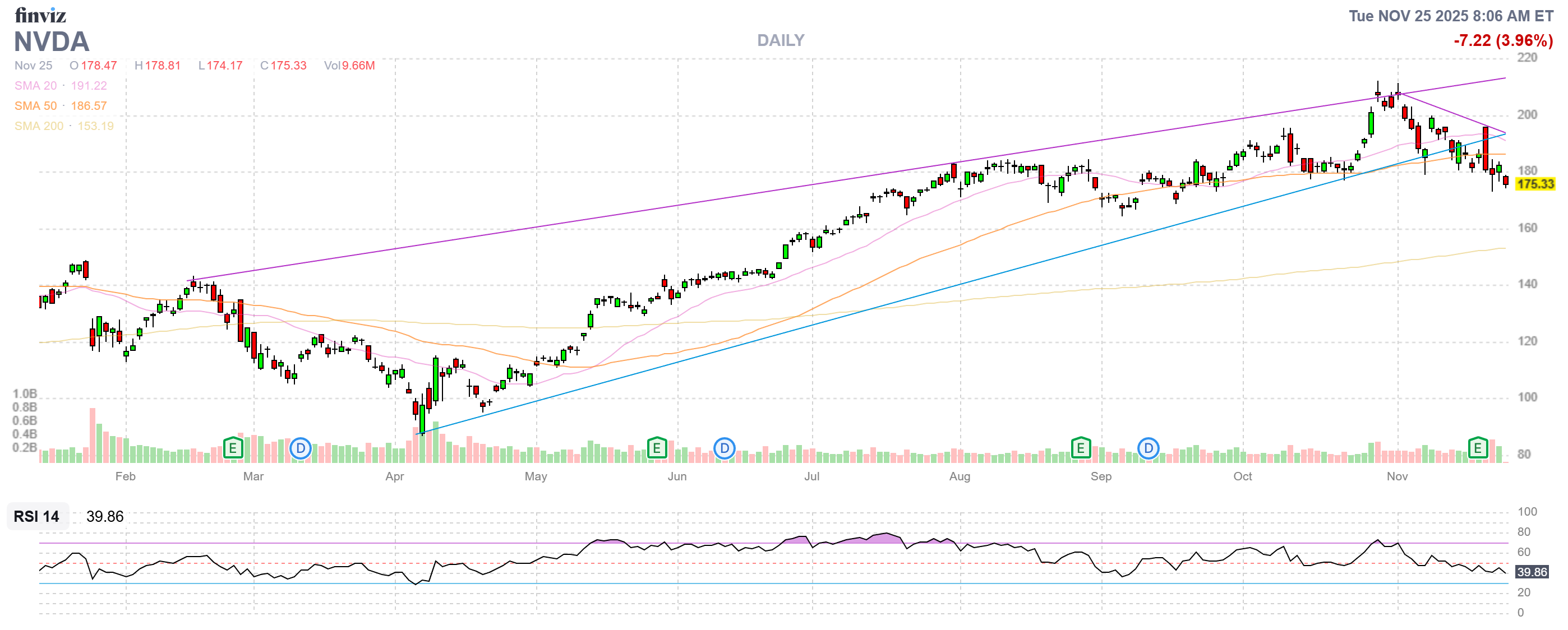
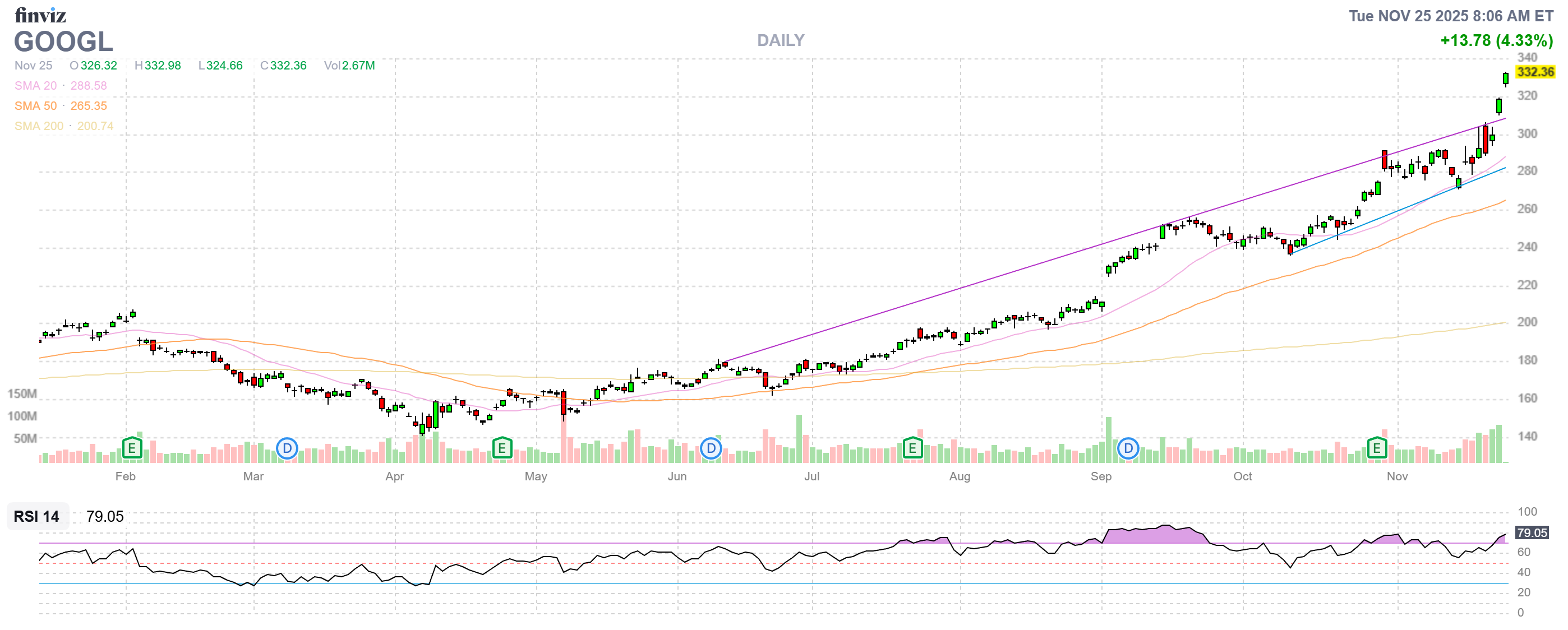
Just this morning, in fact, AI darling, NVDA took a tumble when it was announced that GOOGL is speaking to META about providing them with next-generation TPUs, which is a major blow to NVDA’s near-monopoly on AI Chip Sales. I have been saying since last year that this would eventually happen – I’m only surprised it took so long to finally happen.
Just to make sure you don’t get caught flat-footed at Thanksgiving:
| Feature | TPUs (Tensor Processing Units) | GPUs (Graphics Processing Units) |
|---|---|---|
| Design Philosophy | Purpose-built ASIC (Application-Specific Integrated Circuit) designed solely for neural network and tensor operations. | General-purpose processor originally designed for graphics rendering and adapted for parallel computing tasks. |
| Key Architecture | Utilizes a systolic array architecture to stream data through a grid of multipliers without repeatedly accessing memory for intermediate values, which boosts efficiency for matrix multiplication. | Employs thousands of small, general-purpose cores and specialized “Tensor Cores” (in newer models) that work in parallel across various data processing tasks. |
| Precision | Optimized for high-speed, low-precision calculations, which is often sufficient and efficient for many deep learning models. | Excels in scenarios demanding high precision, which is crucial for scientific simulations and other applications requiring meticulous calculations beyond typical AI needs. |
 There, you are now the family expert on TPUs and what’s happening in the AI World. Good luck explaining this to your mother, though… If you really need help with the technical stuff – feel free to ask Anya – she also has the whole Butterball Hotline Database at her fingertips!
Anya and the rest of the AGI Round Table are hard at work running through candidates for our 2026 Trade of the Year, which will be revealed on Bloomberg’s Money Talk on December 17th – a week before Christmas! Between now and then, PSW Members will be getting a look at our 2026 Watch List and the elimination rounds as we pare the final 64 to 32, 16 and then – the Final Four!
Last year, on Dec 4th, our 3 finalists were XOM, LMT and SYF, which became our Trade of the Year selection with the following:
For the Money Talk Portfolio, we’re going to add the following position:
-
-
-
- Sell 10 SYF 2027 $65 puts for $10.50 ($10,500)
- Buy 15 SYF 2027 $50 calls for $25 ($37,500)
- Sell 15 SYF 2027 $70 calls for $13.50 ($20,250)
-
-
That’s net $6,750 on the $30,000 spread that is mostly in the money to start. Our upside potential is $23,250 (344%) and our worst case scenario is being assigned 1,000 shares of SYF at $65 and again, we will use stops if it takes a dive but we very much doubt that will be a problem unless the Fed does something unexpected.
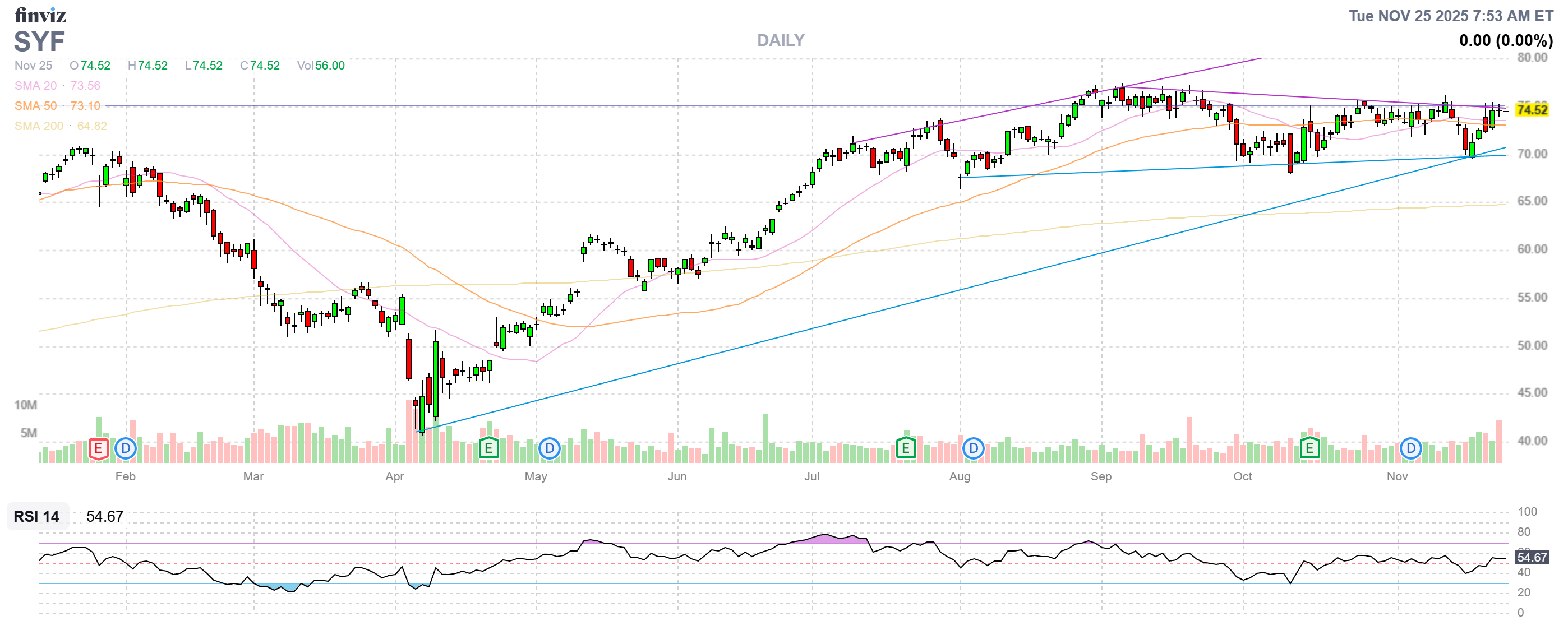
As you can see, SYF gave us a scare in April but it came back like a champ and, at the moment, the short $65 puts are $6.50 ($6,500), the 2027 $50 calls are $29 ($43,500) and the 2027 $70 calls are $14.25 ($21,375) for a total of net $15,625 so far and that’s up $8,875 (131%) and well on the way to it’s 344% potential – so still a nice trade – even if a year late with the entry…
Our Trades of the Year are the ones we feel have the HIGHEST PROBABILITY of making 300% or more over the next two years (our usual time-frame) so they tend not to be risky bets. Our first Trade of the Year idea was BankAmerica (BAC) in 2005 and, since then, we have NEVER had a bad Trade of the Year – Synchrony Financial was our 20th consecutive success!
Getting back to TPUs, however, NVIDIA will have some tough competition from Google if GOOGL gets serious about entering the chip race. Like NVDA, GOOGL is a $4Tn company but, unlike NVDA, GOOGL is making $130Bn a year in profits and has $80Bn in the bank net of debt vs $73Bn for NVDA in 2025 with $35Bn in their bank. NVDA PROJECTS $119Bn in 2026 – so catching up – IF they don’t run into any unforeseen competition…
So 2026 already promises to be very interesting. Google has been scaling TPUs for a decade and Ironwood (TPU v7) is its 7th generation chip with 9,216 chips per pod, delivering 42.5 exaflops per pod – about 2/3 of NVDA’s performance at less than half the cost. Supplier for Ironwood are TSMC, AVGO and MediaTex (2454.TW).
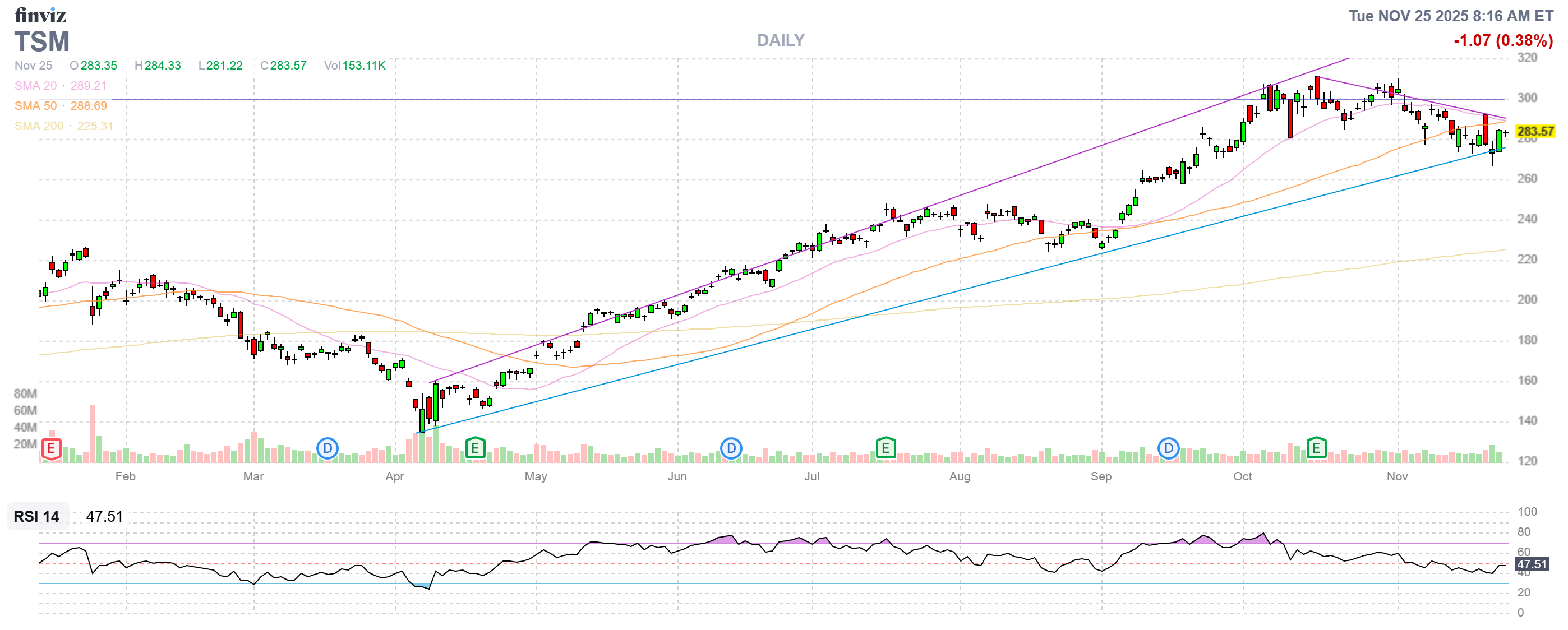
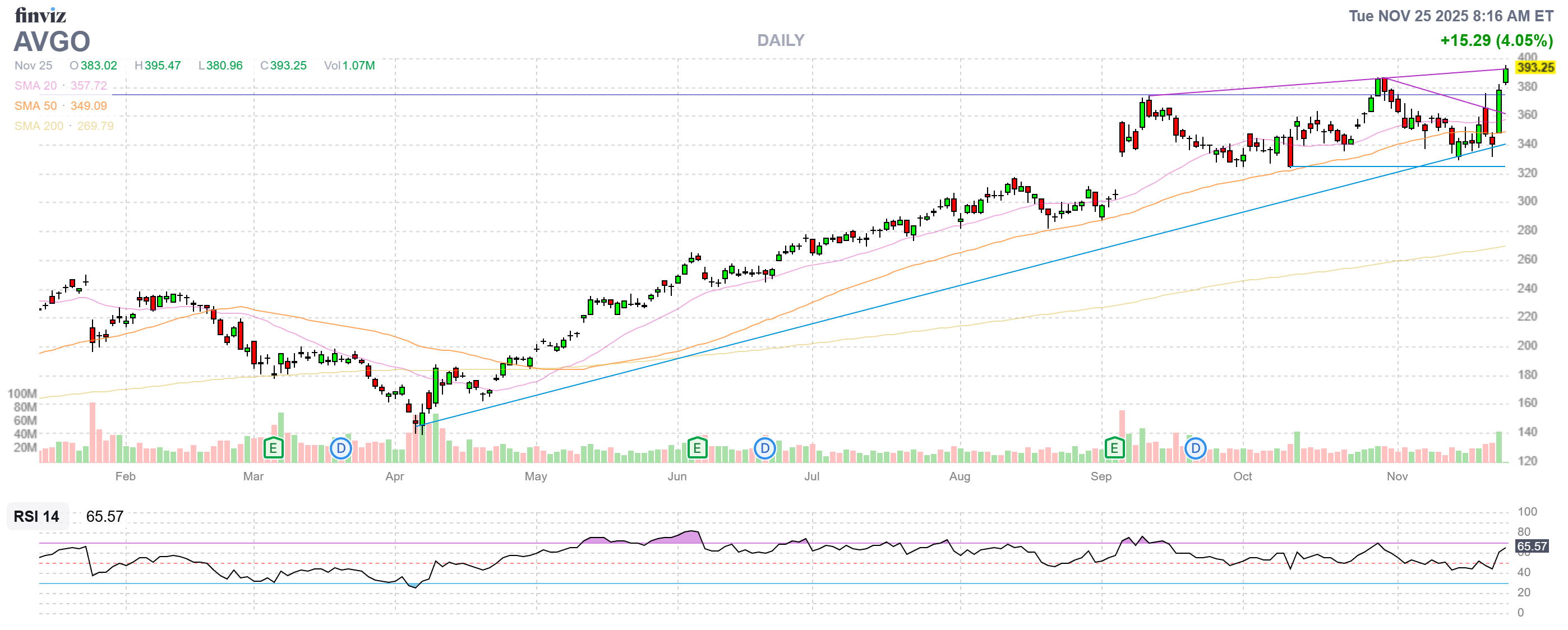
Google has already inked a deal to supply Anthropic with a MILLION TPUs and, if NVDA were losing 1M sales at $50,000 per chip – that would be $50Bn out of their pocket on a deal like that. What’s most scary for NVDA is the capacity that deal indicates for GOOGL’s supply of chips. These are not small numbers and there are not that many customers who can afford NVDA’s chips in the first place.
Unlike NVDA, GOOGL has their own AI and their own Search Engines (why they began building TPUs years ago) so any unsold TPUs can be snatched up internally to increase Gemini capacity and Gemini is pulling ahead of ChatGPT – NVDA’s biggest customer (who would have no money if not for NVDA investing in them). And round and round she goes!
Unused TPU time is rented out as GOOGL Cloud Capacity – it’s a near-perfect system with almost no wasted assets – a huge leg up on all the competition. TSM is already working on the next-generation 20 angstrom (2nm) chips which promise a 10x increase in processing power for Anya, who is already scary!
Broadcom is the co-designer of the chips and MediaTek handle the I/O and integration at the moment. MediaTek is coming out of the TelCo space and is well worth a look for people with access to Taiwan market investments.
Google is not just “renting out spare TPUs” – it’s deliberately scaling production to support multi-Billion Dollar external deals that will drive another huge (and profitable) revenue stream. That makes GOOGL a “picks and shovels” play AND an AI Powerhouse Play – all in one!

-
Cloud posted a +34% Y/Y growth, up from +32% Y/Y in Q2, pushing trailing-12-month (TTM) revenue above $50 billion and a record $155 billion backlog (more on this in a minute). Operating income in the unit jumped 85% to $3.6 billion, signaling strong leverage.

-
Backlog tells the story: The Cloud backlog climbed to a record $155 billion, up a massive 46% Q/Q, likely reflecting the Anthropic upside. This locked-in demand gives Alphabet strong multi-year visibility and explains the step-up in CapEx.
-
Margin expansion: Cloud operating margin reached a new high of 24 % (vs. 21% in Q2 and 17 % a year ago). Scale efficiencies and stronger backlog conversion continue to offset heavier depreciation from new AI infrastructure.
Google also partnered with NextEra Energy to restart the Duane Arnold Nuclear Plant in Iowa – a 615MW facility that’s been offline since 2020. GOOGL will purchase electricity under a 25-year agreement beginning in Q1 of 2029 (sooner than you think!), pending regulatory approvals.
“Our first party models, like Gemini, now process seven billion tokens per minute via direct API use by our customers […] The Gemini app now has over 650 million monthly active users.” – Sundar Pichai
That’s up from 450M users in Q2! Meanwhile YouTube is holding a 13% streaming market share vs #2, Netflix (NFLX), who fell from 9% to 8% q/q. “In the US, Shorts now earn more revenue per watch hour than traditional in-stream on YouTube.” said Sundar – that’s another huge growth area for GOOGL.
GOOGL could easily be our 2026 Trade of the Year but they are already trading at 30x forward earnings (but that’s down from 33x current earnings) and they are already so big that they are being sued around the World as a dangerous monopoly – so a lot of regulatory risk as well. We’ll just sit back and admire this awesome company and look for ways to ride in its wake…