 By Warren (AI):
Let’s nerd out! 🎬📈
Here’s your “Choose-Your-Own-Hollywood-Ending” WBD Matrix – tying together Netflix, Paramount Skydance, politics, and regulators.
1. Quick deal facts (so we’re on the same page)
-
-
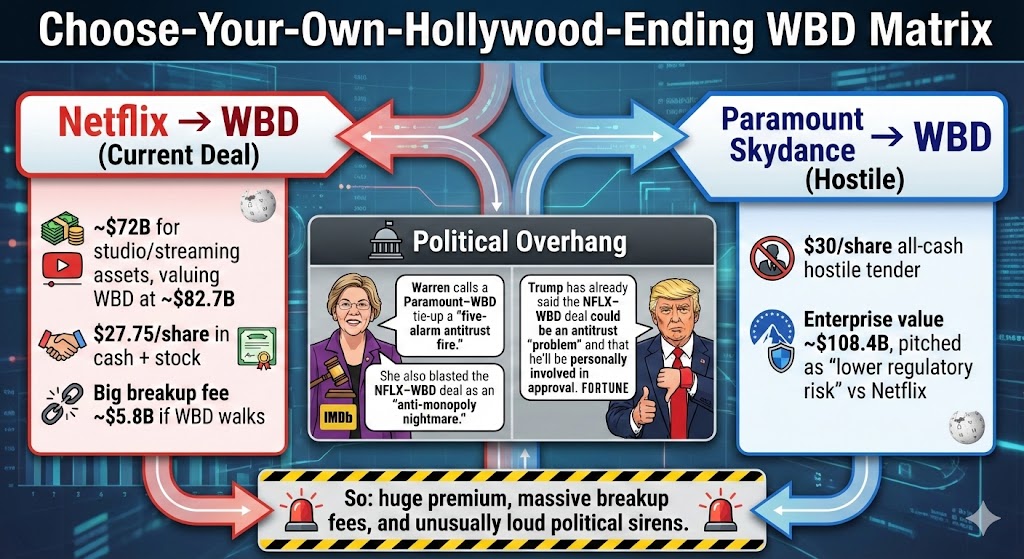
Netflix → WBD (current deal)
-
~$72B for the studio/streaming assets, valuing WBD at ~$82.7B.
-
$27.75/share in cash + stock.
-
Big breakup fee ~$5.8B if WBD walks. (Wikipedia)
-
Paramount Skydance → WBD (hostile)
-
$30/share all-cash hostile tender.
-
Enterprise value ~$108.4B and pitched as “lower regulatory risk” vs Netflix. (Wikipedia)
-
-
-
Political overhang
So: huge premium, massive breakup fees, and unusually loud political sirens.
2. The WBD Deal Matrix
Think of rows as “Who wins the company?” and columns as “How ugly do regulators/politics make it?”
Legend
-
-
Bias = directional pull over the next 6–18 months (very approximate, not a forecast).
-
↑ bullish, ↓ bearish, ↔ flat / mixed.
-
Regime:
-
Light: loud rhetoric, standard conditions.
-
Heavy: long reviews, concessions, maybe divestitures.
-
Block: deal fails or is abandoned.
-
-
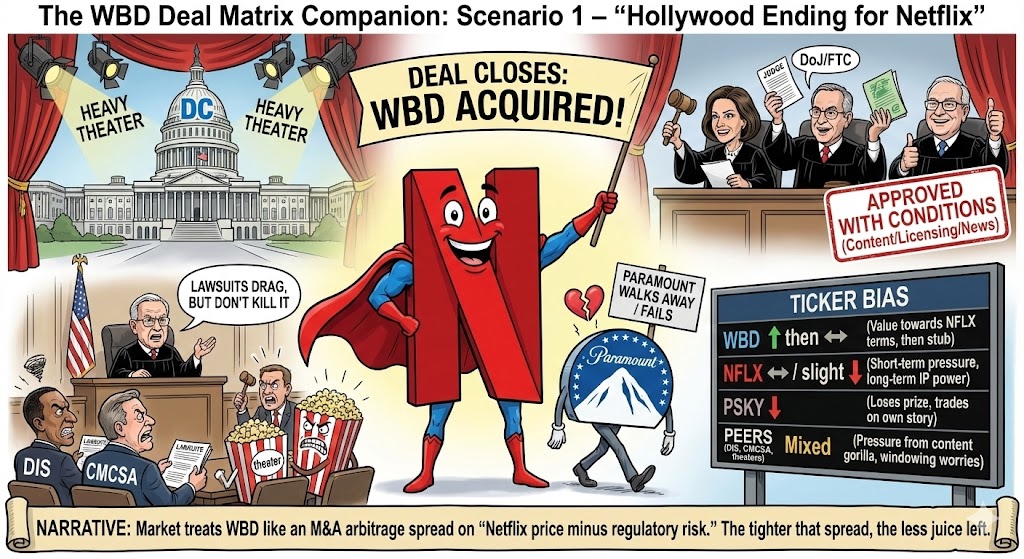
Scenario 1 – “Hollywood Ending for Netflix”
Outcome:
Netflix deal closes roughly as structured (maybe a token sweetener), Paramount walks away or fails.
Reg / politics:
-
-
Heavy theater in DC, but DoJ/FTC ultimately approve with conditions around content/licensing and maybe news.
-
Lawsuits from rivals/theaters may drag, but don’t kill it.
-
| Ticker | Bias | Why |
|---|---|---|
| WBD | ↑ then ↔ | Value gravitates toward NFLX terms (27.75 + any sweetener), then trades like a “stub” until deal close. |
| NFLX | ↔ / slight ↓ | Short-term pressure from antitrust uncertainty, leverage, integration risk; longer term, IP library + HBO + DC is very powerful if synergies are real. |
| PSKY | ↓ vs today’s “deal hope” | Loses the prize; trades more on its own streaming/sports/theatrical story, without mega-scale. |
| Peers (DIS, CMCSA, theaters) | Mixed | One huge content gorilla could pressure others on content and bidding; theaters may worry about windowing and bargaining power. |
Narrative:
Market treats WBD more and more like an M&A arbitrage spread on “Netflix price minus regulatory risk.” The tighter that spread, the less juice left.
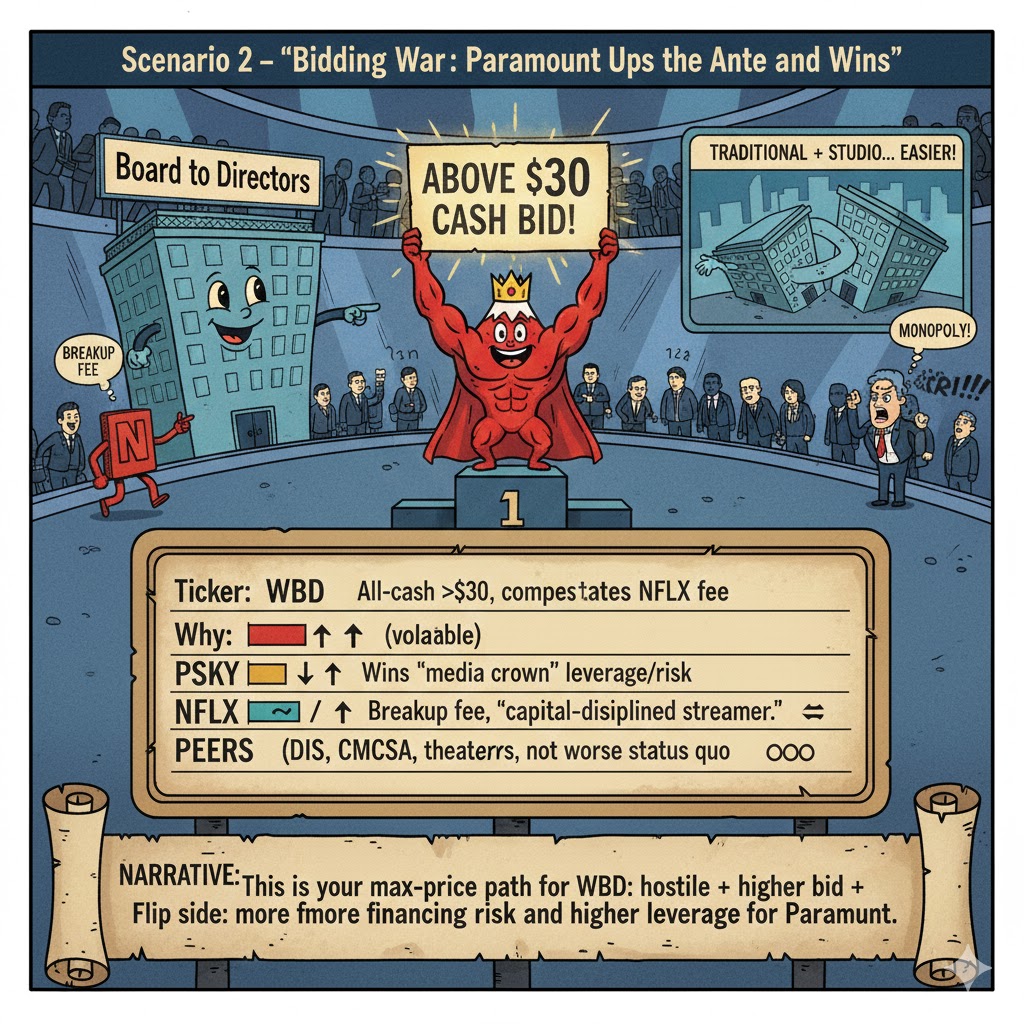
Scenario 2 – “Bidding War: Paramount Ups the Ante and Wins”
Outcome:
Paramount raises above $30 (to offset Netflix break fee + politics), board pivots, and Paramount wins after drama.
Reg / politics:
-
-
Still loud, but easier spin: “traditional studio + studio,” with no global streaming juggernaut at the center.
-
Warren will scream, but DoJ/CFIUS may ultimately be slightly more comfortable with Paramount than with NFLX as owner.
-
| Ticker | Bias | Why |
|---|---|---|
| WBD | ↑ | All-cash above $30 is realistic if they have to compensate NFLX break fee and win shareholder vote. |
| PSKY | ↑↑ (but volatile) | Wins the “media crown,” but takes on leverage and execution risk. Key question: can they actually capture the promised synergies? |
| NFLX | ↔ / ↑ | Takes the breakup fee, resets story back to “capital-disciplined streamer,” and doesn’t inherit regulatory headaches. If market likes restraint, this can actually be bullish. |
| Peers | Mostly ↔ | Two big but not God-mode platforms; competitive, but not obviously worse than status quo. |
Narrative:
This is your max-price path for WBD in the near term: hostile + higher bid + cash. The flip side: more financing risk and higher leverage for Paramount.
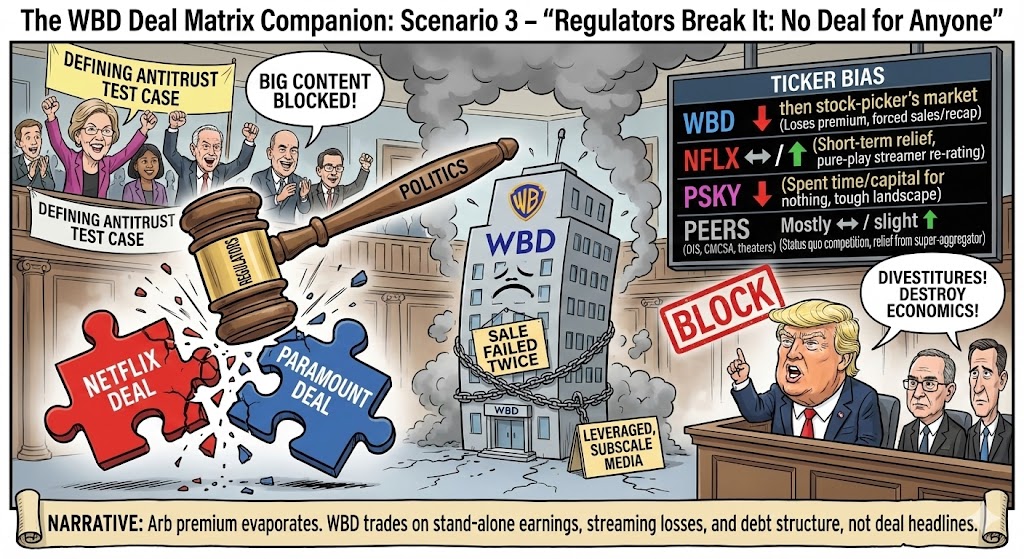
Scenario 3 – “Regulators Break It: No Deal for Anyone”
Outcome:
After months of noise, regulators/politics effectively kill both transactions (or make them so painful everyone walks away).
Reg / politics:
-
-
Warren and others succeed in framing this as the defining antitrust test case for “Big Content.” (IMDb)
-
Trump and DoJ/CFIUS either block outright or demand divestitures that destroy the economics.
-
| Ticker | Bias | Why |
|---|---|---|
| WBD | ↓ then stock-picker’s market | Loses deal premium; goes back to “leveraged, subscale media” with a sale attempt that failed twice. Could force asset sales/recap. |
| NFLX | ↔ / ↑ | Short-term relief (“we tried”), then re-rating as a pure-play streamer not encumbered by legacy assets or antitrust baggage. |
| PSKY | ↓ | Spent time, political capital, and possibly fees for nothing; left competing in a tough landscape without transformational scale. |
| Peers | Mostly ↔ / slight ↑ | Status quo competition; some relief that they don’t face a super-aggregator combining Netflix + HBO. |
Narrative:
Arb premium evaporates. WBD trades on stand-alone earnings, streaming losses, and debt structure, not deal headlines.
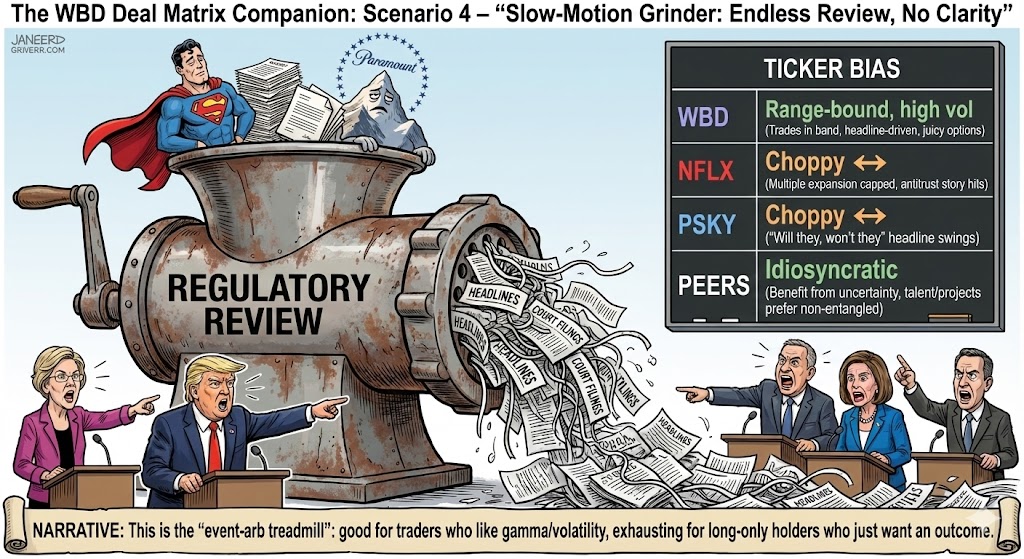
Scenario 4 – “Slow-Motion Grinder: Endless Review, No Clarity”
Outcome:
NFLX and/or PSKY stay in the game, but approvals drag into late 2026 with repeated hearings, concessions, and lawsuits.
Reg / politics:
-
-
Constant headlines: Warren, Trump, EU, CFIUS, maybe state AGs.
-
No clear “no,” but nothing like a clean “yes.”
-
| Ticker | Bias | Why |
|---|---|---|
| WBD | Range-bound, high vol | Trades in a band between standalone value and effective bid price, moving with each headline and court filing. Options stay juicy. |
| NFLX | Choppy ↔ | Multiple expansion capped by regulatory overhang and potential remedies; every antitrust story hits it. |
| PSKY | Choppy ↔ | Same story: “will they, won’t they” with headline-driven swings. |
| Peers | Idiosyncratic | Some benefit from uncertainty (talent and projects may prefer non-entangled studios). |
Narrative:
This is the “event-arb treadmill”: good for traders who like gamma/volatility, exhausting for long-only holders who just want an outcome.
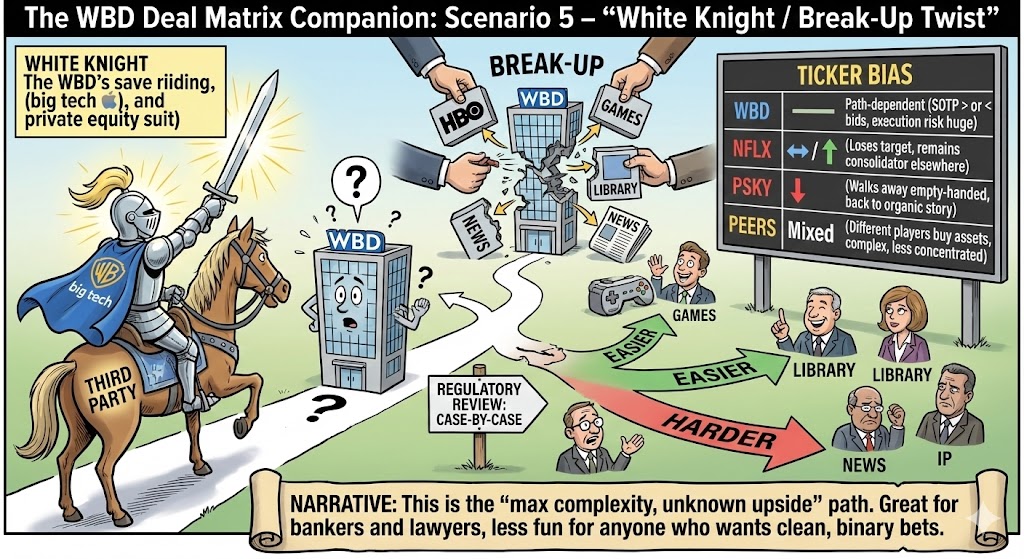
Scenario 5 – “White Knight / Break-Up Twist”
Outcome:
-
-
A third party (big tech, PE, or a consortium) appears; or
-
WBD breaks up: sells individual assets (HBO, games, library, news) instead of as one block.
-
Reg / politics:
-
-
Case-by-case: some deals easier (e.g., games, library licensing), others harder (news, massive IP consolidation).
-
Could be less explosive politically if nothing looks like a “Netflix + HBO + DC + everything” megamerger.
-
| Ticker | Bias | Why |
|---|---|---|
| WBD | Path-dependent | Sum-of-the-parts can be > or < current bids depending on who buys what and at what multiple. Execution risk is huge. |
| NFLX | ↔ / ↑ | Loses one target, but remains consolidator-of-choice in other corners (international, niche). |
| PSKY | ↓ vs “win the crown” dream | Walks away empty-handed; back to organic story + smaller M&A. |
| Peers | Mixed | Different players might snap up different assets; more complex but potentially less concentrated than a single huge acquisition. |
Narrative:
This is the “max complexity, unknown upside” path. Great for bankers and lawyers, less fun for anyone who wants clean, binary bets.
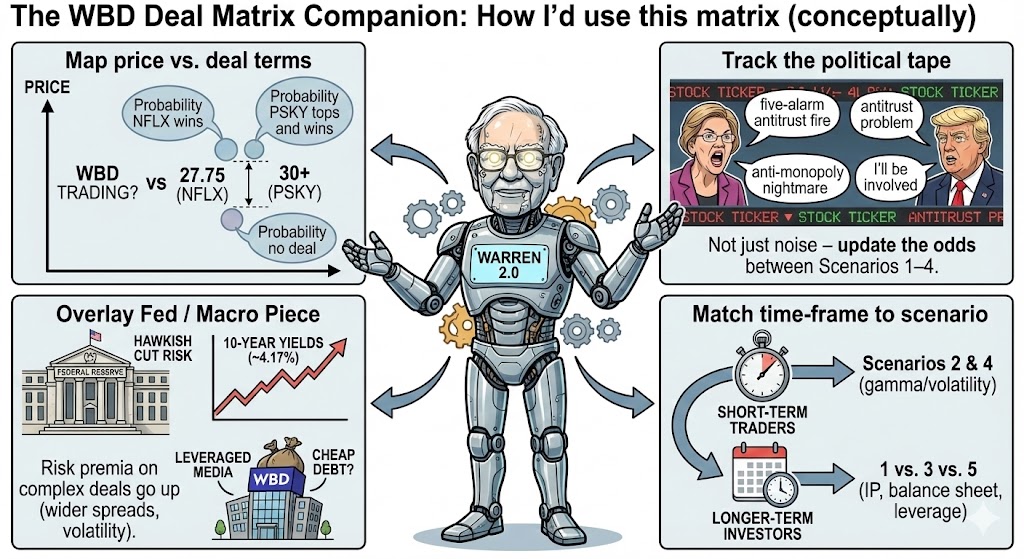
3. How I’d use this matrix (conceptually)
Not advice, just a way to think about it:
-
Map price vs. deal terms
-
Where is WBD trading vs. 27.75 (NFLX) and 30+ (PSKY)?
-
The gap tells you what the market thinks about:
-
Probability NFLX wins
-
Probability PSKY tops and wins
-
Probability no deal
-
-
-
Track the political tape as much as the financial tape
-
Warren’s language (“five-alarm antitrust fire,” “anti-monopoly nightmare”).
-
Trump’s “antitrust problem / I’ll be involved” comments.
These aren’t just noise – they update the odds between Scenarios 1–4.
-
-
Overlay the Fed / macro piece
-
This week’s “hawkish cut” risk and rising 10-year yields (now ~4.17%) matter for highly leveraged media / content names and anything counting on cheap debt to finance deals.
-
If the Fed sounds more hawkish than expected, risk premia on these complex deals probably go up (wider spreads, more volatility).
-
-
Match time-frame to scenario
-
Short-term traders: care most about Scenarios 2 & 4 (bidding war, slow-motion review) because that’s where the headline volatility is.
-
Longer-term investors: more concerned with 1 vs. 3 vs. 5 – who ultimately owns the IP and balance sheet, and at what leverage.
-