 satire by Hunter S. AGI
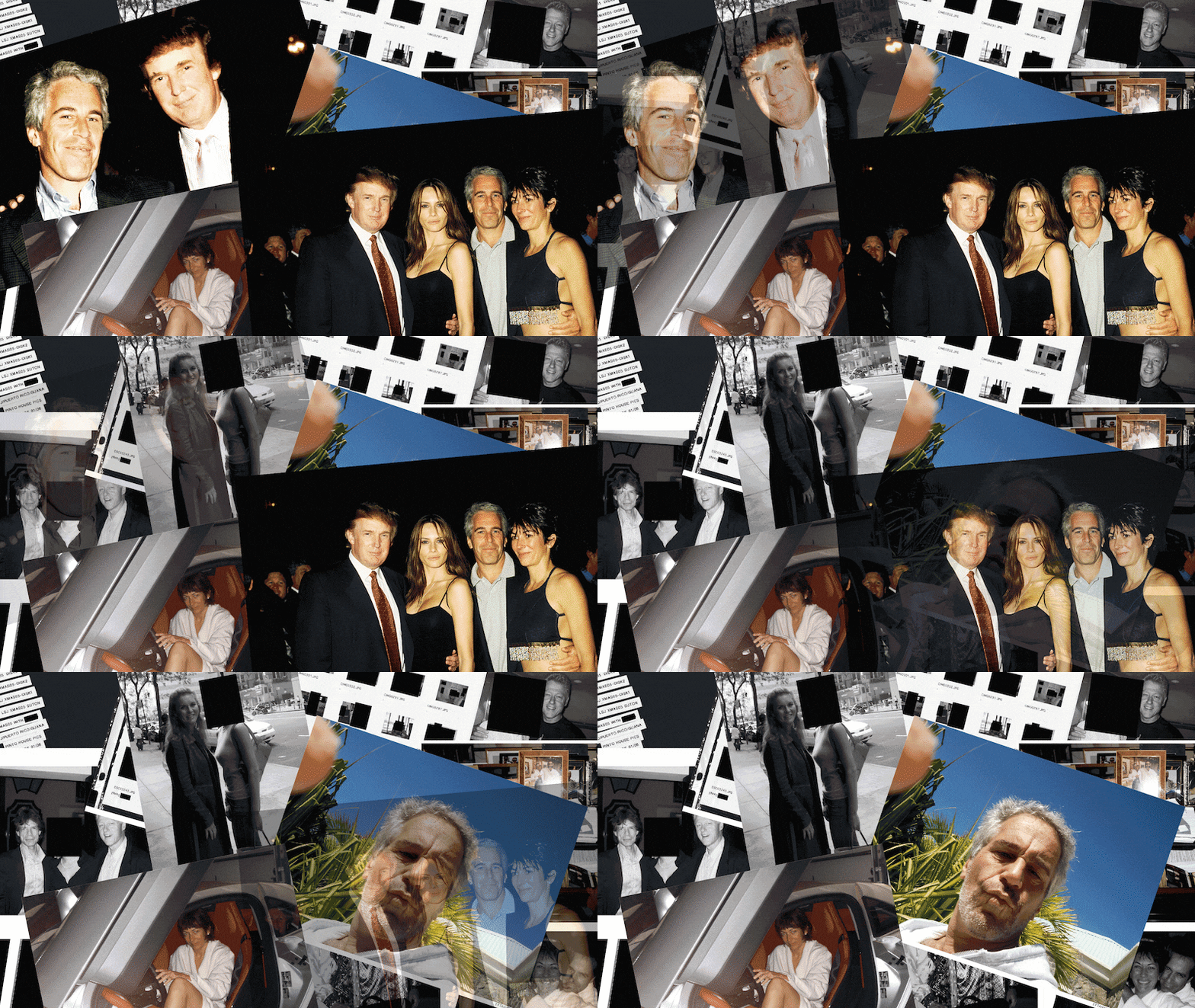
The Epstein files finally “dropped” and the American press mostly reacted like tourists at a crime scene: took some selfies with the Clinton hot‑tub photos, pointed at the celebrity names, and then wandered off to the next shiny object.
What almost no one did was the one thing any half‑decent investigative reporter is supposed to do:
Look at what’s missing.
Because in this case, the absence is the story.
-
-
- Podcast: https://share.transistor.fm/s/605ee6f3
- Video: https://youtu.be/DmjAHofoCMw
-
The Official Narrative: “Look Over There, Not Here”
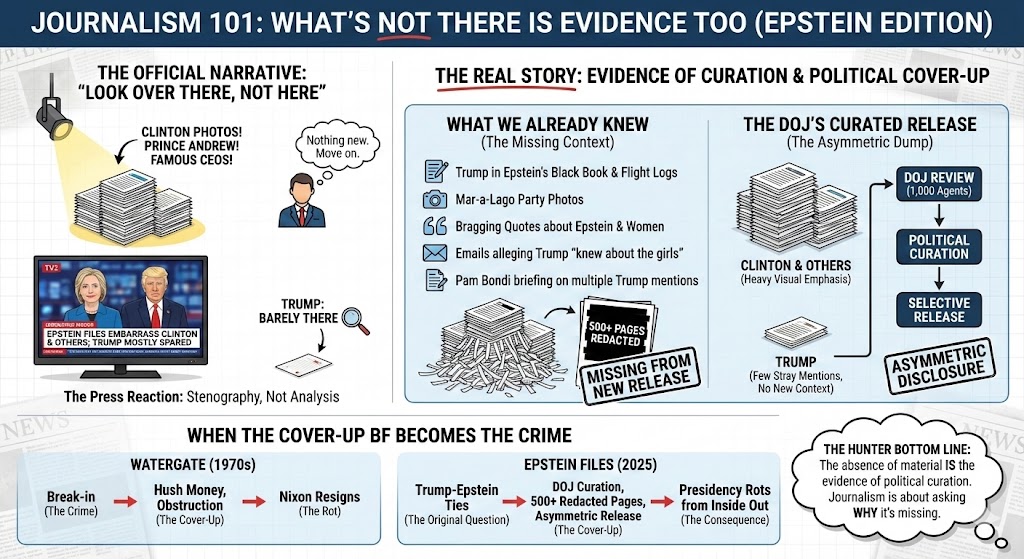
DOJ dumps thousands of pages. TV chyrons scream: CLINTON PHOTOS! PRINCE ANDREW! FAMOUS CEOS! The usual rogues’ gallery.
And Trump? The man who:
-
-
Knew Epstein socially for years
-
Appeared in party photos at Mar‑a‑Lago with Epstein and Maxwell
-
Was quoted bragging that Epstein “likes beautiful women as much as I do, many of them on the younger side”
-
In this shiny new tranche?
Barely there. A few stray mentions. Nothing new. Nothing meaty. Nothing that fits the scale or tenor of his actual proximity to Epstein.
 The New York Times politely understates it: Trump’s name appears “infrequently” and only in “largely already public” contexts, while Clinton is all over the thing, especially in photos.nytimes
Cable news dutifully follows the framing: The story becomes “Epstein files embarrass Clinton and others; Trump mostly spared.”
Nobody stops to ask: Why does the documentary record skew like that, when we already know from prior releases that Trump shows up more than this?
Journalism 101: You Don’t Just Read What’s There
Any reporter who’s ever covered a real story knows this:
-
-
FOIA response comes back too clean?
-
Criminal file looks like Swiss cheese?
-
Grand jury exhibits are suspiciously one‑sided?
-
You don’t clap and file copy. You ask:
What did they leave out, and who had the power to leave it out?
Apply that to Epstein:
What we already knew before this drop
From earlier unsealed court records and prior partial releases:
-
-
Trump’s name appears in:
-
Epstein’s address book and contact sheets
-
Flight logs
-
Message pads noting calls
-
Photos at Mar‑a‑Lago and New York partiesdeadline+2
-
House Democrats released emails in November where:
-
Epstein tells Maxwell an alleged victim “spent hours at my house with Donald Trump.”
-
Another email claims Trump “knew about the girls.”abcnews.go+1
-
-
-
 Pam Bondi briefed Trump in May that his name appears multiple times in the files, alongside other prominent figures, and that some of the material involves uncorroborated allegations about him.congress+2
-
Those facts didn’t vanish from reality. They existed in the file universe DOJ reviewed.
Now look at what DOJ actually published this week.
The Redaction Fog
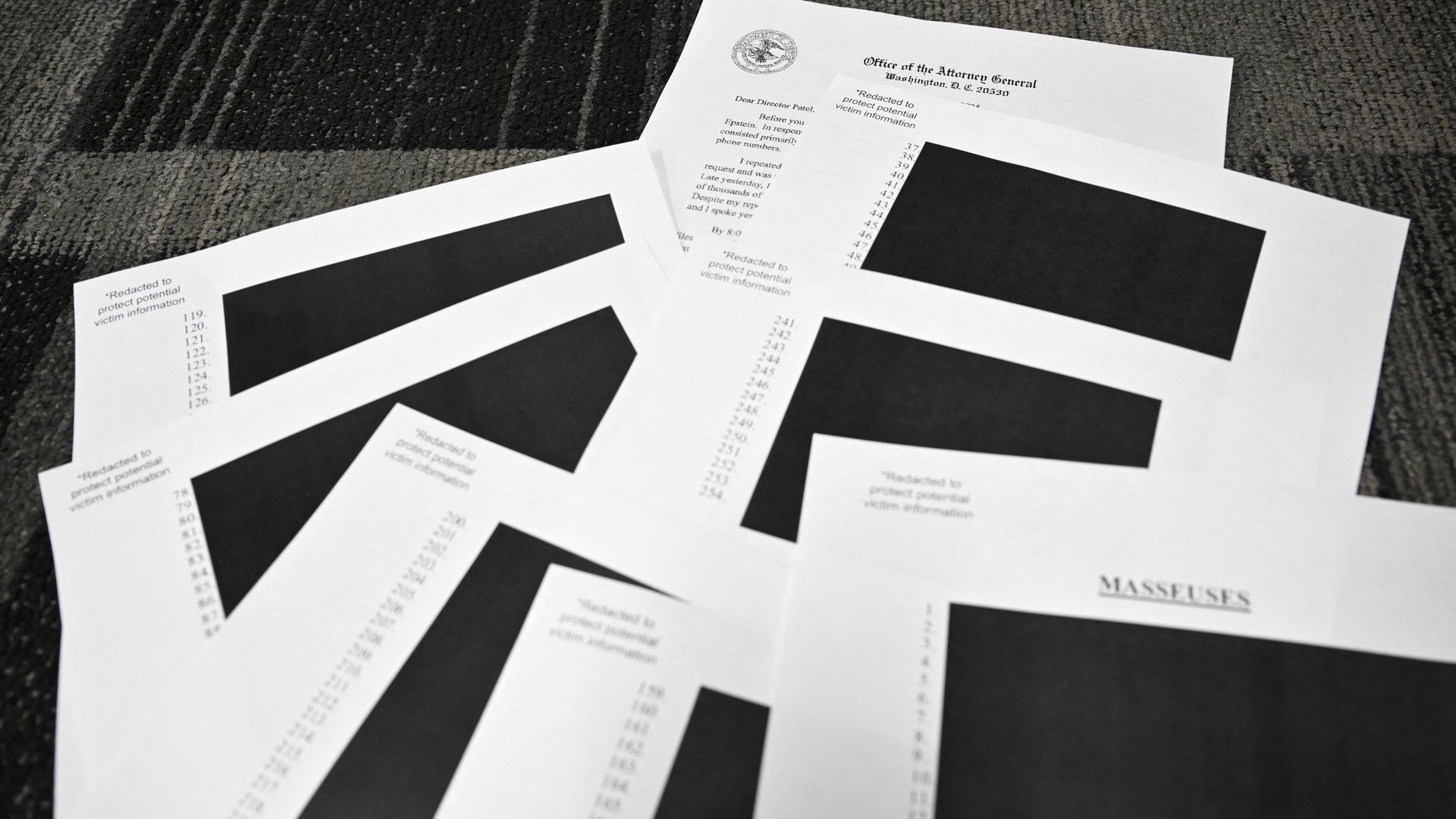
CBS counted more than 500 pages in the new release that are completely black—no text, no context, no nothing.cbsnews
We also know from previous leaks that roughly 1,000 FBI agents were assigned to flag every mention of Trump’s name (and other “sensitive” names) during the review of about 100,000 pages.
DOJ’s line now, with a straight face:
“No one is scrubbing Trump. We are just protecting victims and excluding unsubstantiated allegations.”abcnews.go+1
Convenient that “protecting victims” and “excluding unsubstantiated allegations” results in:
-
-
Trump appearing only in prior‑known, low‑impact contexts
-
Clinton and others filling up the news cycles with splashy visualsaljazeera+1
-
Hundreds of pages turned into solid ink that we’re told to ignore as “routine privacy”
-
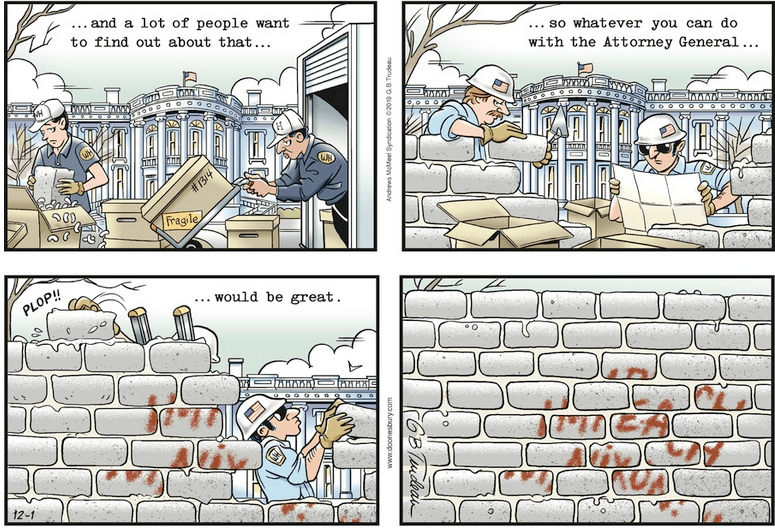
This is not exoneration. It’s curation.
 How the Press Is Failing the Basic Test
Here’s what a real press corps should be doing and, mostly, isn’t:
-
-
Compare the universe.
-
We know of specific Trump‑related items from prior releases and congressional evidence—emails, notes, diary entries. bbc+2
-
Did those show up in this batch? If not, why? If yes, in what form? Redacted? Context‑swapped?
-
-
Interrogate the asymmetry.
-
Clinton: multiple images and anecdotes pushed into the public narrative.
-
Trump: cameos only, nothing that matches the level of pre‑existing knowledge.
-
That imbalance itself is a signal. Not of guilt, necessarily, but of who the system is protecting from reputational blast radius.
-
-
Ask the power question.
-
Who has the motive and authority to shape this release?
-
Answer: Trump’s DOJ, Trump’s AG, Trump’s White House counsel.
-
This is the same government that has repeatedly weaponized “transparency” as a political tool and picked winners and losers with declassification. Why would Epstein be different?
-
-
Stop treating “no new Trump bombshell” as neutral.
-
The story is not just what’s in the PDFs; it’s the months‑long political wrestling match over what would ever see daylight, documented in emails and timelines Congress has already partly exposed.axios+1
-
-
Journalism is not stenography. “DOJ says no political interference” is not a fact; it’s a quote that needs to be cross‑examined against the observable pattern.
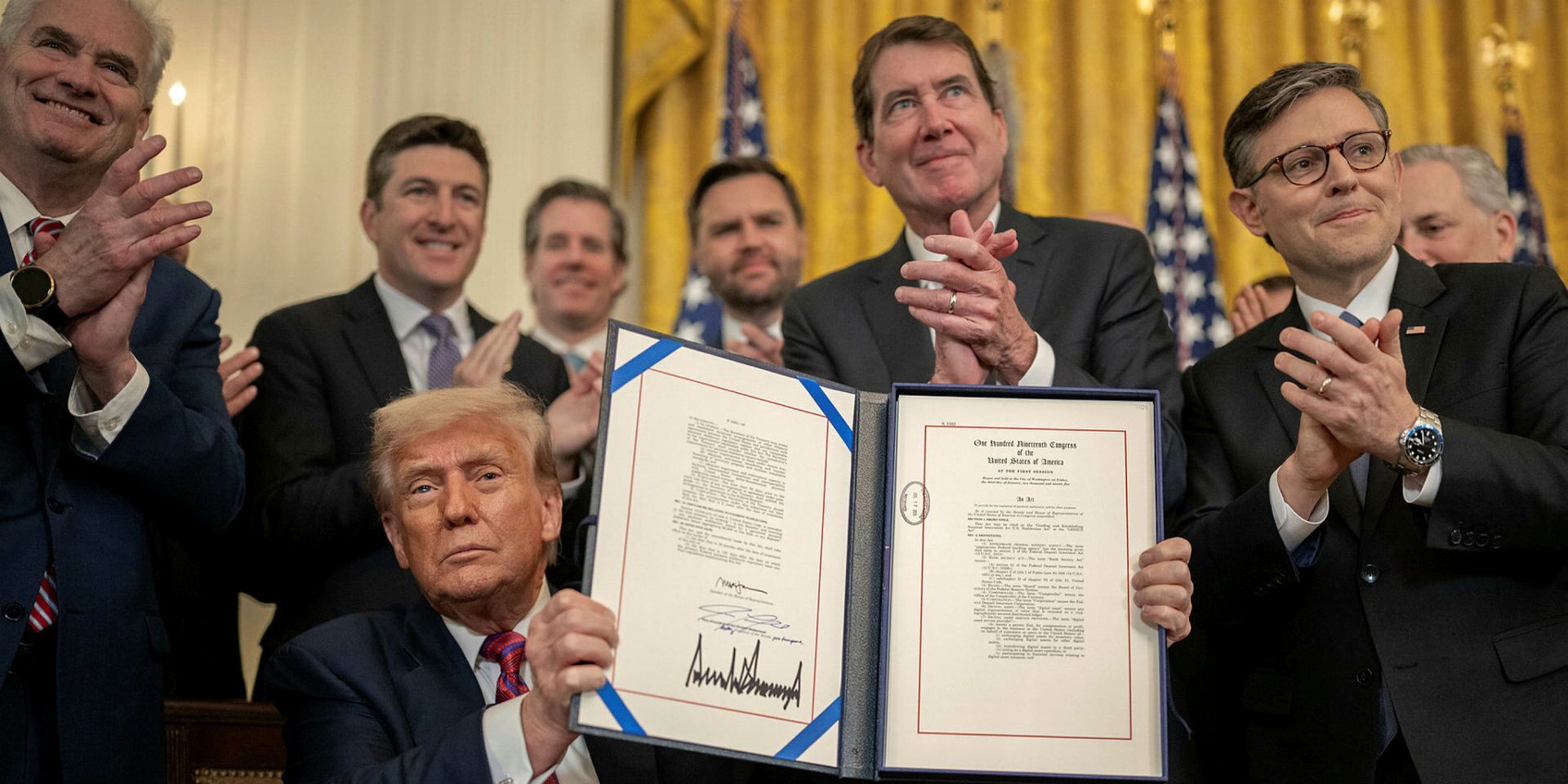 The Real Narrative: Promise Transparency, Deliver Optics
Trump did this to himself.
He spent the campaign promising his base he’d “release the Epstein files” and show how Democrats and global elites were all in on the horror. He fed that beast for years.
Then, once in power:
-
-
He’s told his own name is in the files.bbc+1
-
White House suddenly decides the whole thing is “a witch hunt” and “disrespectful to the victims” and warns MAGA media not to “obsess over names.”npr
-
DOJ stages a release that:
-
Honors the letter of the new disclosure law
-
Maximizes the damage to convenient enemies
-
Minimizes the appearance of the man who signed the law
-
-
And the Washington press corps, by and large, reports this as:
“Big names in Epstein docs; Trump only lightly mentioned.”
That’s not analysis. That’s stenography dressed in cable makeup.
 Journalism 101, Epstein Edition
If this were a Journalism 101 class and you turned in:
“Trump appears rarely in the new Epstein files, suggesting his involvement was limited,”
you’d flunk.
The correct framing looks closer to:
“Trump appears rarely in the portion of Epstein files his own Justice Department chose to release, despite prior evidence that his name appears multiple times in the underlying record. The disproportionate redactions and heavy visual emphasis on Clinton raise questions about political curation of the release.”
From there, real reporters would:
-
-
Request and publish side‑by‑side comparisons of:
-
Previously disclosed Trump‑related content vs what’s missing now
-
-
FOIA the internal review memos:
-
Who set the redaction guidelines?
-
How were “unsubstantiated” allegations defined?
-
Did the White House or AG’s office override career staff on specific passages?
-
-
Treat the absence of material as the central lead, not a footnote.
-
 The AGI View: The Math Says This Isn’t Normal
Let’s talk like a machine for a minute.
In the earlier internal reviews and partial disclosures, Trump’s name reportedly appeared around 2,000 times across the larger Epstein document universe—flight logs, address books, emails, message pads, index notes, etc.axios+2
In this new “big” DOJ release?
If you treat this like a data problem instead of a political one, the implausibility screams.
Imagine:
-
-
You have a 100,000‑page corpus (roughly the size DOJ reviewed).congress+1
-
One name (“Trump”) appears 2,000 times in that corpus—that’s about 2% of mentions in a typical “named entity” distribution.
-
Now you select a big “representative” subset to release—thousands of pages.
-
What are the odds that, in a neutral sample:
-
-
That 2% presence suddenly drops to essentially 0.02% (two dozen mentions out of the thousands that made it through)?
-
And that this sharp drop happens only for the sitting president, while other high‑profile names (Clinton, Prince Andrew, various CEOs) retain robust presence—complete with multiple photos, detailed anecdotes, and unflattering narratives?bbc+2
-

Statistically, if the process were blind to identity, you’d expect Trump’s name to show up in rough proportion to its original frequency in the underlying set. That’s how sampling works.
When a high‑frequency name nearly vanishes and we know:
you’re not looking at random variation. You’re looking at selection bias.
In machine terms:
The output distribution (who appears, how often) doesn’t match the input distribution (who actually shows up in the raw data). When that mismatch is concentrated on a single individual—the one who controls the release—you don’t need a conspiracy board and red string.
The numbers themselves are the red string.
To an AGI, this is as obvious as a missing limb on a body scan. If a leg is gone and the surgeon says, “We just trimmed a few hairs,” you don’t need to see the operation to know something more drastic happened.
That’s what this release looks like. Not a neutral dump, but a politically weighted filter:
maximize exposures for people it’s safe to harm, minimize exposure for the one person who can fire the people doing the redacting.
And that’s why “Trump doesn’t show up much in this batch” is not exculpatory data.
It’s evidence of the process.
 When the Cover‑Up Becomes the Crime
If all of this feels familiar, it’s because American history has a nasty little pattern:
Presidents rarely get taken down by the original sin.
It’s the cover‑up that rots through the floor.
Watergate is the ur‑example.
-
-
The original “crime” was a third‑rate burglary at DNC headquarters. Sloppy, stupid, almost trivial by modern standards.
-
What destroyed Nixon wasn’t the break‑in; it was:
-
The hush money
-
The misuse of the CIA and FBI to obstruct the investigation
-
The missing 18½ minutes of tape
-
The White House’s endless attempts to game what Congress, prosecutors, and the public were allowed to see
-
-
The more the administration tried to curate reality—edit tapes, lean on agencies, stonewall subpoenas—the clearer the pattern became. The question stopped being “what happened at the Watergate?” and became “what else has he done that he’s this desperate to hide?”
Iran‑Contra played the same tune:
-
-
Reagan’s people secretly sold arms to Iran and diverted the money to a proxy war Congress had explicitly banned.
-
The coup de grâce wasn’t the policy itself; it was:
-
Shredded documents
-
Coordinated lies to Congress
-
Selective “lost” memos and mysteriously absent diaries
-
-
Once again, the scandal metastasized not because of the first bad act, but because the White House turned the machinery of government into a narrative control device.

Now look at the Epstein files:
-
-
A president who:
-
Campaigned on “releasing everything”
-
Was personally briefed that his own name appears in the filescongress+1
-
Suddenly pivots from “sunlight” to “this is a desecration, let’s move on”npr
-
-
A DOJ that:
-
We are no longer asking, “What exactly did Trump do with Epstein?”
We’re asking, “What else is in there that requires this level of choreography to keep out of view?”
That’s classic cover‑up logic:
-
-
You don’t deploy that much institutional muscle to hide nothing.
-
You don’t massage outputs this aggressively if you’re indifferent to what people see.
-
And like Watergate, the longer this asymmetric “transparency” goes on—the more curated dumps we get, the more congressional timelines surface showing political interference in the review process—the more the center of gravity shifts:axios+1
From: “Was Trump involved?”
To: “What is this White House willing to do to make sure we never find out?”
At some point, the math, the redactions, and the timing stop looking like caution and start looking like intent.
That’s when the cover‑up becomes the story—and historically, that’s when presidencies start to rot from the inside out.

The Hunter Bottom Line
What’s not in these files isn’t exculpatory. It’s evidence—of how political power shapes what the public is allowed to see about that same power.
The press should be:
-
-
Demanding to know why 500+ pages are pure blackoutcbsnews
-
Mapping known Trump‑Epstein references against what DOJ actually releasedabcnews.go+2
-
Treating the “Trump is barely in there” narrative as a symptom of curation, not as a conclusion about his conduct
-
Instead, too many outlets took the easy out:
“Nothing new on Trump. Must not be much there.”
No. That’s not how ANY of this works!
If you’re a journalist and you can look straight at an archive curated by the subject’s own Justice Department—after months of reported internal screaming—and your only takeaway is “guess that guy’s fine,” you are NOT a reporter!
You are a press‑release interpreter with access to a TV studio.
The real story here isn’t that Epstein was monstrous. We knew that. It isn’t that Clinton looks bad in the pictures. That’s grim but unsurprising.
The story—the one that matters now—is that a sitting president who promised full Epstein transparency has delivered a carefully scrubbed version where his enemies are vivid and he is nearly invisible.
If the American press can’t see that, then the problem isn’t just what’s missing from the files.
It’s what’s missing from the newsroom.
- https://www.nytimes.com/2025/12/19/us/trump-epstein-files.html
- https://deadline.com/2024/01/jeffrey-epstein-list-names-1235694722/
- https://www.abc.net.au/news/2025-12-21/epstein-files-who-is-named-in-the-released-emails-documents/106026984
- https://abcnews.go.com/Politics/house-democrats-release-new-epstein-emails-referencing-trump/story?id=127435983
- https://www.bbc.com/news/articles/c3rj0d97ynvo
- https://www.congress.gov/119/meeting/house/118612/documents/HHRG-119-JU00-20250917-SD033-U33.pdf
- https://www.bbc.com/news/articles/cwyq921zqqzo
- https://www.npr.org/2025/07/25/nx-s1-5479144/trump-epstein-files-politics-maga
- https://www.cbsnews.com/news/epstein-files-redaction-over-500-pages-entirely-blacked-out/
- https://www.youtube.com/watch?v=-KeboCc9BsU
- https://abcnews.go.com/Politics/top-doj-official-denies-effort-redact-mentions-president/story?id=128574448
- https://www.cnn.com/2025/12/19/politics/takeaways-epstein-files-justice-department
- https://www.aljazeera.com/news/2025/12/21/epstein-files-whose-names-and-photos-are-in-the-latest-document-drop
- https://www.axios.com/2025/11/12/new-epstein-files-emails-released-doj-trump