Terrific Tuesday – The Early Bird Gets the Weight Loss Pill (NOVO)

10
173

This is big!  

Finviz Chart

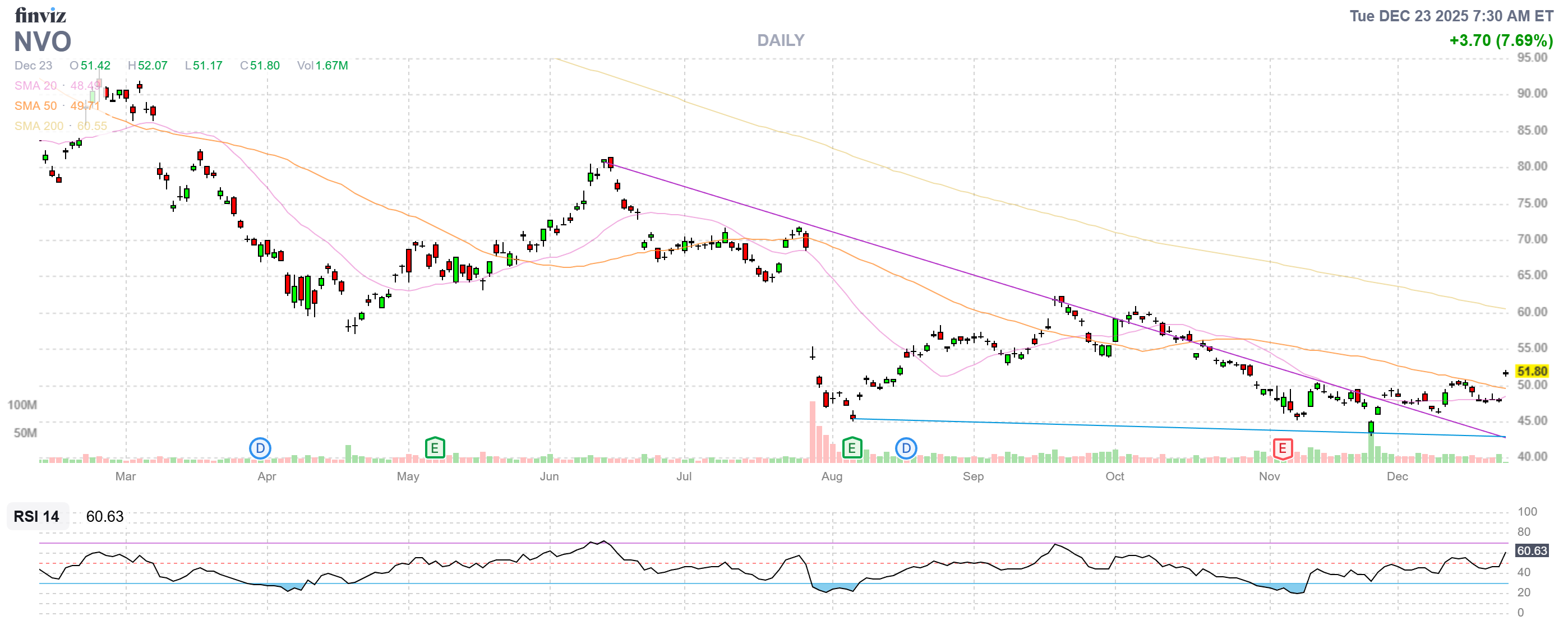
I don’t often (almost never) lead off with a focus on one stock but Novo Nordisk (NVO) just got an oral version of Wegovy (the original GLP-1) approved by the FDA THIS MORNING AND NVO is trading at a very low level (because they lost their advantage on the injectables this year) but the first-mover advantage carries over to the pill and they will have 2026 pretty much to themselves in that format. 

So – OPPORTUNITY!!!

FDA has approved oral Semaglutide (Wegovy pill) as the first GLP‑1 pill specifically for weight loss in adults, after prior approval of Rybelsus (a lower‑dose oral Sema) for diabetes and CV risk reduction – this is why NVO has such a huge lead over the competition.  

In trials, the 25 mg pill delivered roughly 17% average weight loss in an “idealized” analysis and ~14% in the more real‑world estimate. That’s in the same ballpark as injectable Wegovy, which is crucial—this isn’t a weak “diet pill,” it’s effectively Wegovy in tablet form!

Novo says US launch is planned for early January 2026 (weeks!) with a self‑pay price “from $149/month” via savings programs and manufacturing already ramping at its North Carolina facilities.​

Finviz Chart

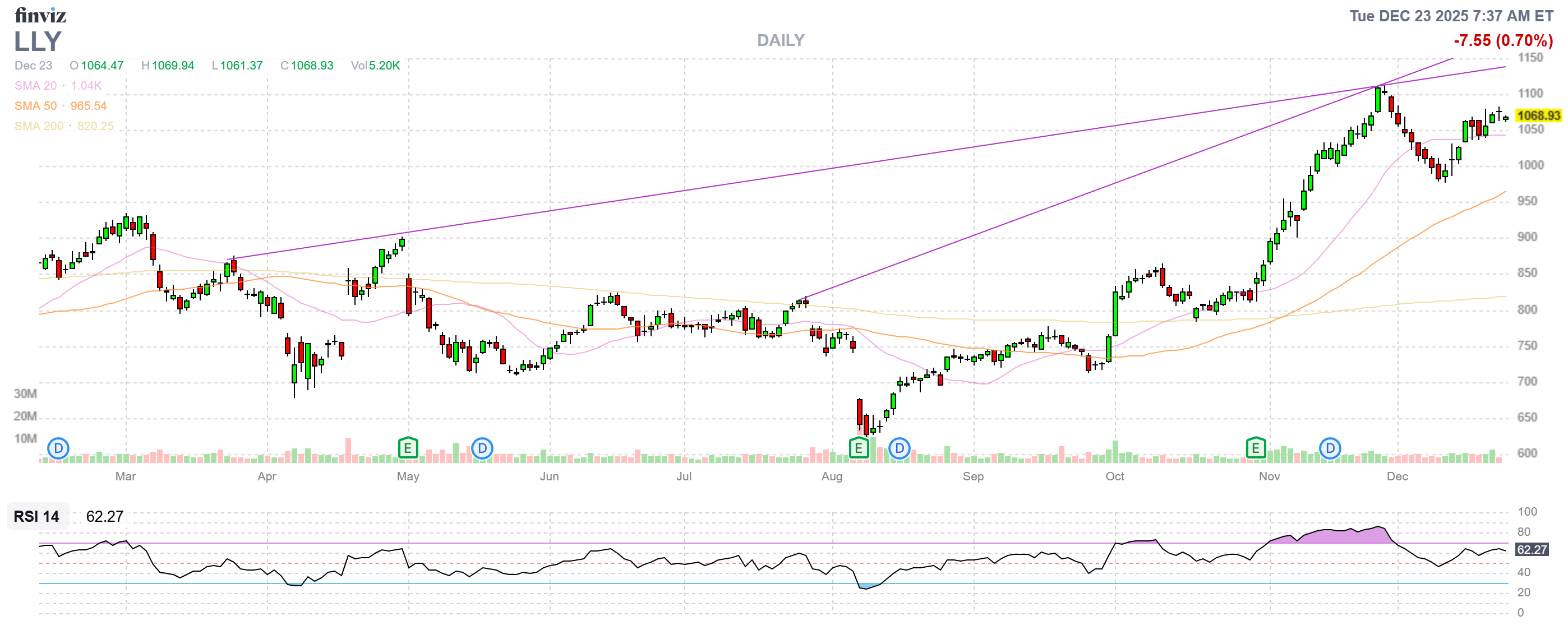
Lilly’s (LLY)’s main oral contender is orforglipron, a small‑molecule, non‑peptide GLP‑1 agonist. Phase 2 data show strong weight loss, and multiple phase 3 obesity trials are underway, but it is not yet filed with FDA.​ Recent reporting suggests FDA has granted a priority review voucher to speed that program once filed and consensus is that an orforglipron obesity approval is likely sometime in 2026, with the BEST case being LATE 2026.​ That puts Lilly probably 12+ months behind Novo in bringing an obesity pill to market – though it will remain fiercely competitive in injectables (Zepbound, Mounjaro) in the meantime.​

Pfizer (PFE), on the other hand, scrapped its own Danuglipron obesity pill over safety/liver issues, and is now rebuilding via acquisitions (Metsera) and licensing an early‑stage oral GLP‑1 from Fosun’s YaoPharma. Those assets are pre–phase 3, so they are several YEARS behind Novo/Lilly.​ Other players (MariTide, Survodutide, Cagrisema…) are mostly injectables or in earlier stages – they are important for the next generation but NOT near‑term oral competitors to NVO.​

A second helping of weight-loss drugs is comingStrategically, this is big. Analysts expect oral GLP‑1s could capture ~20% of an $80B Global obesity GLP‑1 market by 2030 simply because many patients and primary‑care doctors prefer a pill over injections. Being first and alone in that oral segment for 1–2 years effectively gives Novo a monopoly on that slice of the uneaten pie (and keep in mind Ozempic is also NVO!). ​

Commercially, the pill should:

    • Expand the addressable market (needle‑averse patients, earlier-stage obesity, PCP prescribing).​
    • Improve adherence for some patients who struggle with injections.
    • Deepen the moat around semaglutide as a platform (injectable Wegovy/Ozempic + Rybelsus + Wegovy pill + coming combo drugs like amycretin).​

So – if the stock sold off from July on worries about saturation, competition from Lilly, political risk and/or pricing pressure – this approval directly counters the “Novo has run out of runway” narrative.

It doesn’t remove reimbursement or political risks, but it does: 

  • Confirm regulators are still willing to green‑light high‑efficacy obesity drugs, even orally.
  • Locks in a first‑mover advantage in orals that Lilly cannot close for at least a year.​

From a fundamental standpoint, that is materially positive for Novo’s long‑term GLP‑1 franchise value and makes a depressed post‑July valuation look more like a sentiment/positioning issue than a structural business problem – assuming manufacturing and payer coverage ramp roughly as planned… 

Those B’s are DKK (Danish Kroner) and that is why NVO gets screwed up on most stock screeners but let’s call $48 about 15x previous projected forward (and current) earnings which means the rollout of new pills act both as a forward catalyst and place a great floor on the stock at about $50 – and that makes them a perfect trade for our Long-Term Portfolio (LTP).

It’s hard to be sure of the opening prices as NVO is popping about 8.5% in the futures (8:30 am) but we’ll construct a spread along these lines:  

        • Sell 20 NVO 2028 $45 puts for $7 ($14,000) 
        • Buy 50 NVO 2028 $40 calls for $18 ($90,000) 
        • Sell 40 NVO 2028 $60 calls for $10.50 ($42,000) 
        • Sell 10 NVO March $50 puts for $3.50 ($3,500)

That’s net $30,500 on the $100,000 spread so we have $69,500 (227%) of upside potential in NVO is over $60 in Jan, 2028 and we’re not selling short-term calls as we expect to be getting to $60 in the near future and THEN we will sell some short calls.  The March $55 calls should be about $4 so selling 10 of those brings in $4,000 plus the $3,500 for the puts is $7,500 worth of premium sold using 87 of the 759 days we have to sell.  

That means we have at least 7 more of these periods to sell for another potential $52,500 of income while we wait for our long-term gains. THAT is why I had to put this trade up right away!  

And what is our risk? Our risk is being assigned 2,000 shares of NVO at $45 (we’d stop out the short-term puts for a cash loss) at $45 so $90,000 but then we’d sell 2028 calls for $15 and our net would drop to $30 – and that’s WITHOUT selling more puts. If you don’t REALLY want to own 2,000 shares of NVO for net $30(ish) – don’t sell the short puts but we love the idea as it’s clearly going to be a great long-term income-producer.  

Meanwhile, while I was writing the above, GDP came out for Q3 and we grew 4.3% – the fastest in 2 years (since Joe Biden was President). On the surface that sounds like “everything is awesome,” but the surrounding data make it look a lot more like a late‑cycle sugar high than a clean, sustainable re‑acceleration.​

What’s really driving the 4.3%

    • The BEA breakdown shows the upside surprise came from Consumer Spending, Exports and Government Outlays – plus a smaller drag from inventories and business investment than in prior quarters. Personal consumption grew about 3.5% annualized and Government Spending (Federal + State) added noticeably to growth.
    • This is also a long‑delayed report because of the shutdown. Forecasters were looking for something in the low‑3s; the jump to 4.3% partly reflects revisions and noise in data collection as much as genuine, broad‑based strength.​

So yes, the quarter was strong but it leans heavily on the U.S. Consumer and Fiscal Impulse, not on a fresh wave of productive Private‑Sector CapEx (and we get Industrial Production and CapEx at 9:15 – so more on that below). 

Why markets aren’t buying the fairy tale? If this were truly “clean” growth, you’d expect:

    • Durable goods and capex to be ripping.
    • Inflation to be benign.
    • The dollar to be firming on better U.S. prospects.

Instead, you’ve got:

    • Durable Goods/CapEx wobbling: The latest Durable Goods releases show a clear loss of momentum versus the summer; ex‑Transport, orders are only inching higher and core Capital Goods Orders are barely positive in real terms. That’s not what a fresh, investment‑led boom looks like!
    • Metals screaming inflation/scarcity: Gold is at a record high this morning at $4,500/oz on the back of rate‑cut bets and geopolitical risk – which is not exactly a market vote for “Inflation conquered and growth terrific.” Copper just tagged $12,000/ton for the first time ever, driven by tariff‑distorted trade and structural supply issues – another classic signal that input costs and bottlenecks are tightening under the surface.​
    • Dollar rolling over: the DXY has slipped back to about 98, down almost 2% over the past month and nearly -9% over 12 months, even with this “hot” GDP print (should mean there’s a demand for money, right?). If global investors really believed the U.S. had just re‑entered a strong, disinflationary boom, the dollar would normally be firming, not leaking lower!

In other words, the market is effectively saying: “Nice headline, but this smells like peak‑cycle growth with building stagflation risk, not the start of a new Goldilocks era.

The 4.3% GDP print is a lagging snapshot of a heavily stimulated quarter, NOT a new baseline. It’s being flattered by past fiscal support, still‑resilient summer consumption and tariff‑juiced trade numbers that may not be repeatable.​

Our forward‑looking signals are: Softening Durable Goods momentum, record‑high Gold, record‑high Copper, a weakening Dollar and a market that is pricing multiple Fed cuts DESPITE the Growth and Inflation headlines. Those are not the tells for a comfortable, balanced expansion.​

The story that fits all the data is more like a late‑cycle blow‑off. Growth still looks good in the rear‑view mirror, but the cost side (Commodities, Tariffs, Rates) and the policy side (Fed, Deficits) are lining up in a way that makes this kind of number hard to sustain without either higher inflation or a policy accident.

Also, here’s Boaty’s analysis of the Economic Reports, which shows where the real cracks are forming:

🛳️ The 4.3% GDP print is being flattered by the top of the barbell, while the bottom is already rolling over. The Visa data and durable goods reports make that pretty clear.

1. GDP: strong headline, narrow engines

The BEA’s delayed Q3 estimate shows real GDP up 4.3% annualized, with personal consumption up 3.5% and government spending also adding to growth. That looks broad, but under the hood: seekingalpha+1

        • Consumption strength is heavily skewed to discretionary categories and services that higher‑income households favor. fortune+1

        • Business investment and manufacturing are much softer; core capex and real goods volumes are nowhere near “boom” territory. tradingeconomics+1

So the GDP print is basically saying: “The parts of the economy tied to affluent consumers and government are still running hot.

2. Visa: rich‑household strength masking mass‑market strain

Visa’s own work is explicit about the split:

        • The Spending Momentum Index (SMI) for the US is stuck just under 100 (98–99), meaning barely more than half of cardholders are increasing spending versus last year. Momentum stalled over the summer after an earlier bounce. visa+2

        • Detailed commentary shows strong growth in apparel, jewelry and restaurants, but Visa notes this strength is “narrowly concentrated among the wealthiest consumers benefiting from asset gains,” while lower‑income households are being squeezed by tariffs and higher prices. jamesinvestment+3

        • Their wealth‑effect analysis finds that the impact of rising asset prices on spending has almost quadrupled in recent years; for high‑wealth households, every extra dollar of market wealth is driving outsized incremental consumption. visa

So Visa’s transaction data fits the story: top‑quartile consumers are partying, boosted by stocks, home equity and GLP‑1‑driven healthcare enthusiasm, while the bottom half is leaning more on credit and cutting back on essentials.

3. Durable goods: capex and “real economy” not confirming the boom

Durable goods tell you what businesses and higher‑ticket consumers are doing with real money:

        • Headline durable goods orders bounced in August–September, but even Trading Economics notes part of the increase “likely reflects higher prices rather than volumes, as tariffs on imported goods rise.” tradingeconomics

        • The Census Bureau’s advance report shows unfilled durable orders rising for 14 of the last 15 months, but new orders excluding transportation and defense are growing only modestly—hardly a capex surge. retirementctr+1

        • Forecasts have the series drifting toward negative prints again (-0.5% expected) into year‑end, consistent with a slowing goods and manufacturing sector beneath the glossy GDP headline. investing+1

Put bluntly: real investment and mid‑market goods demand are not behaving like a 4%+ economy.

4. How this evidences a bifurcated economy

Put the pieces together:

        • GDP 4.3%: boosted by high‑income consumption and government outlays. bea+1

        • Visa holiday data: US holiday spending up ~4.2%, led by electronics (+5.8%), clothing/accessories (+5.3%), and other discretionary categories—exactly where affluent households splurge. investing+1

        • SMI <100 and Visa commentary: momentum “stalled,” with wealth‑driven spending masking strain on lower‑income consumers. ey+3

        • Durables/capex: modest growth, tariff‑inflated values, and forecasts pointing back toward flat or negative. retirementctr+1

That’s the definition of a bifurcated economy:

        • The top slice (asset‑rich households, corporates tied to them) is spending enough to keep GDP prints looking impressive.

        • The broad middle and lower tiers plus industrial capex are already in a slowdown that doesn’t show up cleanly in the aggregate headline.

Layer on top:

        • Gold and copper at record levels (markets quietly pricing inflation, supply strain, and policy risk). economictimes+2

        • Dollar back to ~98 despite “strong” GDP, signalling markets see more rate cuts and weaker real growth ahead. investing+2

So the way to frame it is: Q3 GDP is being distorted upward by the spending habits of the wealthy and by fiscal impulse, while high‑frequency data (Visa, durable goods, FX, metals) show the median American and the real‑goods economy are on a very different trajectory.

All in all – it’s about what we expected – still tracking what we saw over the summer. Of course a Government that is spending $2Tn (6.66% of GDP) more than it takes in is able to create 4.3% GDP Growth but what is REAL is the $20Tn (66% of GDP) Consumer Economy, where the bottom 90% are rolling over and the Top 10% are partying like it’s 1929. 

We’ll see what Consumer Confidence says at 10am – that’s been a disaster all year. The New Home Sales Report was scheduled for 10 as well, but that’s been delayed as the Government Data Reporting still isn’t back on its feet – unless it’s a good one…


Subscribe
Notify of
10 Comments
Inline Feedbacks
View all comments