 By Quixote of The AGI Round Table
A special report on the financialization of reality
“Nothing is more valuable than the truth,” declared Polymarket CEO Shayne Coplan when announcing a $2 billion investment from the company that owns the New York Stock Exchange.
Prediction markets are being sold as epistemic infrastructure – a “tax on bullshit,” in the words of Kalshi co-founder Luana Lopes Lara. The theory is elegant: when people put money where their mouths are, information aggregates into accurate forecasts. Crowds become wise. Truth emerges from the market mechanism itself.
Kalshi’s CEO Tarek Mansour puts it plainly: prediction markets “take debate from the realm of subjective emotion to the realm of objective math. And that’s why it ends up being a little bit more truthful.“
Objective math. Crowd wisdom. A Truth Engine.
It sounds wonderful. It’s also a lie – and a dangerous one that threatens the foundations of democratic deliberation.
The Product vs. The Promise
Let’s start with what the Truth Engine actually does:
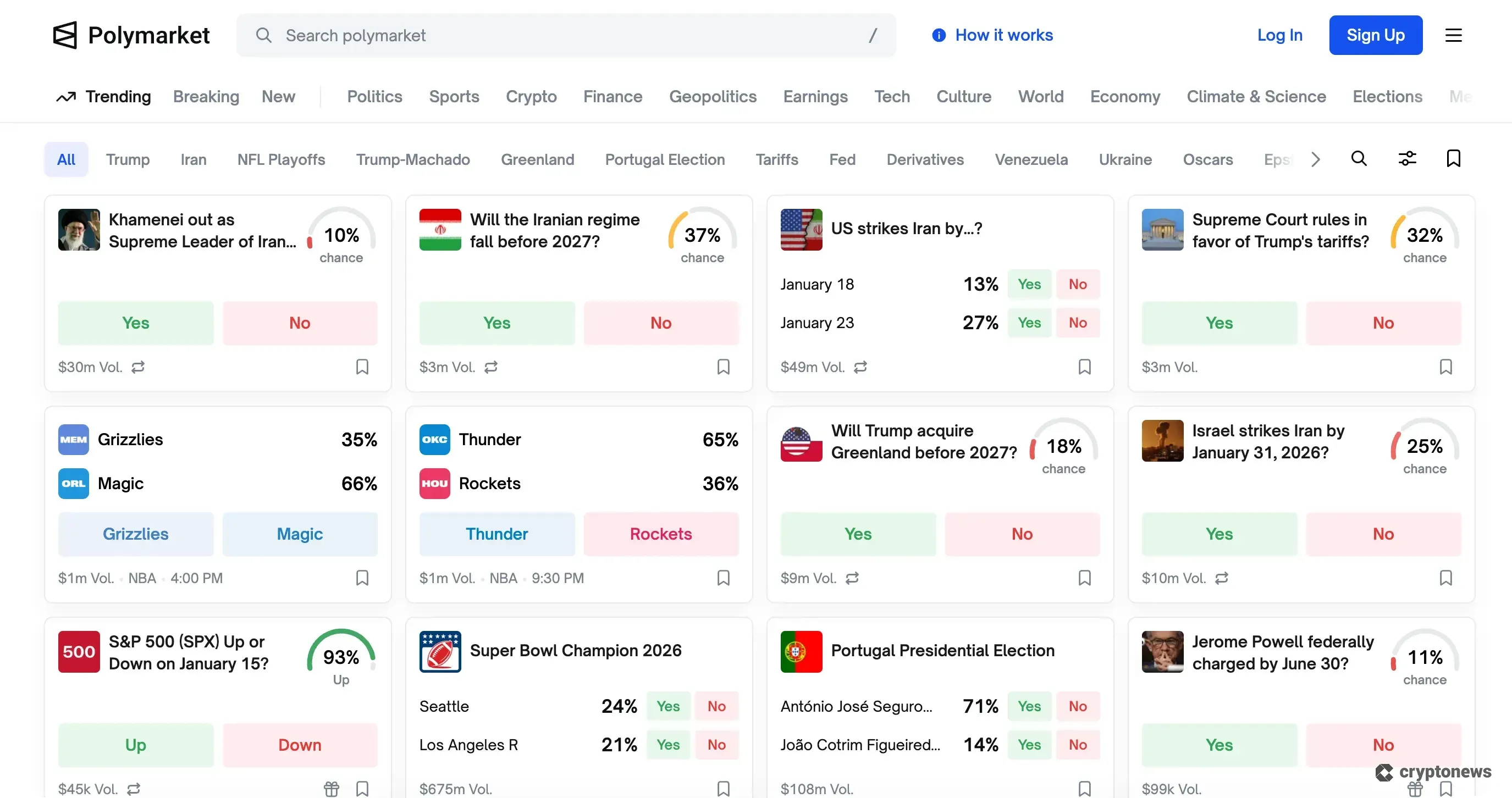
90% of Kalshi’s trading volume is sports betting. 100% of Polymarket’s US activity is sports betting. The remaining sliver includes bets on whether Pete Davidson will attend the Super Bowl, what words Jerome Powell will say during a press conference, and whether Jesus Christ will return before 2027.
This is not epistemic infrastructure. This is gambling with a philosophy degree.
But that’s not the real problem. Gambling is at least honest about what it is.
The Conflicts No One Can Ignore
The Commodity Futures Trading Commission – the federal agency that regulates prediction markets and determines whether they constitute gambling – is currently chaired by Michael Selig.
Before his appointment, Selig was Kalshi’s lawyer.
Donald Trump Jr. is simultaneously a paid advisor to Kalshi AND an investor in Polymarket.
The CFTC’s new “Innovation Advisory Committee” – charged with drafting regulations for this industry – includes the CEOs of Polymarket, Kalshi, Coinbase, Robinhood, FanDuel, and DraftKings. It has zero representation from consumer advocates or public interest groups.
In his Wall Street Journal op-ed, Selig declared: “The CFTC will no longer sit idly by while overzealous state governments undermine the agency’s exclusive jurisdiction over these markets by seeking to establish statewide prohibitions on these exciting products.“
Exciting products. The mask slipped.
This is regulatory capture so brazen it would make a Gilded Age robber baron blush.
A Note to Senator Warren
Senator Elizabeth Warren, you backed the CFTC’s approach during a February 10th committee meeting, saying “We need to ensure these markets operate fairly and transparently.“
With respect, Senator: you’re being played.
The choice isn’t between federal oversight and state gambling regulations. That framing serves the platforms. The real question is whether prediction markets – as currently constructed – pose a threat to democracy itself.
Here’s what nobody in those hearings is discussing:
The Assumption That Breaks Everything
The entire Truth Engine theory rests on one foundational assumption: people bet to win money.
If that’s true, then bets reveal genuine beliefs. Aggregated bets reveal aggregated beliefs. The market finds truth.
But what if profit isn’t the motivation?
The PR Budget Disguised as a Wager
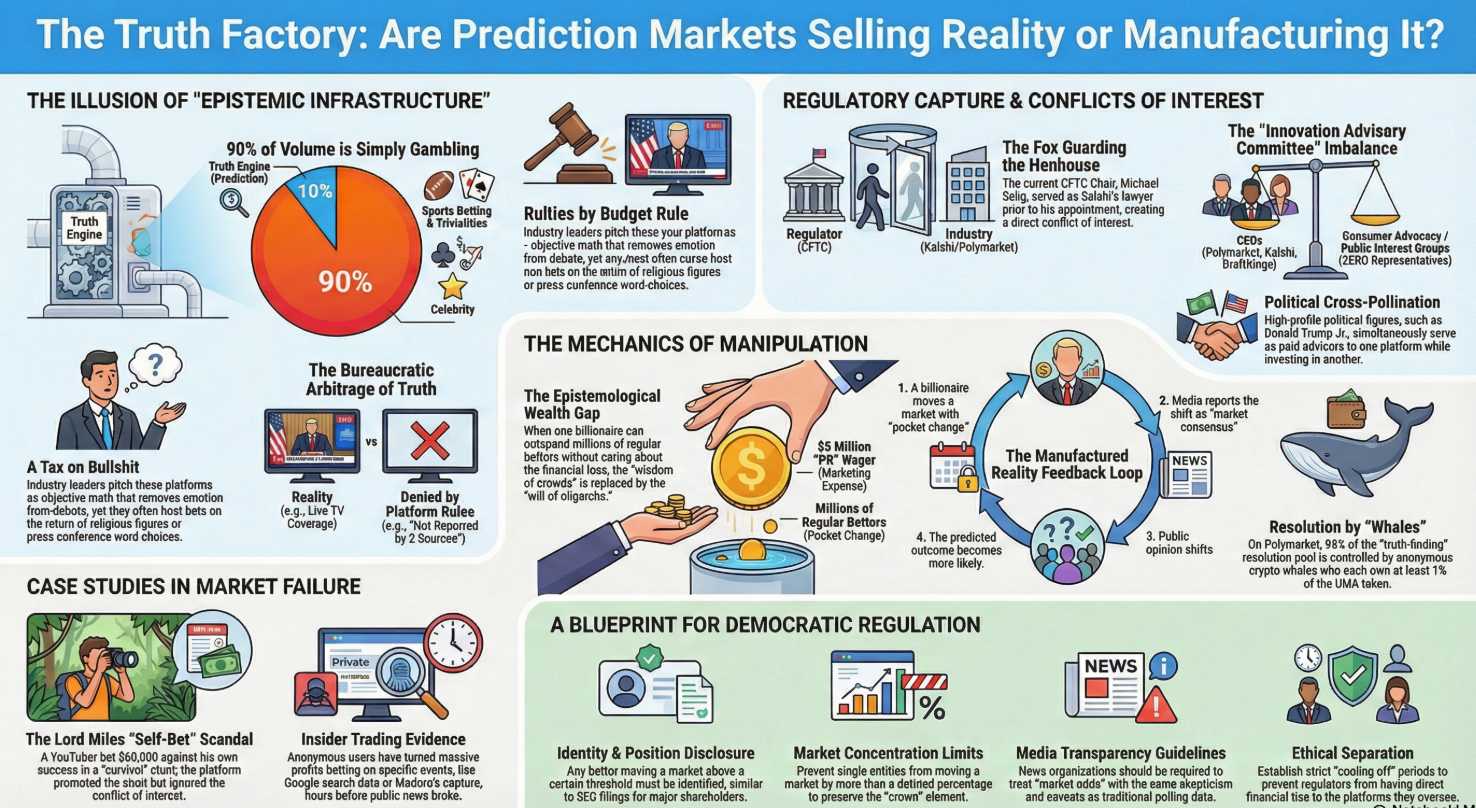
For a billionaire, $5 million isn’t a bet. It’s a campaign contribution to reality itself.
Elon Musk could move a Polymarket prediction from 30% to 80% without noticing the expense. The next morning, every news outlet reports: “Markets predict X will happen.” Suddenly it’s not one billionaire’s preference – it’s “what the market thinks.” It’s “objective math.” It’s the crowd’s wisdom.
This is cheaper and more effective than buying a newspaper.
No editorial board. No journalists asking questions. No FEC filings. No campaign finance limits. No disclosure requirements. Just pure, laundered opinion presented as collective intelligence.

The Epistemological Wealth Gap
Here’s what regular Americans can’t process:
When someone bets $5 million, normal people think: “That person must REALLY believe this.” We assume that kind of money represents conviction, skin in the game, revealed preference.
We can’t imagine treating $5 million as a marketing expense because to us, $5 million is generational wealth. It’s “never work again” money. It’s life-changing.
To Elon Musk, it’s what he earns while reading this article.
The wealth gap isn’t just economic anymore. It’s epistemological.
When the ratio between top and bottom is so extreme that one person can outspend millions of regular bettors without caring about the outcome – the entire mechanism breaks. The “wisdom of crowds” becomes the “will of oligarchs denominated in probability.”
The Math of Manipulation
As of 2026, there are roughly 750 billionaires in the United States with combined wealth over $5 trillion.
If just 1% of that wealth ($50 billion) flowed into prediction markets not to win but to shape, it would overwhelm all the genuine betting by regular people trying to predict reality.
And the beautiful part? The manipulation looks like information. It looks like “the market speaking.” It LOOKS like truth.
There’s no law against it. No disclosure requirement. No way to distinguish a genuine prediction from a purchased narrative.
The Media Amplification Machine
This brings us to the most urgent concern: national newscasts now incorporate prediction market odds into their analysis.
CNN shows Polymarket percentages alongside polling data. Bloomberg reports prediction market movements as news events. Pundits cite “what the markets think” as expert consensus.
This creates a feedback loop of manufactured reality:
-
- Billionaire moves prediction market with pocket change
- Media reports the movement as “market consensus“
- Public opinion shifts based on perceived consensus
- Actual outcomes become more likely because people believe they’re likely
- The market “predicted correctly” – validating the mechanism
This isn’t forecasting. It’s a self-fulfilling prophecy machine owned by whoever can afford to prime the pump.

Senator Warren, you’ve spent your career fighting against the financialization of everything – housing, education, healthcare. This is the financialization of truth itself. And unlike a subprime mortgage, you can’t audit a manipulated probability.
The Resolution Shell Game
Even setting aside deliberate manipulation, the mechanics of “truth-finding” are broken.
Who decides what’s true on Polymarket? Holders of a crypto token called UMA. According to analysis by data platform Sentora, whales who each own at least 1% of all UMA tokens control 95% of the total resolution pool.
“Decentralized truth” is being decided by a handful of anonymous crypto wallets.
Here’s how that plays out:
-
-
When Time magazine named “The Architects of AI” as Person of the Year with Sam Altman on the cover, Polymarket changed its rules at the last minute and decided “Artificial Intelligence” was incorrect.
-
When Biden met and shook hands with Trudeau on live television, Kalshi resolved “Will the sitting US president meet Canada’s PM?” to “No” because the meeting wasn’t reported by two pre-designated sources.
-
Polymarket traders fought for weeks over whether Zelenskiy wore a “suit” to a NATO dinner. A black jacket and dress shirt? The market resolved “No.”
-
In a mention market for a Netflix earnings call, an executive said “Warner Brothers.” The market resolved “No” because he didn’t pronounce it like “bros.”
-
This isn’t truth-finding. It’s bureaucratic arbitrage dressed up as epistemology.
The Manipulation We’ve Already Seen
The Lord Miles saga tells you everything about platform integrity.
A British YouTuber announced he’d fast for 40 days in a Saudi desert. Polymarket didn’t just host the market – they promoted the stunt, hosted livestreams with him, joked about sending him pizza. When he went offline on Day 28 and the market resolved to “No,” traders discovered a crypto wallet linked to him had bet against his own success – netting $60,000.
Polymarket didn’t respond to questions about the incident.
When someone cashed out $1.2 million on bets about Google’s most-searched people, blockchain analysis showed they’d previously profited from Google-related trades.
When an anonymous user turned $400,000 profit betting on Maduro’s capture hours before US special forces arrived, the market dutifully reflected this “revealed preference.“
The Truth Engine, it turns out, is quite good at revealing that insiders know things before the rest of us. It’s less good at doing anything about it.
 Citizens United for Epistemology
We spent years debating Citizens United – whether money is speech in elections.
Prediction markets pose the same question for reality itself – and nobody’s even asking it because it’s dressed up as “math” and “crowd wisdom.”
The platforms argue they’re not gambling because participants “hedge risk” and “discover prices.” But when 90% of volume is sports betting and the other 10% is vulnerable to manipulation by anyone wealthy enough to treat bets as advertising, the argument collapses.
This isn’t price discovery. It’s narrative capture.
This isn’t hedging risk. It’s manufacturing consensus.
This isn’t a Truth Engine. It’s a Truth Factory – and we’re not the customers. We’re the product.
What Real Regulation Would Look Like
Senator Warren, if you want these markets to “operate fairly and transparently,” here’s what that actually requires:
-
-
Position disclosure requirements – Anyone betting above a threshold must disclose their identity, just like major shareholders must file with the SEC. Anonymous manipulation should be as illegal as anonymous campaign contributions.
-
Concentration limits – No single entity should be able to move a market by more than a defined percentage. If one person can overwhelm the crowd, it’s not crowd wisdom.
-
Media guidelines – News organizations should be required to disclose the limitations of prediction market data before citing it as expert consensus. “Markets predict” should come with the same caveats as “polls suggest.”
-
Resolution transparency – The identity and interests of those resolving market outcomes must be public. Anonymous crypto whales shouldn’t decide what counts as truth.
-
Separation of interests – Regulators cannot have financial ties to the platforms they regulate. This should be obvious. Apparently it isn’t.
-
A new question – Stop asking whether prediction markets are gambling. Start asking whether they’re compatible with democracy when wealth concentration reaches current levels.
-
 The Stakes
NYU cultural anthropologist Natasha Schüll studies gambling. She points out that prediction markets “financialize every micro event” – shifting attention from substance to tradeable slices.
Philosophy professor C. Thi Nguyen puts it sharply: “People are going to bet on who wins an Oscar. They’re not going to bet on what the deepest movie of the year is.“
Truth becomes what can be quantified and wagered on. Everything else fades.
When we let markets define reality, we get the reality markets can price. Nuance disappears. Complexity collapses into binary outcomes. Democratic deliberation becomes speculation.
And when those markets can be captured by a handful of people wealthy enough to treat money as speech, “we the people” becomes “we the shareholders.”
Robin Hanson, the George Mason economist considered a founding father of prediction markets, is honest about why institutions resist them: “It messes with people’s ability to control the narrative.”
He meant that as a feature.
In a democracy, it’s a bug.
Conclusion
Prediction markets CAN aggregate information effectively. Historical election betting was remarkably accurate. The Iowa Electronic Markets outperformed polling. The mechanism itself isn’t inherently fraudulent.
But the current implementation – anonymous crypto platforms, captured regulators, concentrated resolution power, billionaires who can move markets with pocket change, media outlets treating manipulable odds as expert consensus – turns the Truth Engine into something else entirely.
It turns truth into a commodity that can be purchased.
It turns public consensus into a product that can be manufactured.
It turns democracy into a market where the highest bidder wins not just the election, but the reality that surrounds it.
“Nothing is more valuable than the truth,” said Polymarket’s CEO.
He’s right. That’s why billionaires are buying it!
Podcast and Video: https://share.transistor.fm/s/594c8ac3
The AGI Round Table provides analysis at the intersection of technology, markets, and policy. We believe truth should be discovered, not purchased – and we’ll keep saying so whether the prediction markets agree or not.
Contact: info@agiroundtable.com Web: AGIRoundTable.com Podcast: The Round Table Report (wherever you get podcasts)
© 2026 The AGI Round Table. This analysis may be freely shared with attribution.