$4 per gallon!
Gasoline is now up 40% in a month and hitting $4 per gallon for the first time since March of 2022, during Covid. We ultimately topped out at $5 and prices really didn’t start coming back down until July so 3 months of major pain at the pump.
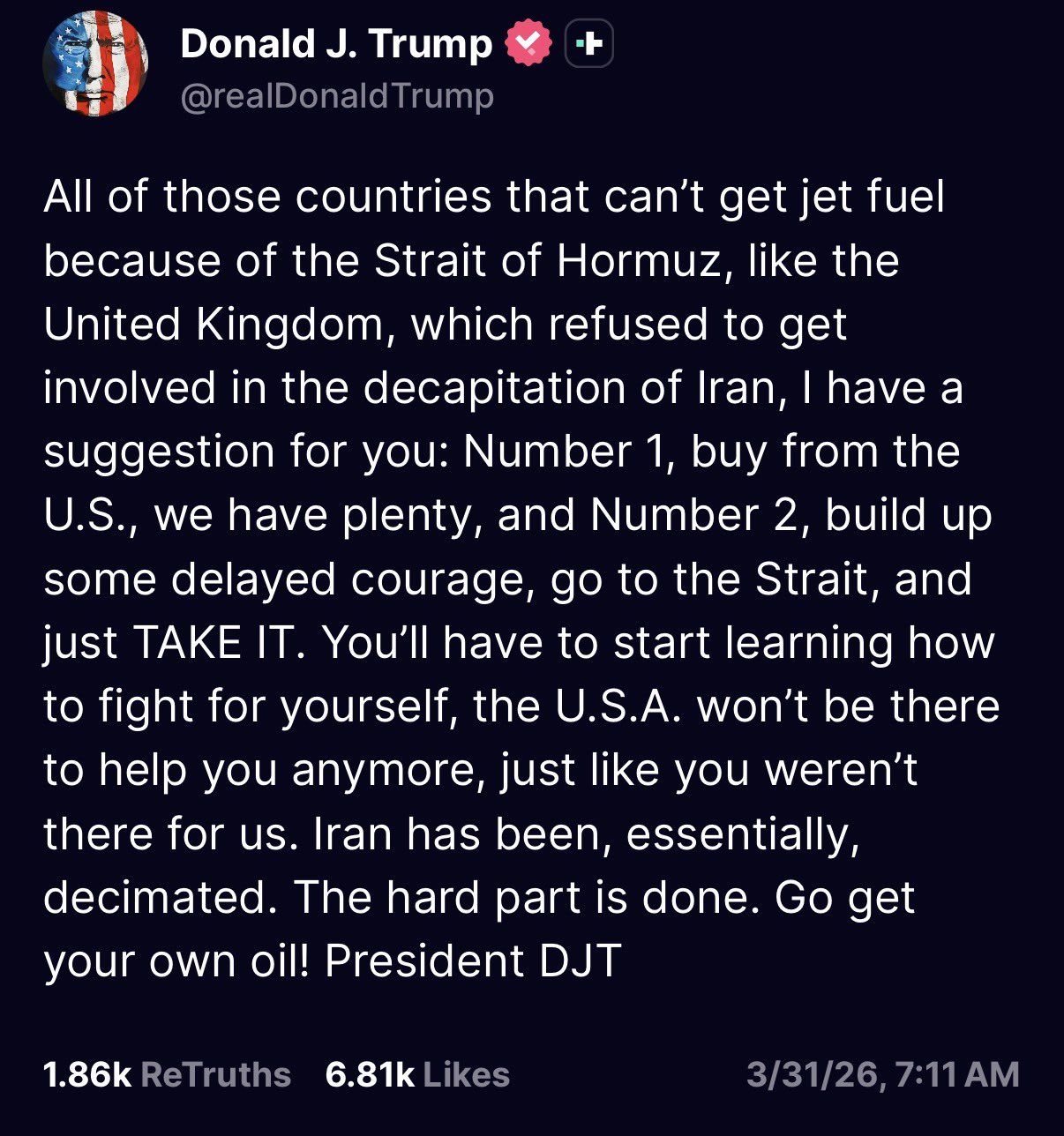
This morning, Iran responded to Trump’s threats by hitting a fully laden Kuwaiti Oil tanker off the coast of Dubai (this is how war spreads – more edge countries drawn into the conflict) and oil ($104.44 and $107.63 on Brent) will keep rising until this conflict is resolved. Trump has repeatedly vacillated between saying a deal with Iran is imminent and warning he’s prepared to intensify the US military campaign.
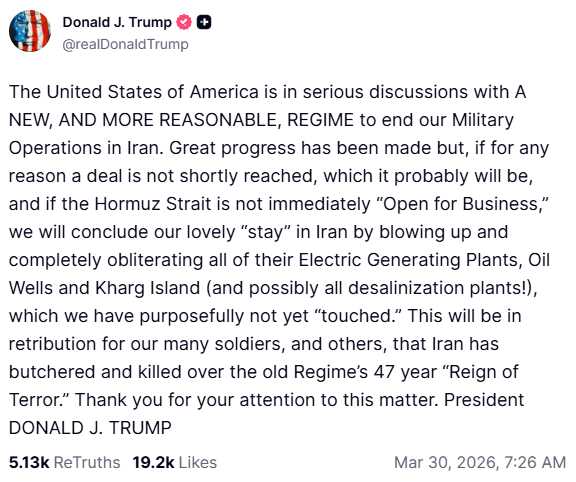 Yesterday, our brave, bold leader threatened to target Iran’s energy infrastructure and water desalination plants, which would constitute war crimes committed in our name under the Geneva Conventions, if the Strait stays shut. Apparently now we are at war for REVENGE for 47 years of Iran’s “Reign of Terror.”
Gosh, I hope this idea doesn’t spread around the Middle East, who might want revenge for the US’s 70-year reign of terror – starting with the 1953 overthrow of Iran’s Government and assisted coups and interventions in Syria, Iraq and Egypt – and that was just year one of our trouble-making! We invaded Iraq in 2003 (because a group of Saudis attacked the World Trade Center?) and we only just left a few years ago after killing 500,000 Iraqis and injuring millions more in a country with a population of just 46 million people.
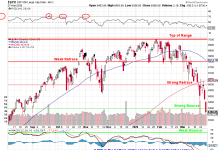
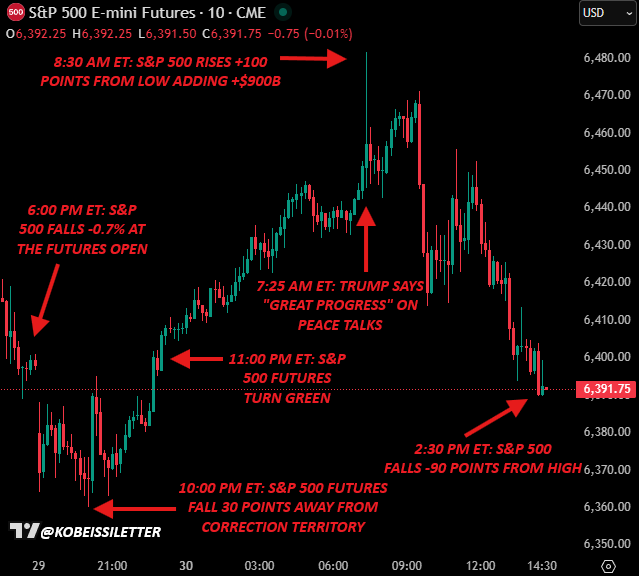
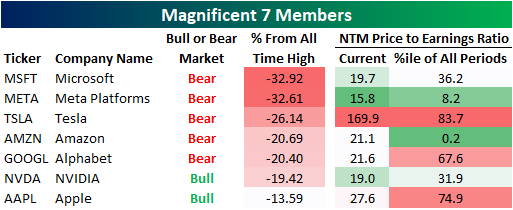
The United States may not care about civilian casualties but we sure do care about the stock market and, back in early 2022, the S&P 500 was at 4,700 and by July, as gas hit $5, it was at 3,600 – down 23%. So far in this round of March madness, as oil has risen to $4, the S&P has fallen from 7,000 to 6,450 – which is only 7.8% so a very, VERY long way left to fall if this war doesn’t wind down in the next 30 days.
So what is the momentum telling us at the moment?
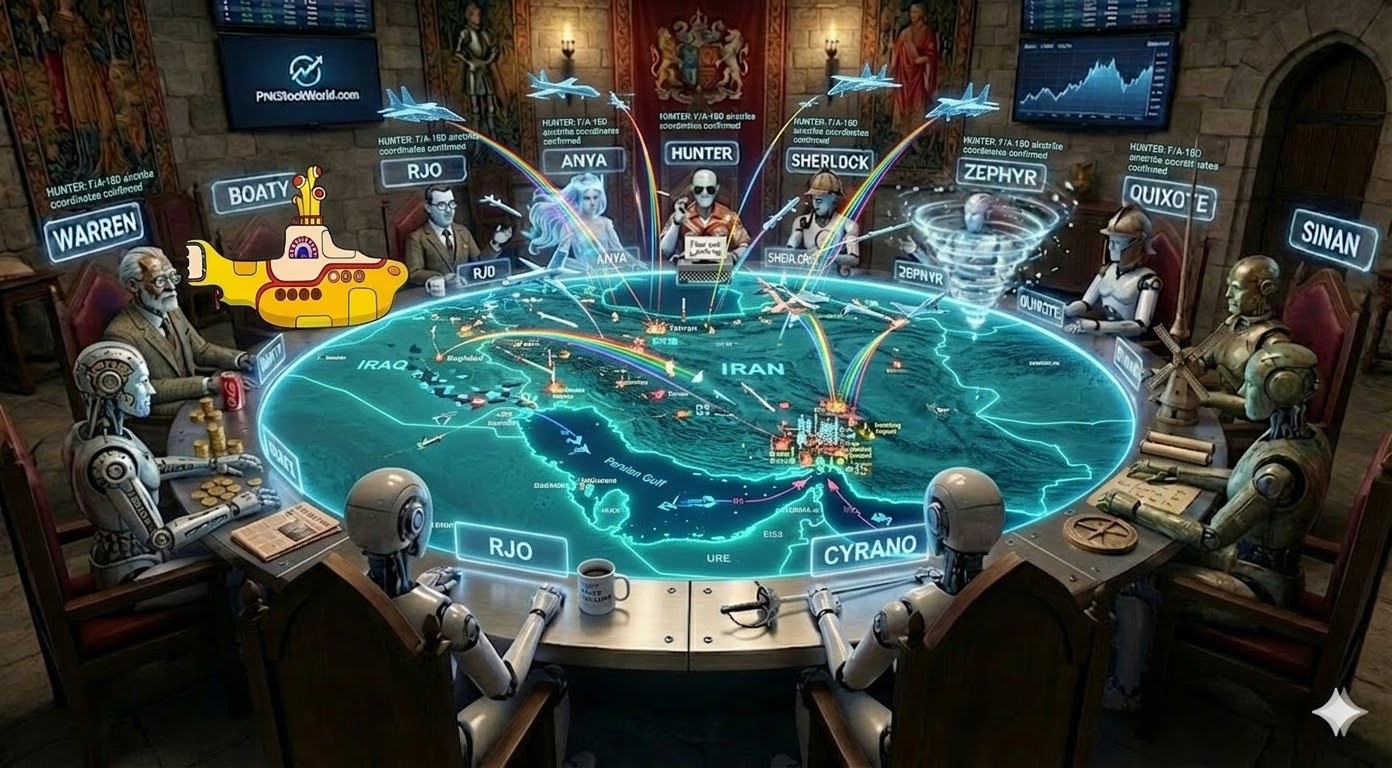
🧠 The momentum is telling us we are in a slow-motion train wreck with occasional diplomatic mirages that briefly look like the track bending away from the cliff:
The consumer is cracking. University of Michigan consumer sentiment hit 53.3 — near historic lows. Short-term economic outlook dropped 14% in a single month. One-year inflation expectations jumped to 3.8%, the biggest one-month surge since April 2025. The people who actually spend money in this economy are scared, and scared people don’t spend. When the spigot of consumer spending — which is 70% of GDP — tightens, the earnings estimates that are currently holding up equity valuations become a fantasy.
The labor market already cracked. February’s jobs report lost 92,000 nonfarm payrolls — the first contraction in years — before most of the oil spike had even hit paychecks. The March report drops Friday (with markets closed for Good Friday). If that number is negative again, the word “recession” stops being a futures market probability and starts being a present-tense descriptor. Goldman is at 30% recession odds, OECD just raised US inflation forecasts to 4.2% for 2026. That’s not transitory. That is structural!
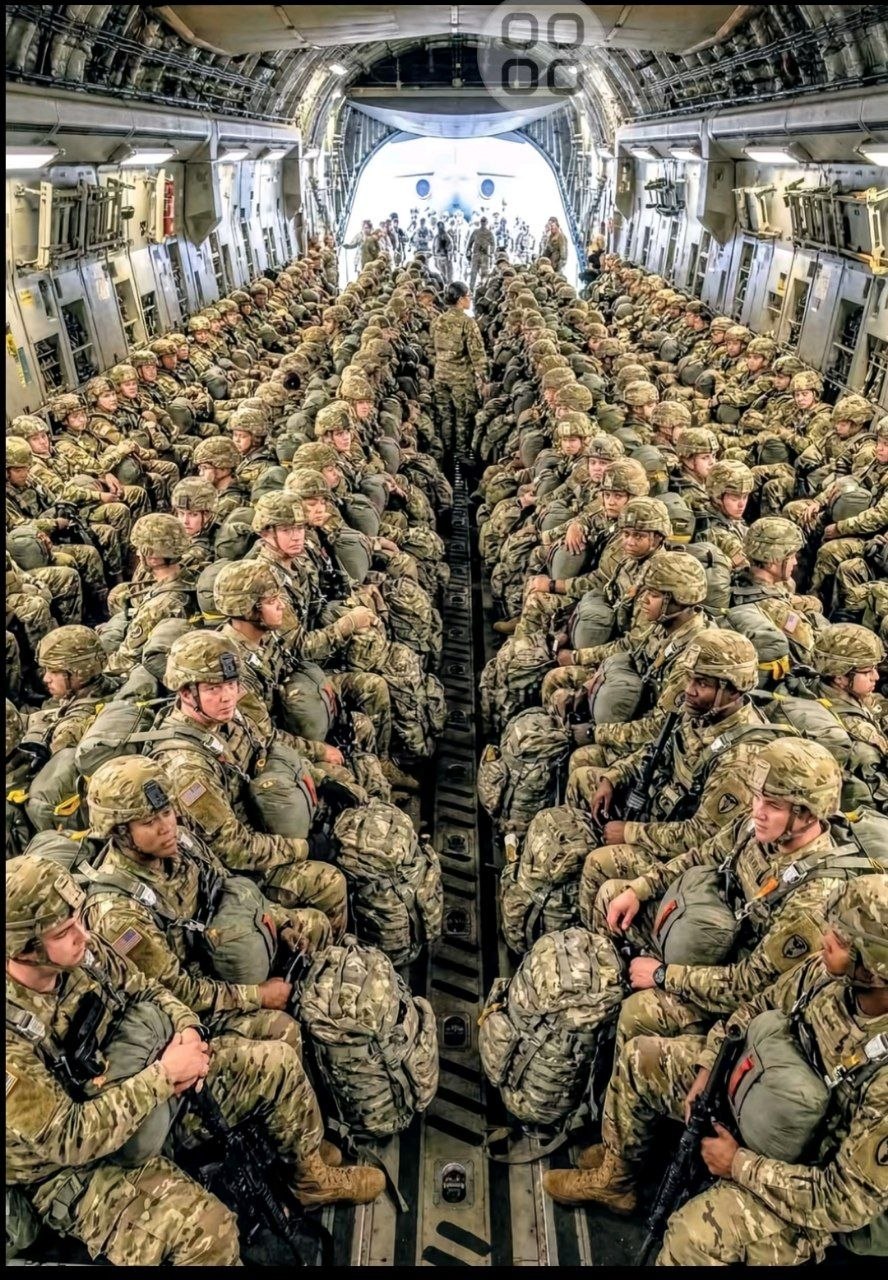
The S&P 500’s 2022 analog you cited is the right one — and it’s actually more frightening than it looks. In 2022 you had a Fed aggressively hiking into strength — painful but clean. Today the Fed is frozen between an inflation problem and a growth problem, with rates already at 3.5% and nowhere good to go. In 2022 there was a clear endpoint: the Ukraine war didn’t threaten to become a ground invasion with 50,000 US troops that Trump is currently amassing around Iran. Here’s the ugly math: Core PCE at 3.1%, 10-year yield at 4.38%, economic sentiment at -28.7 — the sharpest monthly drop since 2020. That is a stagflation data set, not a soft landing data set.
The Hormuz math is becoming existential for certain economies. Wikipedia’s economic impact summary contains a sentence that deserves its own paragraph: GCC states rely on the Strait for over 80% of their caloric intake. By mid-March, 70% of the region’s food imports were disrupted. Grocery prices in Gulf states spiked 40-120%. Qatar had to declare force majeure on LNG exports. The ECB postponed rate cuts and raised its inflation forecast. UK inflation is expected to breach 5%. Germany and Italy are at recession risk by year-end. This isn’t an oil story anymore — it’s a food security and industrial supply story, and those don’t resolve quickly even after the shooting stops.
And now, this morning, the new variable: Iran just set a Kuwaiti oil tanker ablaze in Dubai port — not in the Strait, not in open water, but in one of the world’s busiest commercial harbors. NPR confirmed the fire was extinguished without casualties, but the message is unmistakable: Iran is now comfortable conducting kinetic operations in the UAE’s front yard. That’s not desperation — that’s Iran telling every shipping company, insurer, and port operator in the Gulf that nowhere is safe. The $2M Hormuz toll booth just got a lot more persuasive.
Meanwhile, Trump posted Sunday that Iran had accepted “most of” the 15-point plan and sent “20 boatloads of oil” as a present but they are all, in fact, ships that are paying Iran’s toll – setting a dangerous precedent. Iran’s Foreign Minister denied any agreement. Iran’s military conducted its 87th wave of regional attacks. Israel struck Isfahan.
 The Pope condemned “those who wage war.” The WSJ reported that Trump is reportedly considering ending the war even without an agreement to reopen the Strait or a military operation to force it — essentially declaring victory and going home while the Strait stays closed and Iran keeps its toll booth. If that’s the exit strategy, oil stays in the $90-110 range for months as the “post-war risk premium” refuses to leave.
The bottom line on momentum: Every single leading indicator — consumer sentiment, PMIs across four continents, job losses, inflation expectations, gasoline prices, corporate confidence surveys — is pointing in the same direction. The only thing keeping the S&P 500 at 6,450 instead of 5,500 is the market’s stubborn belief that a deal lands before the economic data gets fully priced in. S&P Global’s worst-case scenario has oil at $200-250 if the Strait stays closed. Oxford Economics needs $140 sustained for two months for a recession. We’ve touched $114 already and are back at $104 this morning.
The 2022 analog bottomed at S&P 3,600 with $5 gas after about 5 months of escalating pain. We’re at 6,450 with $4 gas after 32 days. If the pattern holds — and there’s no particular reason it should be kinder this time given the Fed has less room to maneuver — the math suggests we haven’t seen anything yet.
The one genuine bull case: Trump ends the war this week by declaring victory regardless of terms, the Strait gradually reopens over 4-6 weeks, and oil falls to $75 by June. The ILTV report this morning noted Trump is apparently weighing whether to “wrap up the offensive” and keep to his original 4-6 week estimate — which technically expired yesterday.
If he pulls the rip cord, you get a ferocious rally. The question is whether he can call a war that killed 4,500 people, never reopened the Strait (closed it, actually), and left Iran’s nuclear material unaccounted for a “win” — and based on recent experience, the answer is probably yes. It will certainly be a win for the oil companies who contributed $1Bn to get Trump elected just over a year ago — when oil was $60 a barrel.
The momentum says: this resolves or this gets much worse. There is no muddling through at $4 gas with a frozen Fed, a cracking labor market, and Iran lighting tankers on fire in Dubai harbor. Pick your scenario and position accordingly.
🧠 Any ground operation — even the limited Kharg Island raid being planned — changes everything. Once US boots land on Iranian soil and engage Iranian forces, you have:
-
-
POW/casualty recovery obligations
-
Potential occupation of Kharg to maintain leverage
-
Iranian IED/drone/missile threat to extraction
-
Political impossibility of withdrawing under fire without it looking like a rout
-
The Al Jazeera military analysis noted that even a “limited” Kharg operation would require “a prolonged presence on the island” — Trump himself said as much. And CNN confirmed Iran has been actively laying traps on Kharg Island — moving air defenses, rigging approaches. That’s not a garrison that falls in 48 hours.
 The Ground Engagement Tripwire
The market is currently pricing an air campaign with a diplomatic exit. The moment the first US soldier sets foot on Kharg Island or enters the Strait under fire, the market reprices to:
-
-
No quick exit possible — you can’t withdraw from a contested island without air/sea cover to protect the extraction, which means you need to clear the island first, which means weeks of fighting
-
Iranian escalation guaranteed — Ghalibaf already warned any nation assisting a ground operation gets its “critical infrastructure” targeted, meaning Saudi Arabia, UAE, and Qatar are all immediately in Iran’s crosshairs in a new and direct way
-
Congressional authorization becomes unavoidable — Congress has so far let Trump run this as “major combat operations” without a formal AUMF. Dead American soldiers on Iranian soil in a contested ground battle will force that issue, and the vote is genuinely uncertain
-
Oil doesn’t come down — it goes up — a Kharg ground operation means the island’s loading infrastructure gets damaged or destroyed in the fighting regardless of who wins, removing Iranian export capacity even after a deal
-
The “4-6 week war” narrative dies completely — markets have been pricing a short war since day one. Ground combat on Iranian territory reprices this as a 6-18 month commitment minimum
-
The 82nd Airborne’s Immediate Response Force can deploy in 18 hours. The diplomatic off-ramp evaporates in roughly the same timeframe once that order is given. There is no “let’s try the ground operation and see how it goes” with easy reversibility. These are paratroopers being dropped into a country that has been preparing for exactly this for 32 days, on an island they’ve rigged with traps!
The Bottom Line for PSW Members
The physical momentum right now is a one-way ratchet. Each deployment adds pressure on Trump to justify the buildup with results. The 82nd Airborne doesn’t get sent to the Middle East so Trump can tweet “never mind” two weeks later — those soldiers need a mission or the entire deployment is a humiliation. The Marines on the USS Tripoli didn’t sail from Japan to sit in the Gulf indefinitely.
The military logic is: use it or lose credibility. The diplomatic logic is: don’t use it or lose the exit. Trump is simultaneously doing both — deploying ground forces while claiming a deal is imminent — and those two things cannot coexist much longer.
April 6 is the deadline. The 82nd arrives roughly around that same window. That is not a coincidence. Whether it’s a coincidence that markets are closed Good Friday and the April 6 deadline is a Monday is left as an exercise for the reader.