

By Ilene
For Valentine’s Day, let’s dissect love and visualize the regions of the brain involved and the neurotransmitters responsible – dopamine (passion, motivation), oxytocin (bonding), cortisol (stress?), epinephrine (stress response) and vasopressin (attraction). These neurotransmitters and neuromodulators together create a very pleasurable and euphoric experience when the romance is going well.
Here’s a picture of seven of the twelve the brain regions involved in feelings of passionate love, five of the regions are inside the brain’s outer region and can’t be seen (click on image for a larger view). See Scientific American’s Your Brain in Love.
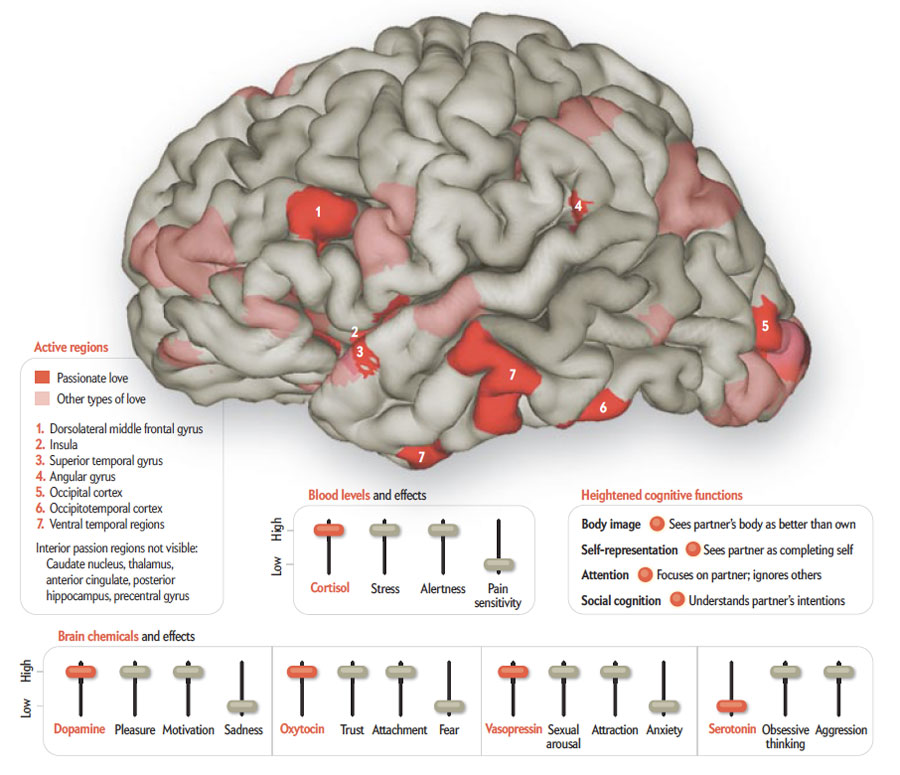
Graphics by James W. Lewis, West Virginia University (brain), and Jen Christiansen.
In the news today, Rutgers studies chemistry behind love and found:
dopamine levels in the brain are central to the feeling of love. But there are significant differences between feelings of romantic love and long-term love.
"I’ve long maintained that romantic love is an addiction — a perfectly wonderful addiction when it’s going well and a perfectly terrible addiction when it’s going poorly," said Rutgers research professor Helen Fisher, a member of Human Evolutionary Studies in the anthropology department in New Brunswick.
Brains scans of heartbroken individuals showed that their brains "were similar to the brains of people addicted to cocaine. The altered dopamine system in people suffering from painful breakups partially explains their tendency to engage in obsessive and addiction-like behavior. Dopamine antagonists help to reverse this dopamine flood." The cure? Possibly a dopamine antagonist, though I don’t know whether this approach has proven to be effective.
See Also: The Biochemistry of Love’s Ecstasy and Agony – Excerpt:
Love’s brain chemistry: millions of years in the making
Research into "the brain chemistry of love" indicates that when a person sees a potential mate, it takes as little as a fifth of a second for the brain to launch a complex "love-related" chain reaction involving multiple areas of the cortical and more primitive subcortical portions of the brain. Activation of some of these areas launches a host of neurotransmitters, hormones and proteins into action. Studies in humans have shown a great deal of similarity with the processes that occur in lower species, suggesting that the systems have evolved over millions of years in order to maintain procreation.
The cerebral cortex receives inputs from all the senses… The main area of the brain responsible for the early, swift love response is the caudate nucleus, a large C-shaped region near the center. This area is almost primordial, thought to be part of the "reptilian brain" that evolved before mammals took the main stage. It plays a key role in the brain’s reward system and is responsible for general arousal and pleasure sensations.
When this area of the brain gets activated, we’re not only flooded with positive feelings and sensations, we’re motivated to keep getting them; we do and say whatever seems appropriate to keep compliments and positive reinforcement coming our way. When researchers, using functional magnetic resonance imaging (fMRI), scanned brain activity of test subjects who described themselves as "madly in love," the more passionate they were about their new partners, the more active were their caudate regions. Of interest, activity in the prefrontal cortex of the brain, which is hyperactive in depression, is turned down during this phase of early romantic love.
The other region central to the "love response" is the ventral tegmental area, also a key component of the brain’s reward circuitry and home to cells that manufacture dopamine, the neurotransmitter that enables obsessive focus, feelings of elation and even mania… (Full article here.)
The extent to which chocolate reproduces these same feelings is controversial, but you probably have to eat an awful lot of it to get an effect. And eating large amounts of chocolate can lead to other problems. According to The Chemistry of Love, "The most well-known love-related chemical is phenylethylamine — or "PEA" — a naturally occurring trace amine in the brain. PEA is a natural amphetamine, like the drug, and can cause similar stimulation." Phenethylamine, like amphetamine, acts to release norepinephrine and dopamine. Because phenethylamine is rapidly metabolized by the enzyme MAO-B (monoamine oxidase B), significant concentrations do not ordinarily reach the brain. (The solution to this of course is a monoamine oxidase inhibitor which can increase levels 1000-fold. Alcohol and THC may increase phenylethylamine levels by 4-fold, according to Wikipedia.)
Regardless of the neurological pathways and neurotransmitters that may be flooding our bodies, love still feels good, and I hope everyone is having a nice Valentine’s Day.
"Live, that you may learn to love.
Love, that you may learn to live.
Nothing else is required."
