

Courtesy of Yves Smith of Naked Capitalism
The Goldman defense against the Levin report is so late and so pathetic that it looks increasingly evident that the bank is simply hoping to cause confusion and muddy the waters rather than mount a frontal, fact-based rebuttal. Mind you, sniping and innuendo can prove reasonably effective if done persistently and loudly enough. The book Agnotology describes how Big Tobacco managed to sow doubt over decades of the link between smoking and lung cancer well after the medical evidence had gone from suggestive to compelling.
The first Goldman salvo was an Andrew Ross Sorkin piece on Monday which we deemed as unpersuasive. While it did point to an error in the Senate report, it failed to make a real dent the report’s findings, and most important, the notion that Goldman staffers, in particular Lloyd Blankfein, were pretty loose with the truth.
The most contested statement is the Blankfein denial that the firm had a “massive short” position; as Matt Taibbi points out today, the only way out on that one is to get into Clintonesque parsings of the word “massive”. Given the overwhelming evidence that Goldman intended to get out of its mortgage risk in late 2006 and its staff DID get the firm short in February 2007, then reversed that position in March to correctly catch a short term bounce (the market recovered from March to May, when it went into its free fall). And in the March-May period, it was still getting as much crap product out the door and lying to clients about its position in the deals, claiming its incentives were aligned when its effective short position in the deals meant the reverse, that it would profit if they tanked, which they did.
But focusing on the “massive short” issue is misdirection pure and simple. Levin sent the entire report over to prosecutors. He didn’t tell them what legal theories to pursue. There are clearly others a prosecutor could pursue, such as misrepresentations Goldman made in selling CDOs like Hudson and Timberwolf, or other questionable statements made by Blankfein and others in Senate testimony (for instance, as we wrote earlier this week, the Blankfein argument that Goldman was merely a market maker is patently untrue, but probably not worth pursuing in isolation).
What is interesting is the Goldman defense reveals how much damage Taibbi has done to the firm. Notice that it is not primarily rebutting the Levin findings; it’s trying to dent its credibility by pointing out errors, but it is not addressing the report’s framing. Instead, it is dealing with Taibbi’s distillation of the report in his article “The People vs. Goldman Sachs,” and specifically, the argument that Taibbi made, that the simplest case was to get the Goldman execs on perjury:
Though many legal experts agree there is a powerful argument that the Levin report supports a criminal charge of fraud, this stuff can keep the lawyers tied up for years. So let’s move on to something much simpler. In the spring of 2010, about a year into his investigation, Sen. Levin hauled all of the principals from these rotten Goldman deals to Washington, made them put their hands on the Bible and take oaths just like normal people, and demanded that they explain themselves. The legal definition of financial fraud may be murky and complex, but everybody knows you can’t lie to Congress.
“Article 18 of the United States Code, Section 1001,” says Loyola University law professor Michael Kaufman. “There are statutes that prohibit perjury and obstruction of justice, but this is the federal statute that explicitly prohibits lying to Congress.”
The law is simple: You’re guilty if you “knowingly and willfully” make a “materially false, fictitious or fraudulent statement or representation.” The punishment is up to five years in federal prison
By contrast, Levin said to the Financial Times in May:
The senator said Goldman’s payment of $550m to settle fraud allegations from the Securities and Exchange Commission in connection with the marketing of one structured debt product did not preclude other allegations. He said Goldman executives misled his committee but suggested they might have stopped short of lies with “wiggle words”.
“They obviously spent a lot of time parsing words,” he said, adding he was “not going to judge whether they committed perjury”
Let me state this again: the Goldman defenders are attributing Taibbi’s legal theory to Levin when Levin left that up to the prosecutors. Slick, no?
Now let’s deal with the latest Goldman-prompted rebuttals. One was e-mailed by Goldman alumni relations, which hardly ever sends anything other than infrequently touting select research pieces:
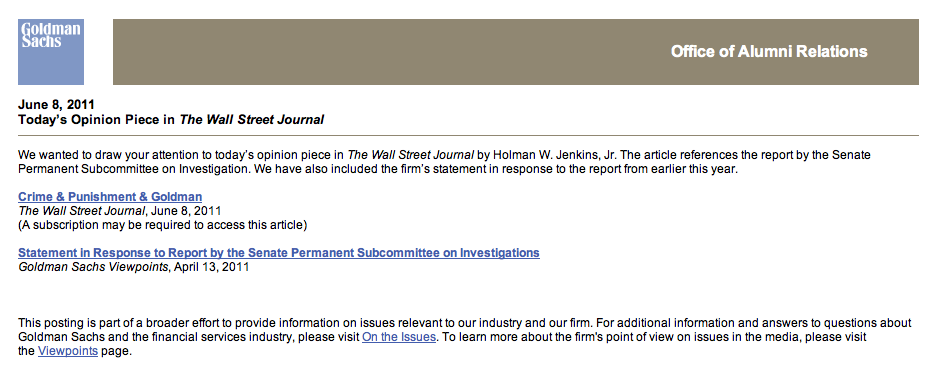
The Jenkins piece, once you edit out the invective and ad hominem attacks, has remarkably little in the way of substance. It’s a classic example of the old saw, “If the law is on your side, pound on the law; if the facts are on your side, pound on the facts; if neither is on your side, pound on the table.”
He calls Levin a whole bunch of names, falsely claims that he is “now backtracking” on perjury accusations Levin never made (when the report was released, he used the word “misled” and has stuck with that formulation) and accuses him of opportunism (on what grounds, exactly? Attacking a famous representative of a powerful donor group like bankers is hardly a pro-survival strategy for a Congressman these days). And he straw mans big time, depicting the report as a witch hunt on Blankfein. Huh? That remark just makes it blindingly obvious that Jenkins didn’t read the report.
He also reveals that he understands nothing about trading or the role of CDOs and credit default swaps in the crisis As we’ve said repeatedly, short sellers via CDS bear no resemblance to short sellers in other markets, and go through the math in long form in Chapter 9 of ECONNED as to how the subprime shorts played a direct role in stoking the subprime bubble and turning what would otherwise have been a contained subprime crisis into a global financial criss. If Jenkins would like to avoid so visibly putting his foot in mouth and chewing in public, he might educate himself rather than take Goldman PR as gospel.
And it also, contrary to multiple source of evidence in the Levin report, tries to depict the firm as dumb and lucky, when it was clear it made a strategic decision to dump as much mortgage risk as possible in late 2006, chose to get net short in February 2007, and then successfully caught a short-term bottom and went long.
Jenkins also bizarrely claims that the failure of Goldman to ride a short position to the market bottom represents some sort of exoneration of Goldman. That’s so barmy I don’t know where to begin. No trader expects to catch peaks and troughs; the pros I know say if you get 50% of a market move, you’ve done very well. And if you read Michael Lewis’ The Big Short, the people who really understood this trade, namely Steve Eisman and the hippie hedgies of Cornwall Capital recognized that if it worked out, it could well represent the end of the financial system, which proved to be a valid concern. The Cornwall folks were very worried about counterparty risk and closed out their trades early.
There is an equally bizarre rebuttal-by-innuendo at the Goldman PR annex over at the New York Times’ Dealbook. In fairness, it reports on the issuance of a Goldman-favoring one-page note by bank stock tout Dick Bove, who seems to have appointed himself a one-man vigilante effort to impede prosecution of his meal tickets (he accused New York attorney general Eric Schneiderman, who seems to be systematically investigating mortgage fraud, of being on a “witch hunt” and “out to make a name for himself”. Since it was the banks that leaked work of Schneiderman’s probes, it’s backwards and uninformed for Bove to accuse Schneiderman of grandstanding).
The problem is there is nothing of substance in the piece, save that Goldman had a little chat with Bove and he is now a true believer:
But now, having gone through the report with Goldman and looked at the supporting documents, he doesn’t believe the allegations that have been levied against the firm. He said he is “perplexed” why Goldman didn’t come forward earlier with their objections to the report.
So we are supposed to trust Goldman via Bove. If the evidence is so persuasive, why is Goldman keeping it so close to the vest? Attorney and structured credit expert Tom Adams said via e-mail:
Apparently unembarrassed by Matt Taibbi’s stinging attack on Dealbook’s shilling for their financial partner, Goldman Sachs, Dealbook continues to due the bidding of their master again today. This time, they interview Dick Bove, of Rochdale Securities, regarding his just published surprising “about face” on Goldman. The report cleverly takes the passive voice, saying that “evidence is now mounting” that a terrible wrong has been done to Goldman because they really didn’t have a net short position, as cited by Senator Levin’s report.
Where is this evidence? Who is it mounting with? In his interview with Goldman, Bove reveals that Goldman themselves walked Bove through their “evidence,’ just as they did for Andrew Ross Sorkin earlier this week, prompting him to echo the new Goldman line that the Senate report was wrong. In his one page note, Bove does not trouble readers with any of the details of the evidence – thus providing no ammunition for potential critics to challenge his conclusion. But Goldman’s hand holding was sufficient to allow Bove to conclude that the Senate committee “misread” the numbers.
Normally, one might expect someone making such an argument – accusing a Senate Committee of lying, basically – to provide some support for such a bold conclusion. Not Bove, though. Perhaps, however, Mr. Bove wasn’t really able to accurately read or understand what Goldman put in front of him. In his interview with Dealbook, he goes even further than what Sorkin argued (that Goldman’s net short position was smaller than what the Senate report claimed because of supposed “offsetting” long positions in mortgage loans elsewhere in their portfolio), and Bove concludes that he doesn’t believe the Senate’s allegations at all and he has “completely changed my attitude about whether they did something wrong”. Instead, he believes Goldman is being unfairly scapegoated.
Taibbi noted when critiquing Sorkin’s article, the more important theme for Goldman’s PR effort appears to be an attempt to undermine the motion that Goldman CEO Lloyd Blankfein lied to the Senate under oath when Blankfein denied that Goldman was “massively short”. Bove dutifully trots out an attempt to defend Blankfein, as well. Comically, Bove compares Blankfein to Andrew Mellon who was subjected to a tax investigation by the Roosevelt administration but ultimately exonerated. This apparently proves to Bove, that rich powerful bankers are commonly the targets of unfair investigations and “scapegoating” and that this is grave miscarriage of justice.
Even an ardent bank defender such as Bove is not persuaded completely. He concedes that Goldman may have done things that “were not correct”, but that the Levin report did not uncover them. Not exactly a firm vote of confidence, in reality, and quite a bit less of a newsworthy story than the Dealbook headline (“Richard Bove Does an About Face on Goldman”) trumpets.
Why has Goldman taken this unconvincing approach to defending itself through the use of bank friendly analysts or reporters? What do they hope to gain from this? Why haven’t they released real numbers and analysis to back up their supposed claims, as reports suggested they might do? This manipulative approach to selectively revealing contradictory evidence, without the courage of a true public defense, seems to a poor solution to their problems. It exposes both the shilly quality of their defenders and a lack of confidence in their counter-attack.
Indeed, there would be some comparatively simple ways to shut up critics and the failure of Goldman to use them raises red flags about their rebuttals. For instance, my understanding is Goldman calculates value at risk (VAR) down to the level of fairly small units within the firm. VAR has its defects, but for this purpose, it would not be a bad first order approximation for contending they were not net short in a meaningful way in the relevant instruments.
The failure of Goldman to provide any metrics over the time frame analyzed in the Levin report, when it clearly depicts strategic decisions of a number of individuals, both at senior levels and on the relevant desks, and then in advance, when trades were being executed, and after the fact, presents an evidentiary hurdle that the firm must surmount. Nothing it has provided even remotely meets that standard.
And it needs to put the arguments and backup before people who can judge it, not reporters or equity analysts. They may be generally intelligent but don’t know the risk characteristics of the various instruments that Goldman would use in establishing and reversing positions in the mortgage market and thus can easily be misled. Goldman’s soliciting votes of approval from people utterly unable to judge the evidence is a sign of weakness, not strength.
