


Courtesy of Mish.
ADP job estimates have been on the high side of BLS estimates for months, and I expect that to be the case again this Friday.
Please consider some snips from the July 2012 ADP National Employment Report®
Employment in the U.S. nonfarm private business sector increased by 163,000 from June to July, on a seasonally adjusted basis. The estimated gain from May to June was revised down slightly,from the initial estimate of 176,000 to 172,000.
Employment in the private, service-providing sector expanded 148,000 in July after rising a revised 151,000 in June. The private, goods-producing sector added 15,000 jobs in July. Manufacturing employment rose 6,000 this month, following a revised increase of 9,000 in June.
Employment on large payrolls—those with 500 or more workers—increased 23,000 and employment on medium payrolls—those with 50 to 499 workers—rose 67,000 in July. Employment on small payrolls—those with up to 49 workers—rose 73,000 that same period. Of the 67,000 jobs created on medium- sized payrolls, 4,000 jobs were created by the goods-producing sector and 63,000 jobs were created by the service-providing sector.
Construction employment rose for the second consecutive month, adding 5,000 jobs. The financial services sector added 9,000 jobs from June to July, marking the twelfth consecutive monthly gain.
Here are a couple of recent regional Fed manufacturing surveys to consider.
Philly Fed Manufacturing Survey
From the Philadelphia Fed Manufacturing Report ….
Indicators Suggest Continued Decreases

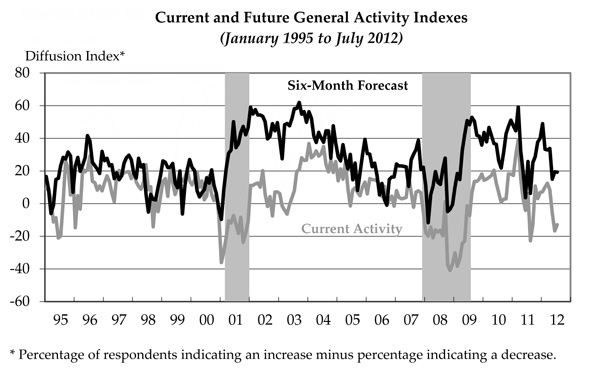
The survey’s broadest measure of manufacturing conditions, the diffusion index of current activity, increased from a reading of −16.6 in June to −12.9. This marks the third consecutive negative reading for the index (see Chart). Nearly 32 percent of the firms reported declines in activity this month, exceeding the 19 percent that reported increases. Indexes for new orders and shipments remained negative but increased 12 and 8 points, respectively.
Labor market conditions at the reporting firms deteriorated this month. The current employment index decreased 10 points, to −8.4, its second negative reading in three months. The percent of firms reporting decreases in employment (18 percent) exceeded the percent reporting increases (10 percent). Firms also indicated fewer hours worked this month: The average workweek index increased 2 points but posted its fourth consecutive negative reading.
Dallas Fed Manufacturing Survey…

