Courtesy of Mish.
I have been collecting links on robots and the roles they play in manufacturing, fashion, and even writing sports updates of major league games.
Let’s take a look at some of them starting with an article in yesterday’s New York Times, Skilled Work, Without the Worker.
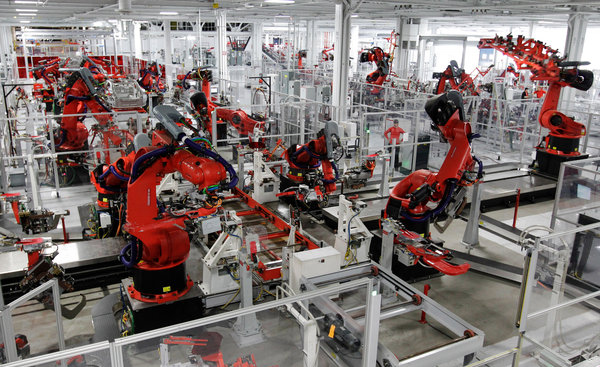
Paul Sakuma/Associated Press
While the many robots in auto factories typically perform only one function, in the new Tesla factory in Fremont, Calif., a robot might do up to four: welding, riveting, bonding and installing a component.
At the Philips Electronics factory on the coast of China, hundreds of workers use their hands and specialized tools to assemble electric shavers. That is the old way.
At a sister factory here in the Dutch countryside, 128 robot arms do the same work with yoga-like flexibility. Video cameras guide them through feats well beyond the capability of the most dexterous human.
One robot arm endlessly forms three perfect bends in two connector wires and slips them into holes almost too small for the eye to see. The arms work so fast that they must be enclosed in glass cages to prevent the people supervising them from being injured. And they do it all without a coffee break — three shifts a day, 365 days a year.
All told, the factory here has several dozen workers per shift, about a tenth as many as the plant in the Chinese city of Zhuhai.
at Earthbound Farms in California, four newly installed robot arms with customized suction cups swiftly place clamshell containers of organic lettuce into shipping boxes. The robots move far faster than the people they replaced. Each robot replaces two to five workers at Earthbound, according to John Dulchinos, an engineer who is the chief executive at Adept Technology, a robot maker based in Pleasanton, Calif., that developed Earthbound’s system.
At an automation trade show last year in Chicago, Ron Potter, the director of robotics technology at an Atlanta consulting firm called Factory Automation Systems, offered attendees a spreadsheet to calculate how quickly robots would pay for themselves.
…