


Courtesy of Pam Martens.
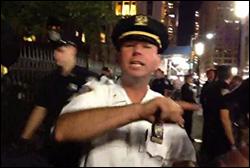
Deputy Inspector Edward Winski, notorious for enforcing a crackdown on peaceful protesters in the Occupy Wall Street movement, was back in charge this past weekend.
We are mindful that the preservation of liberty depends in part upon the maintenance of social order. But the First Amendment recognizes, wisely we think, that a certain amount of expressive disorder not only is inevitable in a society committed to individual freedom, but must itself be protected if that freedom would survive. — U.S. Supreme Court Justice William Brennan, Jr., City of Houston v. Hill (1987)
By Pam Martens: September 17, 2012
With chants of “Police everywhere; justice nowhere,” protesters marching through the streets of lower Manhattan this past weekend to commemorate the one-year anniversary of the Occupy Wall Street movement, ably summed up the situation in New York City. At times, as captured on video footage, law enforcement looked like the unruly mob, grabbing peaceful protesters and arresting people for no apparent reason.
In 1987, in the City of Houston v. Hill, the Nation’s highest court made the law of the land very clear: if it’s a toss up between individual freedom and inconvenient disorder, our Constitution requires that disorder must not only be tolerated by the police, it must also be “protected.”
Unfortunately, the New York City Police Department makes its own laws and carries them out in consultation with private corporations in New York. Those corporations apparently admire the work of NYPD Deputy Inspector Edward Winski. Despite Winski facing multiple claims of violating civil rights, roughing up peaceful protestors, illegally denying access to protesters at public spaces, it was Winski that was out in the streets this past Saturday and Sunday during the Occupy Wall Street protests, barking orders and continuing to oversee arrests of peaceful protesters.
…

