


Courtesy of Pam Martens.
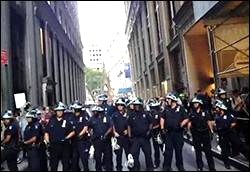 Yesterday, Federal District Court Judge, Richard Sullivan, issued a 32-page smack down to the mass arrest practices of the New York City Police Department. The Court ruled that the NYPD’s arrests of hundreds of peaceful protesters during the 2004 Republican National Convention in Manhattan were unlawful.
In one specific instance, on August 31, 2004, when the police arrested more than 200 peaceful protesters near Church and Fulton Streets, the Court had this to say:
“Moreover, even if [NYPD’s] Monahan’s dispersal order had been sufficiently loud to be heard by all, the marchers had no opportunity to comply with it. Monahan abruptly stopped the march within minutes of its beginning and ordered the marchers to move to the north side of Fulton Street against the St. Paul Cemetery fence. At that point, the police began to form a line that effectively corralled the marchers on the sidewalk, leaving them nowhere to go even if they wanted to leave. Indeed, several marchers (and perhaps bystanders) who attempted to leave were ordered back to the sidewalk, making it clear that they were not free to leave and were effectively arrested. Because the marchers had no opportunity to comply with Monahan’s so-called dispersal order, the Court finds that there was no probable cause to arrest even protesters at the front of the march who might have been able to hear the order.”
The City asked the court to find that there was “arguable probable cause” for mass arrests under which the NYPD would have had a right to qualified immunity. On that point the Court ruled:
“Based on the undisputed facts, and particularly the video of the Fulton Street march and arrests, the Court finds that there was not even arguable probable cause to make those arrests. At most, reasonable officers could disagree as to whether some of the marchers were obstructing traffic; however, no reasonably competent officer could have believed that all of the marchers on Fulton Street had violated the law and were properly subject to arrest. As noted above, it was clearly established by 2004 that an officer must have individualized probable cause to arrest an individual and that mere proximity to illegal conduct does not establish probable cause with respect to an individual.”
Judge Sullivan also rejected the city’s claim that it had lawfully arrested another nearly 400 people near Union Square, concluding that the plaintiffs were entitled to a trial about that location.
…

