


Courtesy of Pam Martens.
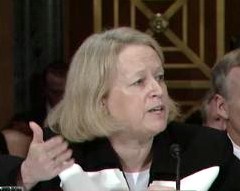
Mary Schapiro, Chair of the SEC
Millions of Americans have no idea that there is a world of difference between money market accounts and money market funds. Two extremely critical words define the difference: FDIC insurance.
Money market accounts are offered by FDIC insured banks and extend the Federal Deposit Insurance Corporation (FDIC) umbrella of protection to the accounts. Money market funds are a mutual fund where the values of the pooled investments can fluctuate and the investor is not insured against loss. Now that banks and brokerage firms are housed under one parent since the repeal of the Glass-Steagall Act, both types of accounts may be offered to the customer by the firm and the distinction is not always spelled out.
The confusion seems to be intentionally aided by the fact that money market funds are permitted to perpetually price at a stable $1 per share, making it appear that the principal is completely safe and never fluctuates, as it does in stock and bond mutual funds. But that’s a deception that is denying American investors the right to transparency with their investments and the right to make informed decisions.
After Lehman Brothers failed on September 15, 2008, the Reserve Primary Fund, a so-called prime money market fund with $62 billion in assets, “broke the buck,” meaning its value dropped below the $1 per share level. That caused a panic. The U.S. Treasury was forced to step in and provide its guarantee to $3 trillion residing in non transparent money market funds.
And here we are, four years later, with money market funds still misleading investors with that $1 per share pricing and holding an unfair competitive advantage over non Wall Street banks offering lower yielding but FDIC insured money market accounts.
…

