


Courtesy of Pam Martens.
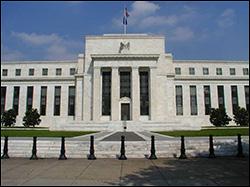
Federal Reserve Building in Washington, D.C.
On December 23 of this year, the Federal Reserve will be 99 years old. And throughout that 99 years, regardless of boom, bust, recession or Great Depression, the biggest Wall Street banks have been enjoying a 6 percent, risk-free return on the capital they hold at the Fed in the form of dividends.
Have you looked at your checking or money market bank statement lately from JPMorgan Chase or Citibank? How about the statement showing the interest you’re earning on your mortgage escrow account with the big banks? While the country suffers through the lingering effects of the Great Recession caused by the biggest Wall Street banks, the public typically receives less than 1 percent on their deposits at the big banks, while the government has legislated a permanent, risk-free 6 percent guarantee to the Wall Street banks for their capital on deposit at the Fed. Now that’s an entitlement program that needs to die!
The Fed requires that its member banks subscribe to “stock” in an amount equal to 6 percent of their capital and surplus. The banks have to post half that amount with the Fed upon becoming a member; the other half is subject to call by the Board of Governors of the Federal Reserve in Washington, D.C. The deposited capital entitles the bank to a corresponding share of “stock” in the regional Fed. The stock is not like regular common stock: it can’t be traded, sold, pledged as collateral, gifted to family members, shorted, or aggregated to effect a takeover. It’s this “stock” that’s receiving the risk-free 6 percent dividend from the Fed.
This corporate welfare program gets even better: if the shares of stock were acquired prior to March 28, 1942, the 6 percent risk-free dividend is tax exempt and the bank doesn’t have to pay corporate taxes on it.
Most of the biggest banks on Wall Street can trace their banking charters back much further than 1942. In the case of a Wall Street powerhouse like JPMorgan Chase, its banking roots date back to the late eighteenth century. Aaron Burr founded The Manhattan Company (predecessor to Chase Manhattan Bank) on September 1, 1799 at 40 Wall Street. The precursor to Citibank, the commercial bank owned by the formerly taxpayer supported Citigroup, dates back to the founding of City Bank of New York in 1812.
…

