


Courtesy of Pam Martens.
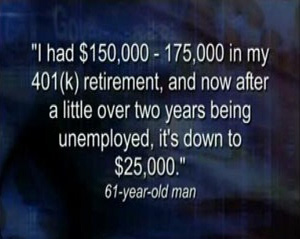
GAO Listens to Older Workers Describe the Impact of the Financial Crisis
The General Accountability Office (GAO) has released a devastating appraisal of the financial toll the 2007 to 2009 Wall Street financial crisis has had on the U.S. economy and workers. According to the GAO, cumulative output losses could exceed $13 trillion with another $9 trillion in losses in household wealth through declines in home equity, bringing just those two areas of losses to potentially $22 trillion. The study notes that it can’t quantify losses in financial assets since the stock market has regained much of its lost ground but many people as well as portfolio managers of pensions and retirement assets locked in their losses by selling as the market dived.
The report indicates that the steep decline in home values during the financial crisis left homeowners collectively holding home mortgage debt in excess of the equity in their homes, marking a first since the data began being compiled in 1945. As of December 2011, the report said national home equity was approximately $3.7 trillion less than total home mortgage debt.
A key concern expressed throughout the study is whether the U.S. economy and many older workers can ever recover from the crisis. According to the report:
“Some studies describe reasons why financial crises could be associated with permanent output losses. For example, sharp declines in investment during and following the crisis could result in lower capital accumulation in the long-term. In addition, persistent high unemployment could substantially erode the skills of many U.S. workers and reduce the productive capacity of the U.S…CBO [Congressional Budget Office] reported that recessions following financial crises, like the most recent crisis, tend to reduce not only output below what it otherwise would have been but also the economy’s potential to produce output, even after all resources are productively employed…
“In a June 2012 working paper, International Monetary Fund (IMF) economists estimated the cumulative percentage difference between actual and trend real GDP for the 4 years following the start of individual banking crises in many countries. They found a median output loss of 23 percent of trend-level GDP for a historical set of banking crises and a loss of 31 percent for the 2007-2009 U.S. banking crisis. Other researchers who assume more persistent or permanent output losses from past financial crises estimate much larger output losses from these crises, potentially in excess of 100 percent of pre-crisis GDP.”
…

