


Courtesy of Pam Martens.
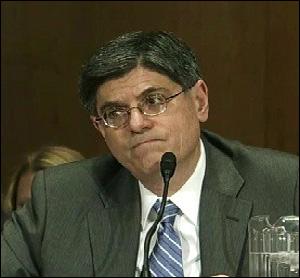
Jack Lew Testifying at His Confirmation Hearing, February 13, 2013
You know the President’s nominee for Treasury Secretary, Jack Lew, is in trouble when media from the left, right and center of the political spectrum are shredding the mild-mannered, bespectacled numbers cruncher. For good reason, I might add.
Lew will now have more embarrassing details to explain (or not, as has become his custom). We’ve dug out the details of his head-spinning mortgage deals with his two former employers, New York University and Citigroup. This comes on the heels of the bombshell dropped by Senator Orrin Hatch in the confirmation hearing regarding Lew’s cozy employment agreement with Citigroup that paid him a bonus of $940,000 if he could somehow manage to secure a “full time high level position with the United States Government or a regulatory body.” The insolvent bank had just been bailed out by the taxpayer, making the $940,000 bonus accepted by Lew in early 2009 a gift from the public purse.
Yesterday, the uber conservative editorial page of the Wall Street Journal clicked off the problems it has with Lew: “Investor in Cayman Islands tax haven? Check. Recipient of a bonus and corporate jet rides underwritten by taxpayers at a bailed-out bank? Check. Executive at a university that accepted student-loan ‘kickbacks’ for steering kids toward a favored bank? Check. Excessive compensation with minimal disclosure? Check.”
The kickbacks the editorial references were akin to what Bernie Madoff was doing in the “legitimate” stock trading side of his company. Madoff paid brokerage firms a penny or two a share to direct stock traffic to his brokerage business to steal trades away from the New York Stock Exchange. The practice was called “payment for order flow.”
While Jack Lew was employed as a Vice President of Operations at New York University, his future employer, Citigroup, was named a “preferred lender.” NYU students were directed to Citigroup for student loans and the company reciprocated with the equivalent of “payment for loan flow,” kicking back to New York University .25 percent of the net loan value directed to it. The University said it used the funds, a whopping $1,394,563 between 2002 to 2007, as financial aid to other students.
…

