


Courtesy of Pam Martens.
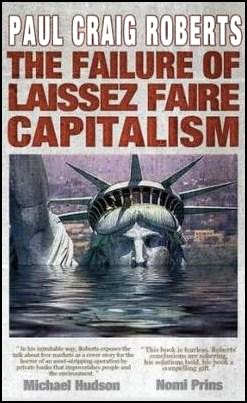 Paul Craig Roberts is one of the most prolific economic writers in America today. As a former Wall Street Journal editor and former Assistant Secretary of the Treasury, Roberts is a walking encyclopedia on monetary policy, economic theory and Wall Street history. After publication in Germany in 2012, his latest book, The Failure Of Laissez Faire Capitalism And Economic Dissolution Of The West, is now available in the U.S. as an eBook.
If you’ve read a Roberts’ column over the past few years, you know there’s nothing timid or constrained in his writing. The same can surely be said for this current work. Roberts expertly details how the one percenters have masterminded a political and economic takeover that just keeps on giving to the one percent as the economy wobbles, the U.S. debt explodes and the middle class is hollowed out.
Roberts sees the last two decades as an era where losses in salaries to the average American worker (as their jobs were moved offshore) reverted back to shareholders and executives in the form of capital gains and performance bonuses from the higher profits that flowed from lower foreign labor costs. “The distribution of income,” says Roberts, “worsened dramatically with the mega-rich capturing the gains, while the middle class ladders of upward mobility were dismantled.”
Roberts does not miss a key construct in how the game was able to continue for so long: “The absence of growth in real consumer incomes resulted in the Federal Reserve expanding credit in order to keep consumer demand growing. The growth of consumer debt was substituted for the missing growth in consumer income.” To make the mountains of debt magically disappear into thin air, it was “securitized, given fraudulent investment grade ratings, and sold to unsuspecting investors at home and abroad.” Now, explains Roberts, the debt has come home to roost: consumers are buried under credit card and mortgage debt and lack the wherewithal to spend.
When the bubble finally burst, says Roberts, “the former bankers running the U.S. Treasury provided massive bailouts at taxpayer expense for the irresponsible gambles made by banks that they formerly headed.” Roberts recounts the fact that an audit of the Federal Reserve – which it fought against for years in court – revealed that it “had provided $16 trillion – a sum larger than U.S. GDP or the U.S. public debt – in secret loans to bail out American and foreign banks, while doing nothing to aid the millions of American families being foreclosed out of their homes.”
Roberts correctly believes that the seriousness of the financial crisis has focused too exclusively on Wall Street without proper focus on the attenuating factor – that the dramatic expansion in consumer debt was used as a substitute for the lack of growth in consumer incomes as jobs were offshored.
…

