


Courtesy of Mish.
Do not expect any government or central bank to learn much from history, especially Japan and especially now.
For example, please consider this bit of “inspirational madness”: Bank of Japan Finds Inspiration in a 1930s Iconoclast.
The bank’s governor, Haruhiko Kuroda, announced a “new dimension in monetary easing,” vowing to double the purchases of government bonds and expand the monetary base. The BOJ also formally adopted a previously announced two-year target of 2 percent inflation. Quantitative easing will be the bank’s core business for the near future, a strategy that resembles the Federal Reserve’s response to the collapse of Lehman Brothers Holdings Inc.
The BOJ’s actions also mark a return, at least partly, to the unorthodox efforts of Japan’s finance minister in the early 1930s, Korekiyo Takahashi, who was praised by Fed Chairman Ben Bernanke for “brilliantly rescuing Japan from the Great Depression through reflationary policies.”
Takahashi has recently received renewed attention from economists, historians and policy makers. In Japan, the number of popular publications on him suggests a Takahashi following. A biography by Richard Smethurst, “From Foot Soldier to Finance Minister: Takahashi Korekiyo, Japan’s Keynes,” became an academic hit when it was published in Japanese in 2010.
Rest of the Story
My friend Pater Tenebrarum on the Acting Man blog shared these thoughts via email.
“For some reason, no-one seems to want to talk about how Korekiyo Takahashi’s policies ended. Here’s the rest of the story…. Eventually Japan went into war that ended in hyperinflation and total destruction of the Japanese economy. Praising the economic policies of Takahashi is quite a bit like praising the economic policies of Hitler. It’s totally absurd.“
Yet here we are in the throes of Keynesian absurdity.
Historical Yen Chart
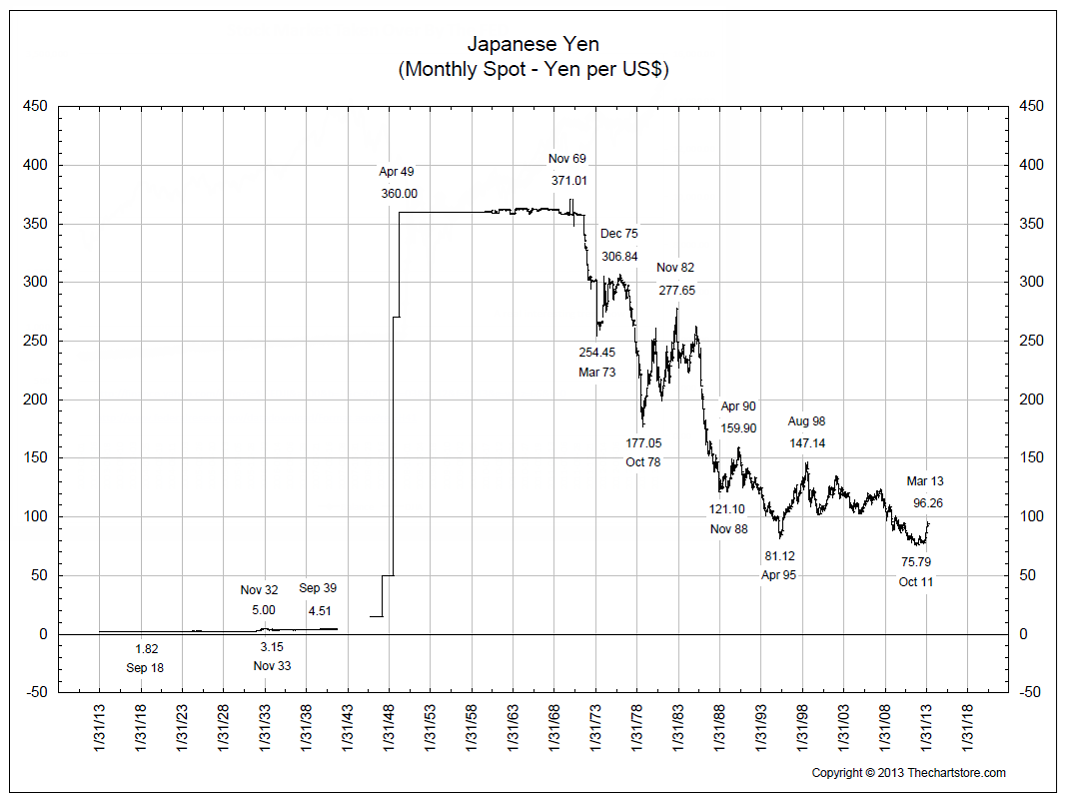
click on chart for sharper image
More Revised History
…

