


capitalism is inherently flawed,.. ~ Hyman Minsky
Instability may not be optional
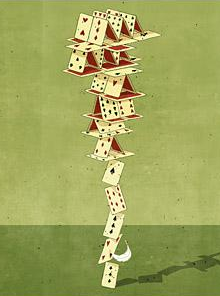 By Steve Keen
Sydney Morning Herald commentator Gareth Hutchens commented that the Rogoff and Reinhart affair shows how slow economists are to realise that their data may be dodgy, but to my mind that is insignificant compared to how slow they are to realise that their theories are dodgier still.
A defining feature of mainstream economic modelling is the belief that the economy is stable: given any disturbance, it will ultimately return to a state of tranquil growth. Mainstreamers argue over how fast this will happen: Chicago/Freshwater /New Classicals argue it adjusts instantly, while Saltwalter/New Keynesians say it will take time because of ‘frictions’ in the economy’s adjustment processes. But they both take the innate stability of the economy for granted, and this belief is hard-coded into their mathematical models.
This stability is also seen as a good thing – so much so that anything which obstructs it being achieved should be removed. They argue over policy in a crisis like the world’s current one, with New Classicals falling firmly into the ‘Austerians’ camp while New Keynesians favour fiscal stimulus, but they speak almost as one in favour of eliminating monopolies, reducing union power, deregulating finance – or they did before the financial crisis came along.
One would think that after as disturbing an event as the Great Recession – and let’s call it as it is now, the Second (or perhaps Third) Great Depression in Europe – that this belief in the innate stability of capitalism might be at least reconsidered by the mainstream. But though they’re willing to tinker at the edges, their core vision of the economy as being either in or near a stable equilibrium remains an unchallenged mantra.
I come from a different tradition that sees the economy as inherently unstable, and which regards this instability as both creative and destructive. Schumpeter famously gave us the phrase “creative destruction” to describe the process by which capitalism develops new products and new institutions, and my work builds on his and that of his most famous pupil, Hyman Minsky.
Here there is also a bit of a “Freshwater vs Saltwater” divide, since Schumpeter focused on the industrial and entrepreneurial process – what you might call Main Street Capitalism – while Minsky focused on Wall Street Capitalism. In the latter case, the instability can be purely destructive, as inventive financiers find ways to portray what are innately Ponzi Schemes as good investments, and end up fleecing the public while conjuring financial crises into existence…
Keep reading: Instability may not be optional | Business Spectator.

