


Courtesy of Mish.
In Potential Mistakes (Wonkish), Paul Krugman wrote "It is important to have an idea of how much the economy could and should be producing, and also of how low unemployment could and should go."
Much of the rest of the post is indeed "wonkish", complete with charts.
Taking "wonkishness" at least an order of magnitude higher, Edward Lambert writing for the Effective Demand blog actually attempts to determine True Potential Real GDP by looking at previous recessions.
Here is chart number 6 in an 8 chart series.
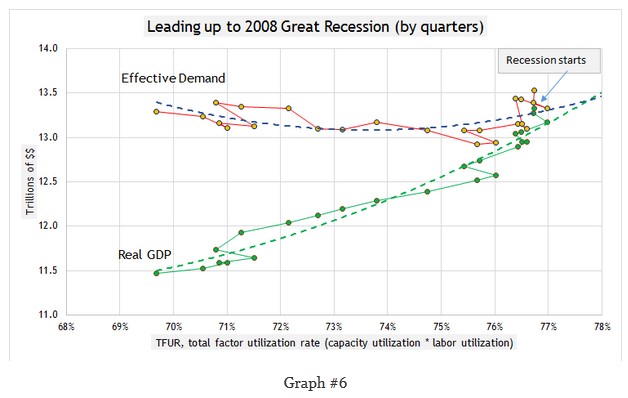
I am not going to bother explaining the chart, nor do I think anyone should spend any time studying it. Rather, let's discuss Lambert's two-paragraph conclusion.
The global economy has been made unstable by low interest rates. I have my doubts that the economy can push against the effective demand limit like it did from 2006 through 2007. The Fed raised rates during that time to control a bit of inflation. Yet, this time around, if the Fed tries to regulate the economy in any way, the global reaction will be tremendous.
Like Paul Krugman says, it is important to know what the economy is really capable of producing in order to set appropriate fiscal and monetary policy. And if my analysis above is correct, monetary policy is based on a false notion of potential real GDP. This is too dangerous to get wrong. The global economy is hanging in the balance.
Measuring Real Potential GDP
I have no issues with the first paragraph above. The Fed (central banks in general) certainly have made the global economy unstable in recent years, blowing repetitive bubbles of increasing magnitude.
However, I strongly disagree with Krugman and Lambert regarding the importance of figuring out real potential GDP.
For starters, GDP is a blatantly distorted number….

