


Courtesy of Lee Adler of the Wall Street Examiner
Central Bankers are Like Pavlov's Dogs
The latest weekly jobless claims data were substantially weaker than the trend, which could be a red flag that the economy has radically slowed in July. Initial claims for unemployment compensation declined at an annual rate of just 0.3%. Stock prices remain extended relative to the claims trend. Stocks could break through resistance and make that extension even more extreme. That would play into the hands of FOMC hawks who want to cut back the rate of Fed purchases under QE. However, if the stock market corrects, and that is joined by signs of economic weakening in the data for July, the arguments of the doves would be strengthened and the Fed would probably extend QE at its current pace for as long as the economic data was weaker. That would be bullish.
The Labor Department reported that the seasonally adjusted (SA) representation of first time claims for unemployment was 343,000, an increase of 7,000 from the previous week’s revised figure of 336,000 (was 334,000) in the advance report for the week ended July 20, 2013. The consensus estimate of economists of 340,000 for the SA headline number was too optimistic (see footnote 1), a reversal of the prior week’s overly pessimistic estimate, in the game of pin the tail on the jackass.
The headline seasonally adjusted data is the only data the media reports but the Department of Labor (DOL) also reports the actual data, not seasonally adjusted (NSA). The DOL said in the current press release, “The advance number of actual initial claims under state programs, unadjusted, totaled 338,1400 in the week ending July 20, a decrease of 71,879 from the previous week. There were 340,780 initial claims in the comparable week in 2012.” [Added emphasis mine] See footnote 2.
The advance report is usually revised up by from 1,000 to 4,000 in the following week, when all interstate claims have been counted. Last week’s number was approximately 1,500 shy of the final number for that week released Wednesday. For purposes of this analysis, I adjusted this week’s reported number up by 1,500. The adjusted number that I used in the data calculations and charts for this week is 340,000 rounded. It won’t matter that it’s a thousand or two either way in the final count next week. The differences are essentially rounding errors, invisible on the chart.
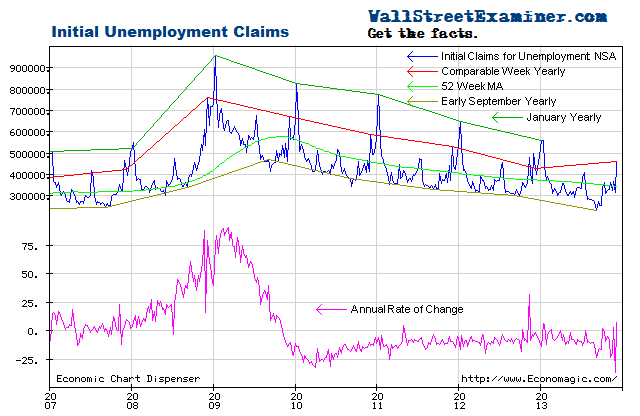
Initial Unemployment Claims – Click to enlarge
The actual filings last week represented a decrease of only 0.3% versus the corresponding week last year. The prior week was down 10%. The average weekly year to year improvement of the past 2 years is -8.2%. The range is from near zero to -20%. The year to year comparisons are now much tougher than the 2010-2012 period as the number of job losses declined sharply between 2009 and 2012, so some slowing in the rate of improvement is to be expected, but if the comparisons go negative, that is if this year’s weekly claims start coming in greater than last year’s it would be a sign of a weakening economy.
The rate of decline in recent weeks had been better than the 2 year average in a sign of a steady growth in economic activity. This week’s data broke that trend. While it may be an aberration, real time federal withholding tax data (which I update weekly in the Treasury Report) corroborates that there’s been some weakening in July and a break of the trend of improvement. This data lends support for the lowering of economic expectations for the start of the third quarter, but not for the second quarter. June data and Q2 data should handily beat forecasts, just as June Durable Goods Orders did today.
The current weekly change in the NSA number is a decrease of 70,000 from the previous week. That compares with an average change of an increase of 95,000 for the comparable week over the prior 10 years, and a decrease 114,000 for the comparable week last year. The current weekly performance is weaker than average and weaker than last year. A similar weaker performance last week broke a string of stronger than average performances.
This week’s data is at the limit of the trend of the past 2 1/2 years, leaving the year to year change on the brink of going negative, that is, the current number of claims could be larger than last year. Next week’s release will give a critical indication in this regard.
Neither stopping nor starting rounds of QE seems to have had an impact on claims. Nor did the fecal cliff secastration. The US economy is so big that it develops a momentum of its own that policy tweaks do not impact. Policy makers and traders like to think that policy matters to the economy. The evidence suggests otherwise.
Monetary policy measures may have little impact on the economy, but they do matter to financial market performance. In some respects they’re all that matters. We must separate economic performance from market performance. The economy does not drive markets. Liquidity drives markets, and central banks control the flow of liquidity most of the time. The issue is what drives central bankers.
Central bankers pay attention to economic data. If this hint of weakness becomes sustained, it would suggest that the US economy has run out of momentum. That could panic the Fed into extending or even enlarging QE, which would probably send stock prices into an extended parabolic blowoff.
Some economic series correlate with stock prices well. Others don’t. I give little weight to economic indicators when analyzing the trend of stock prices, but economic indicators can tell us something about market context, in particular likely central banker behavior. Central bankers are like Pavlov’s dogs. If you ring a bell, they print money, whether it will do anything to help the economy or not. They think that it will. Knowing that can be useful in formulating strategy and tactics. Weakening employment data would ring a bell.
On the chart below the claims trend is plotted on an inverse scale with stock prices on a normal scale. This comparison suggests that bubble dynamics are at work in the equities market, thanks to the Fed’s money printing. Those dynamics could end here, or they could become even more extreme depending on whether stock prices now pull back, or break out. I address the potential outcomes in my proprietary technical work.
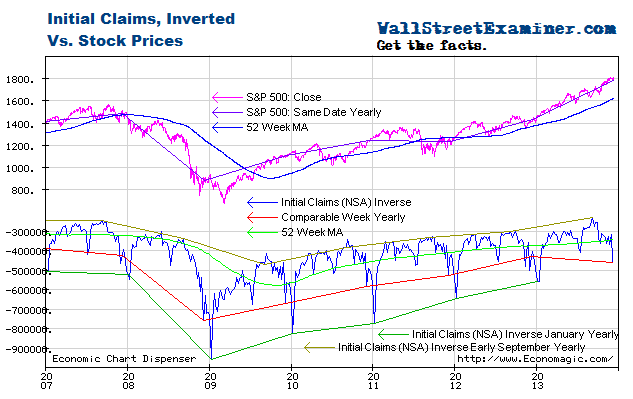
Initial Unemployment Claims and Stock Prices- Click to enlarge
Two weeks ago I wrote, “With Bernanke seemingly reaffirming that QE will be around for a while longer, there’s an increased likelihood that stock prices will decouple completely from economic indicators in the weeks ahead and continue in parabolic blowoff mode until the Fed takes concrete steps to reduce QE.” That probably still applies, especially if economic data weakens in the weeks ahead.
Get regular updates the machinations of the Fed, Treasury, Primary Dealers and foreign central banks in the US market, in the Fed Report in the Professional Edition, Money Liquidity, and Real Estate Package. Click this link to try WSE's Professional Edition risk free for 30 days!
Copyright © 2012 The Wall Street Examiner. All Rights Reserved. The above may be reposted with attribution and a prominent link to the Wall Street Examiner.

