


Courtesy of Pam Martens.
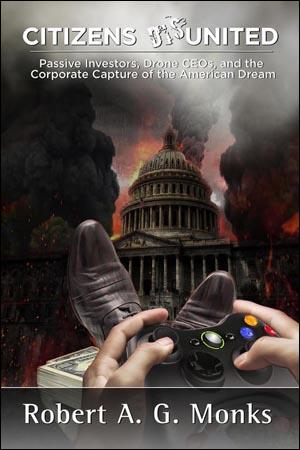 Robert A.G. Monks has written a very dangerous book, Citizens DisUnited: Passive Investors, Drone CEOs, and the Corporate Capture of the American Dream. Grab two copies of this book as fast as you can: put one out to sea in a watertight bottle for future archeologists to piece together the downfall of America; put another in a safe in your home. If things continue on the path we’re on, corporations will be rounding up books like this for bonfires.
Monks’ book is a serious threat to the status quo because there are only a handful of Americans who could so deftly unravel the corporate takeover and corruption of every device or institution available to the average citizen to have a meaningful voice in society. Monks builds his case, much as a skilled trial lawyer presents his evidence to the jury, but in an immensely readable style that, despite the subject matter, is often humorous.
Even for the scholar of this unprecedented era of systemic corruption, there will be many epiphanies and surprises.
Monks has been an activist for decades on corporate governance, or the lack thereof. He has written and testified widely. Together with well-known corporate governance expert, Nell Minow, he wrote Power and Accountability (Harper Business, 1991); Corporate Governance (Blackwell Publishing, 1995); and Watching the Watchers (Blackwell Publishers, 1996).
As the title suggests, the book is an indictment of the U.S. Supreme Court’s embrace of corporate dictatorship in its Citizens United decision which enshrined corporate personhood and removed barriers to corporations infusing vast sums into U.S. elections.
Monk writes: “…the defense of Citizens United offered by Justice Samuel Alito at a November 2012 meeting of the archconservative Federalist Society borders on the clinically obtuse or borderline deranged. ‘The question is whether speech that goes to the very heart of government should be limited to certain preferred corporations – namely, media corporations,’ Alito said. ‘Surely the idea that the First Amendment protects only certain privileged voices should be disturbing to anybody who believes in free speech.’ ”
…

