


Lee notes we have two countervailing forces at play – a strongly bullish liquidity indicator fueled by the Federal Reserve buying Mortgage Backed Securities from Primary Dealers (see charts below) vs. deleveraging and capital destruction.
Courtesy of Lee Adler of the Wall Street Examiner
The FOMC is clinically insane so I can’t predict how it will react to the softening of stock prices and skyrocketing yields. Empirically, the Fed “should” taper its rate of securities purchases, but the Fed usually makes policy in reaction to immediate short term stimuli, not with regard to any long term game plan that makes any sense. In any case, QE will stay around at some substantial level, and we can make judgments about the implications of that in the face of the negative forces that are beginning to swirl about the markets.
The composite liquidity indicator rose last week as the Fed’s usual mid month settlement of MBS [Mortgage Backed Securities] forward purchases added a pile of cash to Primary Dealer accounts. Other components in the indicator pulled back as a result of deleveraging and capital destruction elsewhere. The “elsewhere” appears to be gaining in importance relative to the US market core liquidity tracked by this indicator.
The indicator remains in a strongly bullish trend mostly due to the massive cash infusions from the Fed’s purchases of MBS. The August round of settlements totaled $67 billion. However, the Treasury increased supply by $45 billion [supply of Treasuries to be purchased], in effect a “synthetic taper” that absorbed some of the funds from the Fed’s injections. That may give us a preview of the impact of the actual Taper when it begins. The indicator line will then rise at a slower rate.

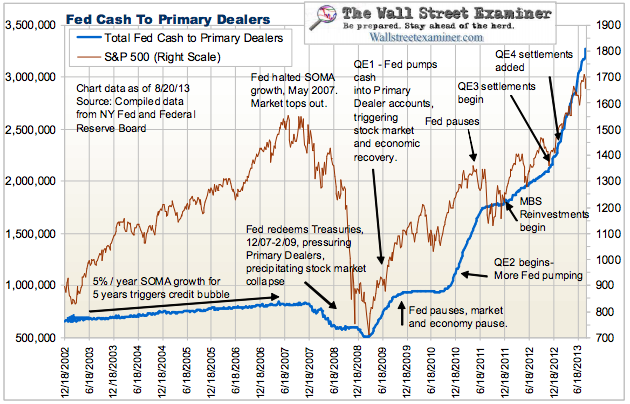
The recent selloffs in stocks and bonds have created a situation where the markets appear to be running counter to the liquidity trend. Deleveraging and capital destruction in areas outside of those covered by this indicator are creating countervailing negative forces. Stocks also may have become too extended relative to the liquidity trend, similar to 2011. A pullback was due. Any tapering of QE and/or persistent increase in Treasury supply could exacerbate the correction over the next couple of months.
As long as the trend of this indicator remains strongly upward, it’s highly doubtful that a full blownbear market could emerge, but I would defer to the technical indicators that we follow in the nightly stock market updates for signals in that regard. If long term technical indicators go to the sell side, I’d respect those signals, regardless of whether this indicator remained bullish. Technical analysis of price trends must always be given the greater weight in the event of conflict between liquidity indicators and price action. For the most part, we have not had to face such a conundrum as the technicals and liquidity factors have usually been in gear.
Get regular updates the machinations of the Fed, Treasury, Primary Dealers and foreign central banks in the US market, in the Fed Report in the Professional Edition, Money Liquidity, and Real Estate Package. Click this link to try WSE's Professional Edition risk free for 30 days!
Copyright © 2012 The Wall Street Examiner. All Rights Reserved. The above may be reposted with attribution and a prominent link to the Wall Street Examiner.

