


Courtesy of Mish.
By now, everyone is well aware that real wages have not kept up worker productivity. But why is that?
The Fed, government bureaucrats, and economists are puzzled by the phenomenon as well as what to do about it.
I can explain easily, but first let’s zero in on what is happening.
Workers Don’t Share in Companies’ Productivity Gains
In stark contrast to the great American dream, CNN notes Workers don’t share in companies’ productivity gains.
Companies are on a tear in terms of productivity and profits, but they aren’t sharing much of the gains with their workers.
The gap between hourly compensation and productivity is the highest it’s been since just after World War II. This divergence is one of the major drivers of the nation’s growing income inequality.
“A bigger share of what businesses in the U.S. are producing is going to the owners of the firms and the people who lent money to the firm, and a smaller share is going to workers,” said Gary Burtless, senior fellow in economic studies at The Brookings Institution.
Productivity, which measures the goods and services generated per hour worked, rose by 80.4% between 1973 and 2011, compared to a 10.7% growth in median hourly compensation, according to the left-leaning Economic Policy Institute, which crunched the numbers last year.
Real Wages vs. Productivity
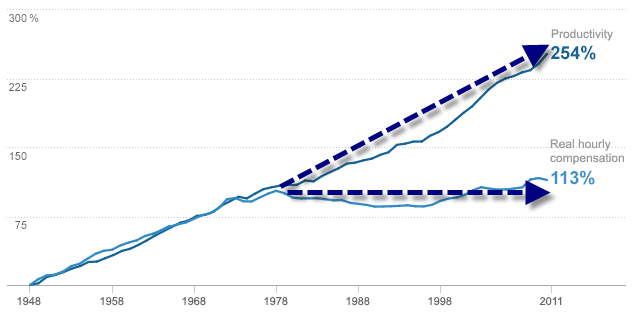
CNN states “Global competition and national deregulation have kept compensation down, while the decline of union power weakened workers’ ability to bargain for higher pay.”
Where Did the Productivity Go?…

