


Courtesy of Mish.
In Long-Term Jobless Left Out of the Recovery, the Wall Street Journal notes that Despite Improving Economy, Prospects Are Bleak for Millions of Unemployed.
More than four years after the recession officially ended, 11.5 million Americans are unemployed, many of them for years. Millions more have abandoned their job searches, hiding from the economic storm in school or turning to government programs for support. A growing body of economic research suggests that the longer they remain on the sidelines, the less likely they will be to work again; for many, it may already be too late.
The recession, for all its brutality, was comparatively egalitarian, said Gary Burtless, a Brookings Institution economist. It struck the young and old, educated and uneducated, white collar and blue collar. The recovery, by contrast, has been asymmetric: Those who held on to their jobs or quickly found new ones have made up much of the ground they lost, while the jobless continue to suffer.
“If you’ve made it through and you’re still employed, your stock portfolio has recovered, your house price is recovering, too,” Mr. Burtless said. “For the unemployed, this has been a miserable recovery compared to pretty much any of the postwar recoveries.”
Recent studies in both the U.S. and overseas found employers often won’t even consider the long-term jobless for openings.
Many have given up applying. Nearly seven million people say they want a job but aren’t actively looking for work. The share of the population that is working or looking for work—a measure known as the participation rate—stands near a three-decade low. The rate was falling even before the recession, partly because of the aging of the baby-boom generation, but economists disagree about how much of the more recent decline is tied to the weak economy.
For economists, the key question is how many of the labor-force dropouts will return when the economy eventually rebounds more strongly.
At least some of those who have left the labor force are unlikely to return. More than 8.9 million Americans were receiving federal disability payments in August, 1.8 million more than when the recession began. Experts suspect many of the new recipients would have kept working in a healthier economy; research has found that once people begin receiving disability payments, relatively few return to work.
But other workers, especially those in their 20s and 30s, will almost certainly return.
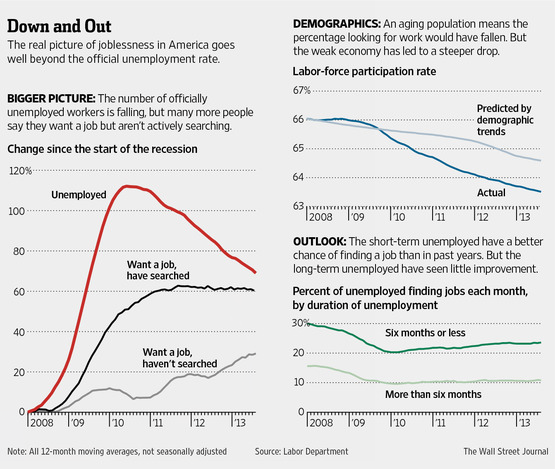
What is Happening vs. Why
The Wall Street Journal did a good job explaining “what” is happening. The Journal failed to explore “why” this is happening.
I will address the key question in a moment. First consider a few more charts….

