


Courtesy of Mish.
The latest Gallup survey shows Near-Record Number of Americans Struggle to Afford Food.
More Americans are struggling to afford food — nearly as many as did during the recent recession. The 20.0% who reported in August that they have, at times, lacked enough money to buy the food that they or their families needed during the past year, is up from 17.7% in June, and is the highest percentage recorded since October 2011. The percentage who struggle to afford food now is close to the peak of 20.4% measured in November 2008, as the global economic crisis unfolded.
Question: Have there been times in the past 12 months that you did not have enough money to buy food that you or your family needed?
This is only the third time in 68 successive months of Gallup and Healthways’ tracking, which began in January 2008, that at least 20% of Americans said they struggled to afford food in the past year.
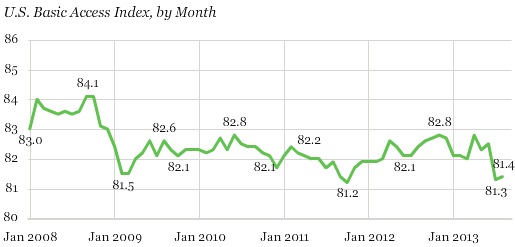
Americans’ Access to Basic Needs Hovers Near Record-Low
Americans remain as likely to have access to basic necessities in general now as they were in October 2011, when it was at its lowest point. The Basic Access Index, which includes 13 questions about topics including Americans’ ability to afford food, housing, and healthcare, was 81.4 in August, on par with the all-time low of 81.2 recorded in October 2011.

Who Does Gallup Blame?
Citing the Wall Street Journal, Gallup blames stagnant wages.
According to an August 2013 Wall Street Journal analysis of Labor Department data, “the average hourly pay for a nongovernment, non-supervisory worker, adjusted for price increases, declined to $8.77 [in July 2013] from $8.85 at the end of the recession in June 2009.” Depressed wages are likely negatively affecting the economic recovery by reducing consumer spending, but another serious and costly implication may be that fewer Americans are able to consistently afford food and meet other basic needs.
Gallup also blames Republicans.
Federal government programs also play a role in addressing this issue. As food stamp (SNAP) enrollment increases, Republicans in Congress are proposing substantial cuts and reforms to the program, while Democrats are resisting such reductions. Regardless, food stamp benefits are set to be reduced in November after a provision of the 2009 fiscal stimulus program expires. Therefore, it is possible that even more Americans may struggle to afford food in the immediate future.
Who is Really to Blame?
- The Fed
- Fractional Reserve Lending (Central banks in general for sloshing money around).
- Lack of a Gold Standard
- Congress (for throwing money at numerous programs)
- War-mongers
Raising the minimum wage does not fix the problem. And wasting money waging wars we cannot afford is counterproductive.
…

