

Courtesy of Pam Martens.
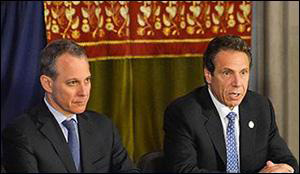
New York State Attorney General, Eric Schneiderman, (left) and Former New York State Attorney General, Andrew Cuomo, (Now Governor) Have the Power Under the NYS Martin Act to Rein In Big Bank Abuses
An institutionalized wealth transfer system is playing out at New York University, a nonprofit organization subsidized by the U.S. taxpayer. Forgivable mortgage loans for multi-million dollar luxury homes have been doled out by NYU to an inner circle of administrators and elite faculty. The University’s President, John Sexton, has received an interest rate of less than one-quarter of one percent from NYU to finance a multi-million dollar beach residence on Fire Island. All this while NYU students carry the greatest burden of debt of any nonprofit university in the country – a figure placed at $659 million in 2010 by the Department of Education and now estimated to be well over $1 billion due to a poorly understood debt compounding trick called “capitalized interest.”
While the unconscionable mortgage loans at NYU have received significant press attention and a Congressional probe by Senator Chuck Grassley, the unseemly details of just how NYU students amassed all this debt and the conflicts of interest between the university’s preferred lender, Citibank, and the Chairman of NYU’s Board, Martin Lipton (who has inexplicably held that post for the past 15 years), have failed to make it to the front pages of mainstream media.
On April 2, 2007, with much press and fanfare, then Attorney General of New York State, Andrew Cuomo (now Governor of the state), announced a settlement with NYU and Citibank (the insured deposit bank owned by the Wall Street poster child of bailouts) Citigroup. According to the settlement documents, NYU had decided in 2001 to put Citibank’s Student Loan Corporation (SLC) on a list it recommended to students as a preferred source for student loans. But unbeknownst to many students and their parents, according to the Attorney General, Citibank was kicking back a portion of the loans to NYU – a sum totaling $1,394,563.75 during the period 2002 through 2007. According to the Attorney General’s settlement, this practice is illegal under New York State Executive Law and General Business Law.
There were a number of decidedly problematic aspects to this settlement. First, Citibank was let off the hook with a tiny commitment to contribute $2 million to a national fund administered by the Attorney General’s office to educate college-bound students about the student loan industry. The settlement came just a few months into the investigation and before the Attorney General’s office had all the facts – as evidenced by the requirement in the settlement that the parties agree to continue cooperating with the investigation. There was also a statement in the settlement which would not hold up to future revelations – that Citibank’s SLC lending division was selected because it was going to offer “private loans to the University’s students and their families at the favorable interest rate of one percent below the prime rate (currently 7.25 percent)[in 2007], with no fees, on terms under which more than 80 percent of the University’s students and their co-signers qualify.”
Another component of the settlement raising serious red flags was the statement Cuomo made in his press release at the time, seemingly saluting Citigroup, a serial law violator that had over a decade clearly demonstrated it had no remorse or intent to reform its practices. In 2011, U.S. District Judge Jed Rakoff in Manhattan rejected a $285 million settlement between Citigroup and the SEC, calling the company a “recidivist” or repeat offender. (To underscore the wholesale failure of Citigroup to reform its egregious practices that have stripped billions in wealth from unsuspecting Americans, we have included a chronology at the end of this article of just some of the milestones in the company’s past decade of abuses.)
…

