


Courtesy of Pam Martens.
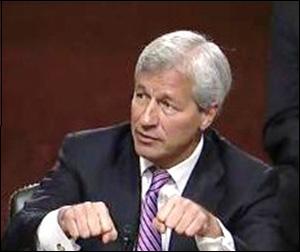
Jamie Dimon, Chairman and CEO of JPMorgan Chase, Testifying Before Congress on the London Whale Trading Losses
JPMorgan has reached a $920 million settlement with four of its regulators over the London Whale matter, a high risk trading strategy where bank deposits were used to gamble in illiquid credit derivatives in London.
We now know why JPMorgan has been auditioning the settlement in the press for the past four days: the language in the various settlement documents is harsh, making it crystal clear the company broke both banking law and securities law. But then, the regulators had very little choice; the U.S. Senate’s Permanent Subcommittee on Investigations had effectively already reached those conclusions in a 307-page report it issued on March 14 of this year.
The settlement with the Office of the Comptroller of the Currency (OCC) reads:
“The credit derivatives trading activity constituted recklessly unsafe and unsound practices, was part of a pattern of misconduct and resulted in more than minimal loss, all within the meaning of 12 U.S.C. § 1818(i)(2)(B)”; and “The Bank failed to ensure that significant information related to the credit derivatives trading strategy and deficiencies identified in risk management systems and controls was provided in a timely and appropriate manner to OCC examiners.”
When the OCC uses the word “bank” in the above citation, it is referring to the insured depository bank – Chase. The law that was broken, 12 U.S.C. § 1818(i)(2)(B), is banking law for FDIC insured institutions. This is where the high risk trading was done, in the insured bank, using insured deposits. It is this aspect that has stunned Congress and brought in the FBI and Justice Department.
…

