


Courtesy of Mish.
It really pains me to see Ron Paul (or anyone else) make a masterful statement on an issue, then blow it at the end with a nonsensical reference to something that is not going to happen.
To understand what I mean, please consider Ron Paul’s article A Grand Bargain for Liberty?
As heartened as we should be by the fight against Obamacare, we should be equally disheartened by the fact that so few in DC are talking about making real cuts in federal spending. Even fewer are talking about reductions in the most logical place to reduce spending: the military-industrial complex. The US military budget constitutes almost 50 percent of the total worldwide military spending. Yet to listen to some in Congress, one would think that America was one canceled multi-million dollar helicopter contract away from being left totally defenseless.
What makes this military spending impossible to justify is that is does not benefit the American people. Instead, by fomenting resentment and hatred among the world population, our costly interventionist foreign policy makes our people less safe. Thus, reducing spending on militarism would not only help balance the budget, but would enhance our security.
Yet both the House and the Senate continuing resolutions not only fail to reduce military spending, they actually authorize $20 billion more in military spending than authorized by the “sequestration” created by the 2011 Budget Control Act. Most of the supposedly “draconian” sequestration cuts are not even cuts; instead, they are “reductions in the planed rate of spending.” This is where Congress increases spending but by less than originally planned—and yet they claim to cut spending.
Under sequestration, military spending increases by 18 percent instead of by 20 percent over the next ten years. Yet some so-called conservatives are so opposed to these phony cuts in military spending that they would support increased taxes and increased welfare “military” spending. This “grand bargain” would benefit the DC political class and the special interests, but it would be a disaster for the American people.
Instead of grand bargains of increased spending and taxes, those of us who support limited government and free markets should form a coalition with antiwar liberals to reduce spending on both the military industrial complex and domestic welfare programs. Instead of raising taxes on “the rich” we should also work to reduce all corporate subsidies. This “grand bargain” would truly be a win-win for the American people.
Sadly, even if a congressional coalition to cut both warfare and welfare spending was formed, it would be unlikely to carry the day as long as the Federal Reserve is willing to enable Congress’s debt addiction by monetizing the debt. But this cannot last forever. At some point the Fed’s policies will result in hyper-inflation and an economic crisis that will force Congress to reduce spending. Hopefully, the growing number of Americans who are awaking to the dangers of our current path can convince Congress to reduce overseas militarism and begin an orderly drawdown of the welfare state before this crisis occurs.
Hyperinflation Nonsense
I agree with every bit of that, save one key phrase “At some point the Fed’s policies will result in hyper-inflation“.
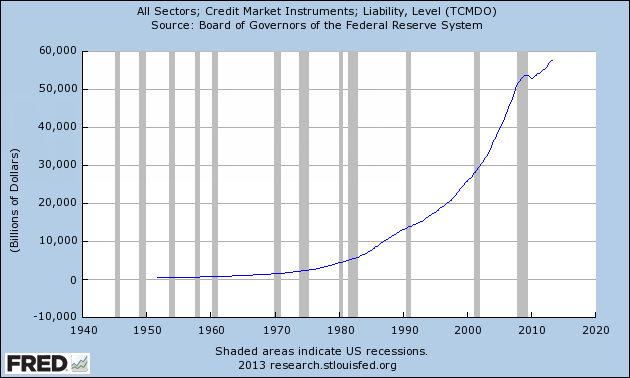
I certainly do not agree with Fed policy, as the Fed has created asset bubble after asset bubble (with help from misguided policies in Congress and fractional reserve lending). But with total credit market debt approaching $60 trillion, it is absurd to believe $85 billion a month in QE will cause hyperinflation.
Total Credit Market Debt Owed
 …
…

