


Courtesy of Lee Adler of the Wall Street Examiner
First time unemployment claims slightly missed expectations again this week as economists were again unable to gauge the impact of the government shout down. The media continues to assess blame for the misses to the California computer glitch. No one has given any details. We have no facts on that supposed reason for the data not being as expected. But the media doesn’t deal in facts, just innuendo.
From the standpoint of eyeballing the charts and the apparent consistency of the data, I see nothing that would indicate that whatever problems California is having in reporting its numbers accurately are having a material impact. The data remains on the same trend on which it has been for more than two years.
The “misses” are the conomists’ problem, not a data issue. Furthermore, this week’s miss of 11,000 isn’t even statistically significant. The seasonal adjustment factor applied to the comparable week of the year over the prior 10 years has varied by 40,000 claims from year to year. The seasonally adjusted number could have just as easily been 10,000 or 20,0oo less or that much more than the number they settled on. The process is nonsense. That’s why I track only the actual, not seasonally finagled number exactly as the Feds collect the actual filings from the 50 states. That number is real. It’s not finagled.
WIth no more government and related workers being furloughed last week, this week’s number gives us a better idea of the underlying trend.
The Labor Department reported that in the week ending October 19, the advance figure for seasonally adjusted initial claims was 358,000, a decrease of 12,000 from the previous week’s revised figure of 362,000 ( was 358,000).
The consensus estimate of economists of 341,000 for the SA headline number was too low for the third straight week (see footnote 1) as economists were consistently unable to guess the impact of the government shout down. They apparently are not aware of the real-time hard data on Federal Withholding taxes, which I track weekly in the Treasury Update. That showed withholding tax collections dropping sharply over the past month. A two week jump in claims followed, but this week they fell.
The headline seasonally adjusted data is the only data the media reports but the Department of Labor (DOL) also reports the actual data, not seasonally adjusted (NSA). The DOL said in the current press release, “The advance number of actual initial claims under state programs, unadjusted, totaled 310,814 in the week ending October 19, a decrease of 49,905 from the previous week. There were 345,226 initial claims in the comparable week in 2012.” [Added emphasis mine] See footnote 2.
Claims were first up in the first week of the government shout down, then nearly even on a year to year basis in the second week, unlike most of the past couple of years when they were typically substantially lower year to year. In the latest week actual filings were down 9% versus the corresponding week last year. That’s a return to the trend of the past couple of years.
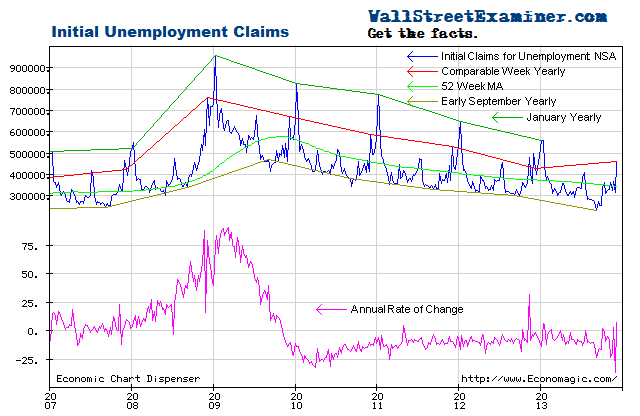
Initial Unemployment Claims – Click to enlarge
There’s usually significant volatility in this number with a usual range of zero to -20%. The average weekly year to year improvement of the past 2 years is -8.0%. In the second and third quarters, claims as a percentage of the total employed were at levels last seen at the end of the housing bubble, just before the market and economy collapsed.

Initial Unemployment Claims Percentage of Total Employed – Click to enlarge
After being worse than trend for the past two weeks, the latest data returned to mid trend. The fact that the numbers have returned to trend so quickly after the ending of the shout down suggests that there will be no lasting damage, contrary to the braying of the political chattering class, none of whom have any interest whatsoever in the facts.
The current weekly change in the NSA initial claims number is a decrease of 46,000 (rounded and adjusted for the usual undercount) from the previous week. That compares with a decrease of 17,000 for the comparable week last year. The third week of October was a down week in 6 of the prior 10 years. The average change for the comparable week over the prior 10 years was a decrease of 23,000. The numbers for this week were better than last year and better than the prior 10 year average.
Federal withholding tax data has slumped sharply since the end of September. It was still on trend until late September when there was a sharp downtick. Since withholding is collected after the end of the pay period, it’s too soon to see a rebound in that data, but it should begin to show up at the end of the month.
To signal a weakening economy, current weekly claims would need to be greater than the comparable week last year. That happened in the October 5 week, but I gave it a mulligan. The trend had previously been one of accelerating improvement in spite of the fact that the comparisons are now much tougher than in the early years of the 2009-13 rebound. It now looks as though the economy has quickly snapped back to the improving trend.
The government shout down polluted this data. I suggested last week that we take it with a grain of salt while everyone else was crying, rending their clothes, and gnashing their teeth, or else blaming a glitch. Apparently the grain of salt was the right call.
Relative to the trends indicated by unemployment claims, stocks have been extended and vulnerable since May. QE has pushed stock prices higher but has done nothing to stimulate jobs growth.
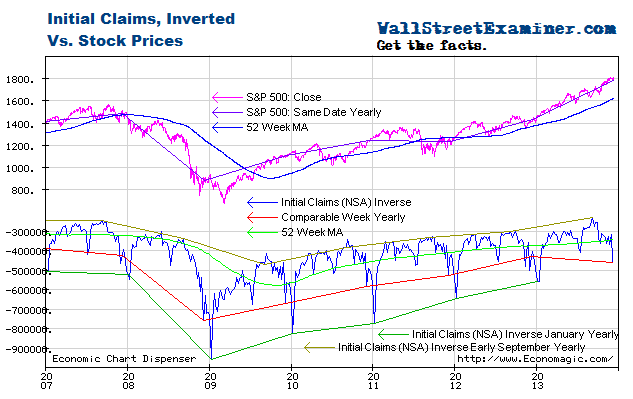
Initial Unemployment Claims and Stock Prices- Click to enlarge
I plot the claims trend on an inverse scale on this chart with stock prices on a normal scale. The acceleration of stock prices in the first half of 2013 suggested that bubble dynamics were at work in the equities market, thanks to the Fed’s money printing. Those dynamics appeared to have ended in July but the zombie has kept coming back to life. I address the specific potential outcomes in my proprietary technical work.
Get regular updates the machinations of the Fed, Treasury, Primary Dealers and foreign central banks in the US market, in the Fed Report in the Professional Edition, Money Liquidity, and Real Estate Package. Click this link to try WSE's Professional Edition risk free for 30 days!
Copyright © 2012 The Wall Street Examiner. All Rights Reserved. The above may be reposted with attribution and a prominent link to the Wall Street Examiner.

