

Courtesy of Pam Martens.
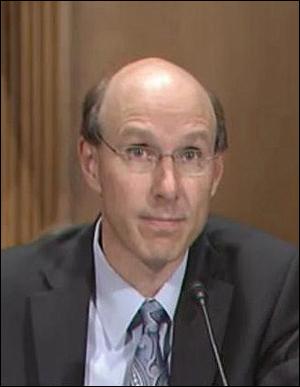
Michael Gibson, the Federal Reserve’s Director of the Division of Banking Supervision and Regulation Has No Law Degree; He’s An Economist
There was a distinct chill in the air yesterday as questioning got underway in the U.S. Senate’s hearing on whether the Wall Street mega banks that caused the greatest economic collapse since the Great Depression from 2008 through 2010 should be allowed to effectively control the price of aluminum and other metals by owning metal warehouses and creating bottlenecks in delivery; or allowed to own oil pipelines, terminals and tankers while trading trillions of dollars a year in oil futures – potentially rigging that market against the consumer.
It’s not that there’s limited evidence that these firms will rig markets. These are the same firms that are serially charged and pay enormous fines for fraud and cartel-like behavior. Traders even refer to themselves as “The Cartel” and “The Bandits’ Club” in chat rooms.
The hearing was called by Senator Sherrod Brown, Chair of the Subcommittee on Financial Institutions and Consumer Protection, part of the Senate Banking Committee. And there was good cause for a chill in the air. Despite the most costly bailout of Wall Street in the history of finance after its collapse in 2008, not one of the seven Republican members of this subcommittee showed up at the hearing; not one submitted a question to be asked of the witnesses.
Then there was the fact that the day before the hearing, the Federal Reserve — which was set to testify at the hearing and is the very entity that is solely responsible for allowing Wall Street to turn itself into a commodities cartel by giving the firms waivers to enter the businesses — engaged in one of its favorite stalling tactics. The Federal Reserve issued a request for public comment to a long-winded series of questions on Wall Street owning and/or storing commodities with a deadline two months away; after which time it said it would study the question some more. The long series of questions posed by the Fed are exquisitely wide enough for Wall Street’s legions of lawyers, lobbyists and trade groups to twist in their favor in the typical 20-page legalistic responses.
Senator Brown called this maneuver by the Fed “timid.” Senator Elizabeth Warren, a participant at the hearing, called it “meager.”
…

