


Courtesy of Mish.
.jpg) Today I am going to ask three simple questions that have easy to understand answers.
Today I am going to ask three simple questions that have easy to understand answers.
- What Causes Economic Bubbles?
- When Do Bubbles Burst?
- Can the Fed Prevent Bubbles?
The Boy Who Cried Bubble
Before answering the questions (and hopefully many of you know the answers already), let's tune in to what the Dallas Fed has to say regarding bubbles in its report Globalization and Monetary Policy Institute Working Paper No. 167, entitled "The Boy Who Cried Bubble" by authors Yasushi Asako and Kozo Ued.
The article is 44 pages long. In the opening paragraph on page two, the authors state "History is rife with examples of bubbles and bursts. A prime example is the recent financial crisis that started in the summer of 2007; However, we have limited knowledge of how bubbles arise and how they can be prevented."
One could safely stop reading right at that point knowing full well that what follows cannot possibly be anything but self-serving platitudes and incomprehensible mathematical gibberish.
And that is precisely the case. The mathematical gibberish starts on page five and continues for the entire remainder of the document.
Here is a quick sample from page seven.
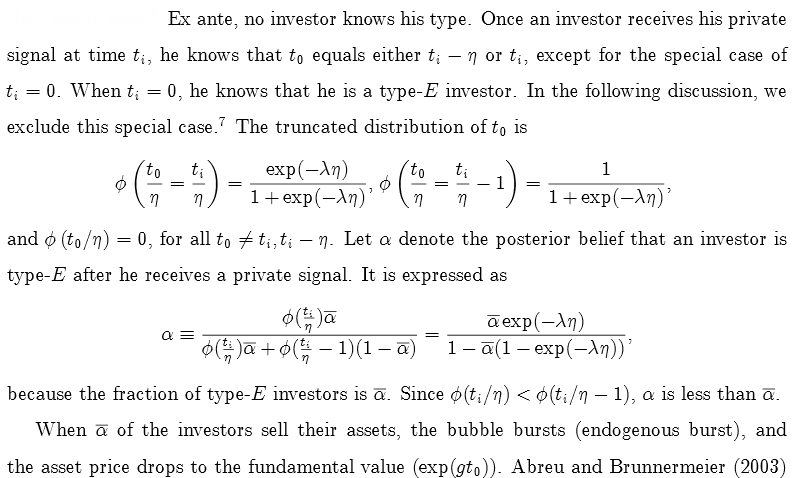
All the remaining pages are equally incomprehensible to all but the geekiest of geeks. Here is another example from page 39.

Hiding Behind Nonsensical Math…
[Bubble picture by Jeff-Kubina]

