


Courtesy of Pam Martens.
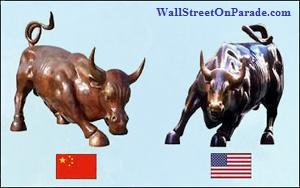
Shanghai's Bull Statue on Its Bund Waterfront (left); Bull Statue in Lower Manhattan (right)
Most Americans would be stunned to learn that companies based in China, a country associated with accounting secrecy, have gained a foothold to the tune of over a trillion dollars on U.S. stock exchanges. According to Thomson Reuters, the market value of Chinese companies currently listed on the New York Stock Exchange and Nasdaq Stock Market is more than $1.4 trillion.
Last week, U.S. investors learned the hard way that when China sneezes, the U.S. may catch pneumonia. Growth in China is slowing and there are growing fears that its massive overinvestment in real estate and manufacturing plants in recent years has led to unsustainable levels of Chinese business and bank debt. Stock markets in countries which have been major beneficiaries of the China growth story plunged at the end of last week, including a two-day drop of almost 500 points in the U.S.
Questions about Chinese growth and debt levels could not come at a worse time in U.S.-China relations. Despite diplomatic efforts by James Doty, Chairman of the Public Company Accounting Oversight Board (PCAOB) and Treasury Secretary Jack Lew in the spring and summer of last year to forge an agreement, a behind the scenes war is raging over China’s decade of stonewalling U.S. regulators over access to documents prepared by auditors of publicly traded companies that are based in China but listed on U.S. stock exchanges. China takes the position that these audit work papers hold state secrets and it prohibits audit firms from releasing the documents directly to U.S. regulators.
The growing concern is that the so-called “state secrets” these documents purportedly hold may actually be a paper trail showing accounting or securities fraud that might, indeed, embarrass China but do far more damage to the life savings of American investors and the reputation of U.S. stock exchanges.
Since 2010, the Securities and Exchange Commission (SEC) has brought dozens of fraud cases against China-based firms and more than four dozen of those firms have been deregistered from U.S. exchanges. Unfortunately, tens of billions of dollars of U.S. investors’ life savings have been lost in the process and significantly more may still be at risk.
…

