


Assessing the health of US labor markets remains a challenge
These same dynamics are responsible for a portion of the decline in labor participation rate. BMO has done some good work in the area, which we try to summarize here. The historical trend looks quite unsettling, as the chart below shows.
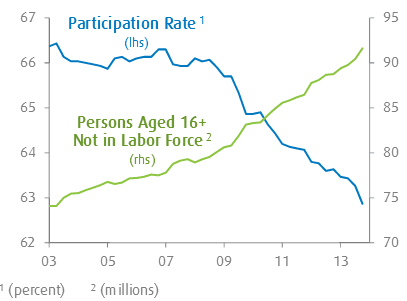
|
| Source: BMO |
But there is an enormous difference in the "natural" labor force participation rate of a 55-year-old vs. say a 35-year-old – that is unrelated to the Great Recession.

And as we get more 55-year-olds in the workforce, the participation rate "naturally" declines.
BMO: – An aging population will continue to press down on the part rate, as persons 55 and over participate at only half the rate of prime-age workers (25 to 54), while persons 65 and over participate at just one-quarter the rate. If the downward pull from aging overwhelms the expected upward push from discouraged workers and college students returning to the labor force, then the part rate will decline further.
BMO lists other reasons for declining participation that are unrelated to demographics. Instead these effects seem to be the result of government policy.
1. Since the onset of the Great Recession many more Americans have started collecting disability (from the Social Security Disability Insurance program) than in the past (see discussion).
BMO: – In addition to the downward pull from demographics, disability rolls could continue to climb. Macroeconomic Advisers estimates that the Social Security Disability Insurance program, by discouraging participation, could have reduced the part [“part” is short for participation] rate by about 0.1 ppts on average from 2006 to 2013 [notice that this represents some hefty numbers on an absolute basis].
BMO: – The expiration of the extended UI benefits program will also depress the part rate this year. Assuming one quarter of the 1.3 million people who lost emergency benefits on December 28 find work and another quarter leave the labor force, the part rate could fall 0.2% in 2014. This accords with the additional decline in North Carolina’s participation rate, relative to the national average, after the state decided to end extended benefits five months earlier.
BMO: – According to the CBO, the Affordable Care Act will likely also reduce the part rate, as new federally-subsidized private health insurance plans will reduce the incentive to seek employer-sponsored plans. Quantifying this impact, however, is virtually impossible.

