


Courtesy of Pam Martens.
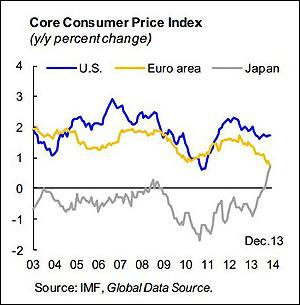
The IMF Released the Above Chart With Its Statement on February 19, 2014, Sounding a Warning on the Potential for Deflation
The U.S. government’s economic policy wonks are the habitual finger wags. They’ve lectured Japan incessantly for 20 years on how to beat its intractable deflation problem and in more recent years pointed at China for keeping its currency artificially low to boost exports. Last October 30, when the U.S. Treasury released its semi-annual “International Economic and Exchange Rate Policies” report to Congress, it turned its finger-pointing on Germany, grousing that:
“Within the euro area, countries with large and persistent surpluses need to take action to boost domestic demand growth and shrink their surpluses. Germany has maintained a large current account surplus throughout the euro area financial crisis, and in 2012, Germany’s nominal current account surplus was larger than that of China. Germany’s anemic pace of domestic demand growth and dependence on exports have hampered rebalancing at a time when many other euro-area countries have been under severe pressure to curb demand and compress imports in order to promote adjustment. The net result has been a deflationary bias for the euro area, as well as for the world economy.”
Wagging the finger at Germany because it lacks sufficient altruism toward its economically struggling neighbors is certainly cheeky from the country whose reckless and misguided deregulation of Wall Street mega banks created the 2008 financial collapse which then played a central role in destabilizing the world economy.
Given this backdrop, it was noteworthy that yesterday the International Monetary Fund (IMF) pointed its own finger squarely at the U.S. central bank, the Federal Reserve Board of Governors, in its statement on “Global Prospects and Policy Challenges” prepared for the upcoming G-20 meeting of finance ministers and central bank governors in Sydney, Australia on February 22 and 23.
To understand what the IMF is actually signaling requires a quick review of central bank jargon versus public jargon. Central bank flooding of the financial markets through bond purchases in hopes something will stick in terms of job creation, economic growth, and longer term financial stability is referred to as quantitative easing or QE by the general public. The U.S. Federal Reserve prefers the more scholarly LSAP or Large Scale Asset Purchases. Not to be outdone, the IMF has its own acronym, UMP, for Unconventional Monetary Policy. Regardless of the chosen phrase, no one is sure how all of this unconventional meddling is going to end, although at least three Republican Senators suspect it is akin to either a morphine drip, disguising chronic pain and a seriously ill patient, or leading the financial markets into a “sugar high” complacency as another asset bubble forms.
…

