


Courtesy of The Automatic Earth.
G. G. Bain Traveling bridge, Marseilles, France June 30 1910
There’s never just one side to any story. The eastern – largely ethnic Russian – past of Ukraine has been saying for a while that it feared being overrun by “hordes” of their western compatriots, who ousted Yanukovych and want to move closer to Europe. This morning the Russian Foreign Ministry stated that “Armed men dispatched from Kiev to the southern Ukrainian region of Crimea attempted an overnight storm of the local Interior Ministry”. Whether such a move, assuming there’s some truth to the statement, would be as much a reaction to Russia’s own recent military movements as it might have ulterior motives, is impossible to say.
Also, as the Guardian reports, the Ukrainian army is quite “formidable”. Its weakest point seems to be that it has a light presence in the Crimean region, ostensibly to not provoke the local people. Who have been told many stories of how ‘those from Kiev’ would come and take their land away, and their culture, force them to speak another language, and perhaps go after their wives and daughters too (as is the age-old way this story has been told). So they might be happy now that Russia sends troops and prevents that from happening.
But while it may seem to make sense that the Ukrainian soldiers of Russian descent, if they were to face the task of halting a Russian invasion, would hesitate, they may well feel they are Ukrainian first. Not so much those in the Crimea, but then, it wasn’t part of Ukraine until Khrushchev gave it away to Kiev as a present. People tend not to react favorably to being given away.
And don’t think the entire Crimea loves the Russians either: the sizeable population of Tartar lineage despises the long term occupier, which cast them from their lands for 40 years and only allowed them to return 30 years ago. It’s all just a matter of putting your pieces on the board as best you can before the game starts, and then hope you will see a move or two more ahead than the other players.
It’s not a US theater, the American army has failed in such circumstances time and again, but it’s not ideally suited for Russia either. Both rely on big armies with big guns, planes, trains and automo-armed vehicles, and that’s not guerrilla gear. Russia can’t win on the ground, but they have a much bigger chance behind the negotiating tables. Especially if it’s with the bungling EU side. Separate from each other, Germany has great contacts in the region, and France and Britain have unequalled secret service departments, but out them together under one command and they don’t function.
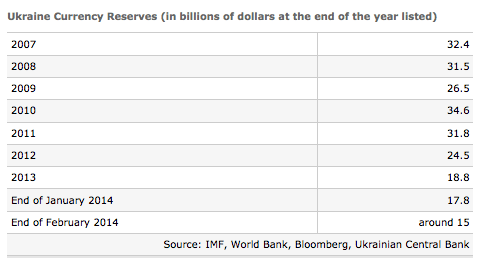
It may be more useful at this point to review Ukraine’s financial situation, since that may trump everything else, and prove to be the more crucial chessboard. Der Spiegel – really, the Germans have great inroads in the region – reports on the topic:
On Wednesday, Stepan Kubiv [governor of Ukraine’s national bank since Monday], noted that his country’s foreign currency reserves had dropped from $17.8 billion (€13 billion) to $15 billion just since the beginning of February, as the national bank attempted to prop up the exchange rate of the country’s currency, the hryvnia. Those efforts met with little success, and the hryvnia has fallen to a record low against the dollar.
And that’s not Kubiv’s only woe. Despite Ukrainian banks limiting cash withdrawals from ATMs, the central bank president says customers withdrew around $3 billion just during the three days of street battles last week, an amount equivalent to 7% of all deposits. On Friday, Kubiv announced that foreign currency withdrawals were being further limited to 15,000 hryvnia ($1,500) per day in order to calm the current volatility.
If we move back to Yanukovych for a moment, here’s a strong number: according to the new government, he made – or helped – $107 billion disappear. That could help build a few nice palaces:
Some $70 billion were taken out of the country in the last three years under Yanukovych, the new government revealed on Thursday, and $37 billion worth of state loans simply disappeared.
And that’s just the past. If more money is taken out of the country, everything could deteriorate very quickly:
So far, the government had pegged its financial requirements for the next two years at $35 billion. But that won’t be nearly enough if investors start pulling out of the country on a large scale.
So who’s going to volunteer to take the losses? Putin might, if he’s given free reign, but he won’t be, so why take losses?
The national bank projects that the loss of Russian credit in Ukraine wouldn’t amount to a dramatic change for Russia. According to the central bank’s calculations, Russian banks have less than 1% of their total assets invested in Ukraine. According to an estimate by ratings agency Moody’s, the four largest Russian financial institutions together have about $20 billion to $30 billion in Ukraine; Russian President Vladimir Putin put that number at $28 billion. From the Ukrainian perspective, though, that’s a considerable amount, with Russian banks’ market share in the country at 12%.
How about Euope then? $23 billion in outstanding loans in Ukraine, of which Italy alone has $6 billion, and Italy’s banks will have a hard time passing even highly compromised stress tests.
European banks, too, stand to lose in Ukraine. According to the most recent figures available from the BIS, European banks have more than $23 billion in outstanding loans in Ukraine. According to the statistics, German banks have lent only around $1 billion to Ukraine, but for Italy that figure is nearly $6 billion. “Italian financial institutions are already in the spotlight after the stress test for European banks,” says Bielmeier at DZ Bank. “Their involvement in Ukraine could increase that stress.”
But maybe it could have been worse. Still, Ukrainians will be subject to the IMF and its policies. Which have never helped one little man.
A long-lasting economic crisis in Ukraine … would not be in Russia’s best interest. “That naturally also has repercussions for joint companies we have with Ukraine,” Russian Economic Minister Alexei Ulyukayev told German business daily Handelsblatt. DZ Bank economist Bielmeier believes as well that these close ties may well be what will save Ukraine in the end. “The risk of national bankruptcy is not very high,” he says. “But only because none of the major blocs has an interest in that happening.”
It would seem Ukraine could use a few savvy negotiators. They could end up both safer and richer if they play their cards well. But with guys like Putin at the table, they will need to be proud as peacocks and have hardened poker faces. But it can be done.

