


Courtesy of The Automatic Earth.
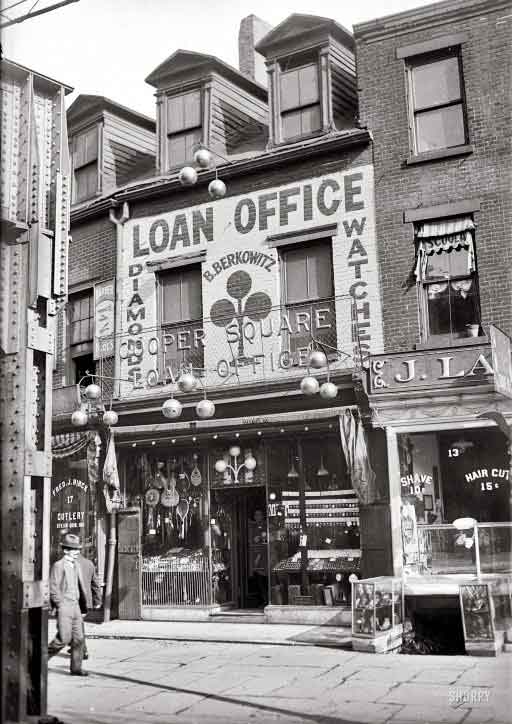
G. G. Bain Pawn Shop, 15 Cooper Square, New York 1920
The other day I stumbled upon an image that got me thinking. I’m still thinking. And I doubt I’ll be done anytime soon. So perhaps it’s a good idea to simply share both the image and my thoughts, and invite you to share what you think, and see where we get. I found it on the site of the University of North Carolina at Chapel Hill School of Education, where it’s part of an ‘exhibit’ of US Government – Office of Price Administration – publicity material on the topic of wartime rationing.
Here’s the front cover of War Ration Book no. 3, issued in 1943 :

And this is the back cover, the image that first set me off:

It’s that one line in there at the bottom, as I think should perhaps be obvious: If You Don’t Need It, DON’T BUY IT.
There once was a time, and it’s only 70 years ago, which means there are plenty people alive today who also were then, when the US government actually and actively urged its citizens NOT to buy things they didn’t absolutely need.
That makes you think about how things have changed. And why they have. Where once it was considered so unpatriotic to buy more than your fair share it could get you shunned by your neighbors, today’s politicians and bankers tell you to spend spend spend. And if you don’t have enough money to spend you should borrow it.
That difference is probably the best explanation available for why we are in the present deep doodoo. Make no mistake: f the American people would today buy only what they need, the economy would collapse in next to no time. Think Stockholm Syndrome.
And if they don’t borrow enough, fast enough, and take on (more) debt, the political/financial system and the media present that as an ominous negative. Saving is for un-American sissies.
If we don’t continue to buy things we don’t need, and at a rapid and increasing pace, we kill the economy we depend on for our wellbeing. Let that sink in.
If you don’t buy stuff you don’t need, in large quantities, lots of stores will go broke, and tons of people will be laid off, who then won’t be able to purchase enough stuff they don’t need, which will lead to more store closings etc. And at some point during this process we will see deflation emerge: the less we spend as (consumers of ) a nation, or a group of nations, the more the velocity of money will sink. And we’ve seen by now what the effect of QE-esque measures are on that: zilch.
So what happened, how did we get there from here? Well, for one thing, this:

That must be the most depressing chart I’ve seen in a long time. Take a good look: that’s the Red Queen trying to stand still on a treadmill that goes 100 miles an hour.
Income, savings, GDP, all increasingly came to depend not on what people produced, but on what they borrowed, on how much debt they incurred. And that’s of course how we got from “If You Don’t Need It, Don’t Buy It” to “If You Don’t Buy Lots of Stuff You Don’t Need, You’re Doomed”.
The French are familiar with the concept of Les Trente Glorieuses, or the Glorious Thirty, the years 1945-1975 (or 1973, the first oil crisis), the period when the country built a prosperous middle class for the first time in its existence. Just like the US did, though it had a few years’ head start, since it wasn’t occupied. Looking back at that graph, it’s easy to see why. We all had Les Trente Glorieuses on both sides of the big blue divide, but none of us still do. Not even the Chinese, the supposed next major world power. Their empire too was built on debt, and will sink because of it.
It would probably be good, though, for the US to recognize that it had a Glorious Thirty, and not pretend that somehow that period still continues. Because that sort of pretense makes Americans look stupid. It’s over, face it. America blew its shot at greatness through its people, just as France did, and Britain. It’s a new world, don’t you know.
And of course natural resources play a major part: WWII rationing had a lot to do with resources getting scarce. And you’d be inclined to think we don’t have that issue today. But then we do. Just in a slightly different way. Today we can see scarcity coming down the road. And we no longer have any way to pay for ever scarcer resources, other than through credit. It’s not as if we can pay for them in exchange of out manual labor. That even sounds ridiculously outdated. Doing actual work.
But then maybe that’s the secret: Work. Make things. Without destroyng your own living quarters. ‘Cause that would be stupid, right?
All fun aside, the present system is not long for this world. Being stuck with debt when the system dies is a bad idea. Being able to make stuff with your hands is not.
Other than that, let me know what you think about If You Don’t Need It, Don’t Buy It.
To get you in the mood, I’ll leave you with some of the material included in the US Government WWII campaigns. That’s what the entire nation thought about at the time.

