


Courtesy of The Automatic Earth.
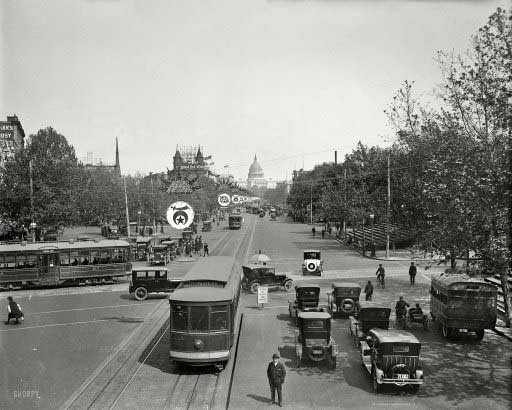
Harris & Ewing Pennsylvania Avenue becomes “Road to Mecca” for Shriners Parade June 1923
It’s hard enough to be optimistic about the future of mankind, and his habitat, on any given day of the week. And then there are days when it’s impossible not to lean towards utter despair. There was a meeting in Washington this weekend, organized by the IMF, during which all kinds of economists discussed how to squeeze more and faster growth out of the world, and it people. Because, as all economists have learned, and just about everyone else believes, if we don’t have enough growth, we are doomed. That yet another IPCC report, presented at the same time, strongly suggests it may be our growth that dooms us, not the lack thereof, is of course completely lost on economists, and, again, on just about everyone else. Here’s how Bloomberg reports on the meeting. I’d say just listen to this gobbledy-gook, as you realize that these are the people shaping the future of your economies and therefore your societies, and indeed your lives:
Raising World Economy’s Speed Limit Emerges as Challenge
Global finance chiefs are trying to soup up their crisis-hit economic engines. How to do so was a theme of weekend talks of the International Monetary Fund’s spring meetings in Washington as economists from JPMorgan Chase estimate the financial crisis and subsequent world recession knocked the potential growth rate of rich countries down to about 1.5% from 2%.
Such a decline in the speed limit of the growth rate at which inflation ignites is troubling because it risks pressuring central banks to raise interest rates sooner than they might otherwise want. The weaker potential also hurts the ability of businesses to boost profits, workers to win pay increases and governments to cut debts. “It is clear to me and not just to the IMF but many other players around the world that there is a real significant potential” to be tapped, IMF Managing Director Christine Lagarde [said].
The debate marks a pivot after six years of worrying over how to spur demand to considering how to increase the supply side of economies so they can handle faster expansion. While growth rates for a time can exceed potential – which is determined by the growth of the labor force and of worker productivity – it cannot do so for an extended period. The IMF predicts advanced nations will grow faster than 2% this year for the first time since 2010.
The problem according to these sages is no longer that there isn’t enough demand for stuff, but that not enough stuff is being produced. And you’re not supposed to ask if, or why, we need more stuff: the economy they want to see simply demands that we buy more. And more still the year after. Rinse and repeat. Exponentially. They got their jargon down just fine, those economics books are good for something:
“Driving growth that creates jobs and raises living standards is now the top priority for the global community, and that focus marks a turning point in the global recovery,” U.S. Treasury Secretary Jacob J. Lew said. Singapore Finance Minister Tharman Shanmugaratnam said there is now “a focus on the medium term more than the short term, and a much greater focus on structural reforms.”
Oh, the sweet promise of reforms. See, economics is one of those fields where, if reality doesn’t fit with the models, reality must be wrong, and needs to be changed. Because, just look, the potential is there to make and sell far more stuff:
The challenge they face was illustrated in a Washington presentation by Bruce Kasman, chief economist at JPMorgan. His estimates show the potential rate of developed economies is about 5.2% of gross domestic product below what it would have been had the 2008 trend held intact. In a sign demand still remains weak, the new trend is still about 4% of GDP above current performance.
[..] Possible solutions include revamping how labor markets work, increasing competition and productivity in non-tradable sectors, paring the size of governments and looking to improve state spending, IMF chief economist Olivier Blanchard said. The lender estimated in February that reforms could add $2.25 trillion to the global economy by 2018.
” … reforms could add $2.25 trillion to the global economy by 2018″. And that would make us happy how exactly?
[..] Central bankers in Washington also trained their eyes on the lack of current demand, as represented by the gap between potential and actual growth. Bank of Canada Governor Stephen Poloz said the gap’s existence is “pushing inflation lower than our traditional model would expect.” That doesn’t mean monetary policy makers aren’t worried about where their economies’ cruising speed is. At the Federal Reserve, the central tendency of forecasts for long-run growth fell to 2.2% to 2.3% in March from 2.3% to 2.5% a year ago.
I can only read this kind of thing anymore as blind nonsense. There is no real discussion going on here, it’s a religious group-think phenomenon in which certain questions are off limits and will get you excommunicated. Which is why I was not exactly thrilled to see this bit at RT either. I understand that there are many well-meaning people involved, but all the IPCC scientists seem to be doing here is to find a way to keep economies growing. And they may say they’re not economists, but they could still argue that we need to not do things, instead of figuring out how to keep on doing them, but differently. Why not focus on simply using much less energy? That is something economists wouldn’t appreciate at all, and it would have some nasty side effects, but why would climatologists be hindered by that?
UN: ‘World Must Triple Nuclear And Renewable Energy’
‘Clean’ power plants and nuclear stations need to triple their energy output to avoid a global warming doomsday. More than $17 trillion in investment in the next 21 years is needed to meet electricity demand alone, UN research has found. Governments worldwide need to speed up renewable and nuclear energy developments to replace carbon emissions and cut down on greenhouse gasses, United Nations researchers said at the Intergovernmental Panel on Climate Change in Berlin on Sunday.
Fresh investment into renewables, nuclear, and carbon energy capture and storage must rise by $147 billion, and an increase of $336 billion is needed on making buildings and transportation more energy efficient, the researchers said. Polluting fossil fuel plants such as coal-fired stations need to be wound down, and spending should fall by $30 billion to make sure that global warming is limited to a 2 degrees Celsius increase by 2030. Another top priority is to slash greenhouse gases by anywhere from 40% to 70% by 2050.
The panel found that the significant decrease in costs of wind and solar power make the goal increasingly realistic. Scientists from 194 different nations said that emissions growth has increased to an average of 2.2% a year between 2000 and 2010, nearly double the annual growth of 1.3% from 1970-2000. “The longer we wait to implement climate policy, the more risky the options we’ll have to take,” Ottmar Edenhofer, a co-chair of the 235 scientists who drafted the report, told Bloomberg News. “We need to depart from business as usual, and this departure is a huge technological and institutional challenge,” Edenhofer said.
I think I’m just going to quote myself, because I’ve written about this many times before. And no matter what anybody thinks, we need to radically change our way of thinking, and our leadership, to make room for both the questions and the answers, if the latter exist, or we’re bound to plunge like so many lemmings off the very steep cliff that exponential growth can’t keep itself from climbing. This is from October 2008:
There is a completely unfounded and utterly irrational picture of the world being touted that claims all will be fine, and soon too. When the economy rebounds, in that familiar imaginary place that’s just around the corner beyond the horizon, the wonderful certainty of unbounded growth will dissolve all debt and make us richer than we’ve ever been before. All of us.
It would not be correct to call this a fantasy. It is much more. It’s religion. It’s chasing the golden calf. And it does not condone critical views and questions. Growth is such a powerful deity that taking on additional, even unlimited, debt, in order to get to the promised land tolerates no scrutiny, a principle not unlike the mind-frame of your everyday suicide-bomber.
Growth, in the eyes of its believers, knows no more limits than do the powers of any of the all-seeing ever-present gods found in the monotheistic religions, Judaism, Islam and Christianity. The faithful growth flock, after having grown from A into A+, accumulating already seemingly infinite earthly possessions, blindly follows their shiny calf along its unidirectional and one-dimensional path to more of the same. The Lord of More. And as long as no questions are ever asked, the only limits will be those imposed by another deity, Gaia.
I have a question. I would like to know why no-one ever asks what exactly is is that they wish to grow into. Where it is they want to go. We have all seen the surveys that show, without missing a beat, that the happiest people on the planet do not live in the richest communities, but in the closest knit ones. Happiness is not two and a half people in a 10000 square foot mansion with wall-size TV’s and a garage filled with vehicles modeled after rhinoceroses.
So why do the faithful of the Lord of More keep chasing the glittering bovine? They do because they know of no other reality. They do because their brains are genetically preconditioned for lies and deceit. What we think sets us apart from everything out there that is alive, this quality we call consciousness, comes at a bitter and fatal price. You cannot be ‘fully’ aware of ourself and others without being able to fool yourself into thinking that you are better and more than you really are. [..]
Even though we can easily rationally understand that the principle of always more is ridiculously impossible, and fatal to our survival, we cannot escape the trap it lures us into. The human mind is as unidirectional and one-dimensional as the religion of More. And we have no choice but to lie to ourselves about that. We must believe that we do the things we do because our rational brain tells us to, even though, when we take a step back, we are all perfectly capable of seeing that it just ain’t so.
Today, in a sort of ultimate tragedy, we convince ourselves that it is possible to take on more debt in order to get out of debt, as long as there is more growth awaiting us in our fantasy future. It’s no more than yet another lie we can’t escape, simply because we can’t escape who we are. The Lord of More will always in the end leave you with less.
And on April 22 2013 I asked what I think may well be the pivotal question, one for which I still haven’t seen an answer. None.
[..] … there’s an urgent need for ideas about what to do in case growth does not return. But there are no such ideas. Turns out that the Spend! and the Cut! sides of the controversy are one and the same. The only real discussion should be whether we do or do not need growth, but instead the discussion is about how much growth is needed. And the answer to that is identical for both sides: as much as we can.
The only good thing about all this is that if and when it becomes clear that there is no growth left in the system, all its one-dimensional advocates, from both the Spend! and the Cut! parties, will disappear into a great void. They have no idea what to do without growth. There is no economics class that teaches them, and they don’t have the brains to come up with an answer themselves. Indeed, perhaps it’s even true that a “not necessarily growth” situation, simply of its own accord, selects for other “leaders”. That power hungry psychopaths, in all the various degrees to which they float to the top of the dungheap, are wiped out and alienated by such a situation.
That could be a very good thing. It’s on the way there, however, that we will see unimaginable damage, mayhem and bloodshed. The forever and always growth classes have an iron grip on everyone’s lives. If only because everyone believes them. Still, just because they can’t change their ways and views doesn’t mean you can’t. You can see quite easily that, in a material sense, you have more than enough already. And many of you have clued in to the destruction ever more growth brings to your children’s living world (not to mention their brains). Unfortunately, quite a few then fall for the “more growth, but more greener” delusion. Or some steady state one (we don’t do steady, we don’t stand still).
When you get down to the heart of it, the only reason we need more growth is to pay off our debts. Which we owe largely to the same small group of rich, psychopathic and powerful that incessantly repeat the “need for growth” message, and makes sure it’s the only message available out there. But we will have to have the discussion some day, and it won’t be initiated by the people and powers that rule our societies today; that one’s up to us.
It’s a very simple discussion. You can start it today with Krugman or one of his alleged adversaries: Why do you advocate economic growth? Why do you see a period of non-growth or shrinkage as a necessary evil that needs to be brought down to its knees at – quite literally – all cost? And what is it you want to grow into? Can you explain that? I’ve never seen that properly defined. Isn’t it perhaps true that if you don’t know the answer to that question, you are by definition blindly chasing a mirage? If you don’t know where you’re going, or why you’re going there, why go at all?
This discussion is far more important to us than the one about how we’re going to shift from coal to wind. We need to define what we want the world of our children to look like. And we do have the ability to possess a pretty good idea today (we’ve actually had it for quite some time) of what that world will resemble if the blind growth religion continues to rule.
But not all is black out there. 10 days ago, our Kiwi friend Nelson Lebo (Nicole and I stayed with him and his wonderful little family for a few days 2 years ago) sent me this article he wrote for the Wanganui Chronicle. Some people answer the question “What Do We Want To Grow Into?” simply by being it in their daily lives. They live the answer.
Financial Independence Through Bicycling
My position is that more people are receptive to messages of saving money than “saving the planet”, and that in many cases both are possible by designing win-win situations. For example, I graduated from University in 1990 with student loans and without a car. Some unexplained thrifty gene in my DNA told me to forgo buying a car until I had paid off my loans. In other words, don’t take on more debt until you’ve paid off the existing debt.
That experience was faster and less painful than I expected, so I carried on living car-free for seven more years before buying my brother’s old ute for $500. I continued bicycling and taking public transit for most of my transport needs but drove about twice each month until early 2000. At that point, after living nearly car-free for over a decade I had saved enough money to buy a small farm…on a teacher’s salary. To clarify, this was by no means a flash farm, and I did work every school holiday for most of those years to earn and save more money. On 1st June 2000 I took title of 38 acres and a 214 year-old farmhouse. I called it Pedal Power Farm.
Over the next eight years I used eco-thrifty thinking and lots of blood, sweat and tears to renovate the farmhouse, build a post and beam barn by hand, and improve soil fertility. In 2008 – at the start of the housing crisis in America – I sold the farm for nearly twice what I paid. Proceeds of the sale paid for four years of doctoral research at Waikato, a second-hand Subaru wagon, and a fully renovated but once run-down villa in Castlecliff.
While car-free living cannot be attributed for all of this, it provided a platform to get out of debt and to get onto the ‘property ladder’ debt-free. Other contributing factors were fiscal conservatism and working my bum off for 18 years. At 45 I am semi-retired with plenty of time to spend with my toddler daughter and to volunteer in the community. If you think about it carefully enough, I suppose you are reading these words in today’s paper because I made a choice 24 years ago to ride a bike.

