


Courtesy of Pam Martens.
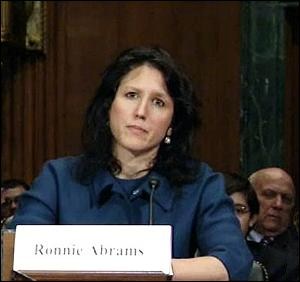
Judge Ronnie Abrams Testifying at Her Confirmation Hearing in 2011; Her Father, Floyd Abrams, Appears in Right Corner
On October 10, 2013, bank examiner Carmen Segarra and her attorney, Linda Stengle of Boyertown, Pennsylvania, took on one of the mightiest and interconnected institutions on Wall Street: the Federal Reserve Bank of New York. They relied on the Federal court system, funded by the taxpayer, and a fair and impartial judge to level the playing field. Things got off to a promising start.
Segarra was a bank examiner at the Federal Reserve Bank of New York, a key regulator of Wall Street banks. She charged in her lawsuit that when she turned in a negative assessment of Goldman Sachs, she was bullied and intimidated by colleagues at the New York Fed to change her findings. When she refused, she was terminated from her job in retaliation and escorted from the Fed premises, according to her lawsuit.
The case was assigned to Judge Ronnie Abrams, an Obama appointee, the daughter of constitutional law expert, Floyd Abrams, and sister to Dan Abrams, the well known legal affairs commentator on television.
Segarra also had a powerful whistleblower protection law on her side, designed specifically to include a bank examiner such as herself working for a Federal agency overseeing banks. The law is known as the Federal Deposit Insurance Act and codified as 12 U.S.C. 1831j. It was enacted to prevent the intimidation, discrimination or firing of employees involved in examining the safety and soundness of the U.S. financial system because they had found wrongdoing and reported it. A key section reads:
“2) Employees of banking agencies
…

