


Courtesy of Mish.
Reports of the pending collapse of China property bubble have circulated for years, including some on this blog. To date, each slowdown was soon followed by another boom to still higher prices. Here we are again, in another slowdown.
China Housing Starts
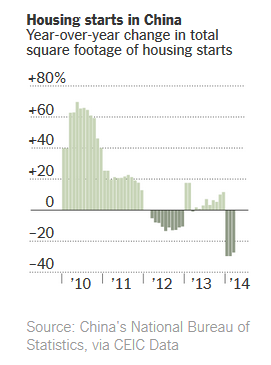
Market Cools, Sales Volume Dries Up
The New York Times reports China’s Sizzling Real Estate Market Cools
After almost two decades of nearly unceasing increases in real estate prices and construction across China, one of the world’s longest-running bull markets finally seems to be stalling, with broad consequences for the country’s economy and possibly its politics.
Prices are falling for both new and old apartments. The volume of deals is drying up. And developers are pulling back, furloughing workers and delaying new projects. In the latest sign, housing starts plummeted 25 percent in April from a year ago, the Chinese government announced on Tuesday.
“You can’t predict how the bursting of a Chinese real estate bubble plays out because it plays out in very small steps,” said Joel H. Rothstein, a partner in the Beijing office of the Paul Hastings law firm who specializes in Asian real estate.
China’s real estate market correction — some economists are even calling it the popping of a bubble — is partly the result of a deliberate decision by the country’s leaders in Beijing.
Economic data released on Tuesday also included a deceleration in industrial production, with growth in steel and cement output slowing to a crawl. Retail sales also grew more slowly than expected in April, and the furniture market stalled as fewer families moved into new homes.
According to Centaline, one of China’s largest real estate brokerage firms, transactions over the May 1 holiday weekend fell by half in Beijing and Shanghai from a year ago. The weekend is traditionally one of the two biggest real estate buying times of the year, along with a weeklong national holiday at the start of October.
A national survey released in March by the Southwestern University of Finance and Economics in Chengdu, China, found that households across the country had 66 percent of their assets in their homes, a figure that rises to 84 percent in Beijing. The comparable figure for the United States, where stocks and bonds are more popular, is 41 percent.
Financial Vulnerabilities in China…

