


Courtesy of The Automatic Earth.

Detroit Publishing 12th Street bascule bridge, Chicago 1900
If we can agree for a moment that there is a very real possibility that we will have both much less capital and less energy available to us in the future, what should we do to define our response to this possibility? The obvious answer would seem to be to scale down, and do that as best we can without causing our societies to crumble because of it. We could take comfort in the knowledge that, despite the huge range of inventions and surge in wealth we have developed over the past 150 years, there is no proof whatsoever that we are happier today than our ancestors were in the Paris of 1900 or Chicago of 1950. We could also acknowledge that our present lifestyles are highly destructive to our habitat, so scaling down would seem to be a good idea from that perspective as well.
Still, though many of us are aware of both the potential of less energy availability and the failure of the use of that energy, in combination with our ingenuity, in making us happier and more fulfilled human beings, scaling down is not on the agenda of societies at large. To the contrary, the “successful” people we see as our leaders talk only of more growth, whether or not that’s realistic, let alone desirable, and we pretty blindly follow them in that line of thinking, presumably until it becomes impossible to deny any longer that growth is no longer on the horizon. Since we have a long tradition of seeing any downturn as merely temporary, that realization may take a long time to sink in, which in turn may mean that people need to be dying by the side of the road before we accept it as truth.
A philosophically intriguing debate is why we are so averse to using less energy, and why we perceive less growth as such a bad thing. There are those who point to our fear of dying, which makes us want to stay always a step ahead of death, so to speak. That’s a nice idea, but the use of – more – energy might kill us too. In a recent episode of his remake of the Cosmos TV series, Neil DeGrasseTyson referred to the fact that we live in a very quiet period of earth’s history, after a very long period of severe turbulence, but there’s this “strange” human drive to unleash all manner of greenhouse gases that risks setting off another period of turbulence.
DeGrasseTyson lamented the fact that we have proven in our history that we can be terribly ingenious, so why can we not now? Why are we unable to steer ourselves away from the consequences of ever more energy consumption? An interesting though perhaps challenging answer to that lament is that “the human species may be seen as having evolved in the service of entropy”, as David Price wrote in 1995, that “when the history of life on Earth is seen in perspective, the evolution of Homo sapiens is merely a transient episode that acts to redress the planet’s energy balance.” That turns the question into: can or can we not escape our destiny? Price:
Life on Earth is driven by energy. Autotrophs take it from solar radiation and heterotrophs take it from autotrophs. Energy captured slowly by photosynthesis is stored up, and as denser reservoirs of energy have come into being over the course of Earth’s history, heterotrophs that could use more energy evolved to exploit them, Homo sapiens is such a heterotroph; indeed, the ability to use energy extrasomatically (outside the body) enables human beings to use far more energy than any other heterotroph that has ever evolved. The control of fire and the exploitation of fossil fuels have made it possible for Homo sapiens to release, in a short time, vast amounts of energy that accumulated long before the species appeared.
By using extrasomatic energy to modify more and more of its environment to suit human needs, the human population effectively expanded its resource base so that for long periods it has exceeded contemporary requirements. This allowed an expansion of population similar to that of species introduced into extremely propitious new habitats, such as rabbits in Australia or Japanese beetles in the United States. The world’s present population of over 5.5 billion is sustained and continues to grow through the use of extrasomatic energy.
But the exhaustion of fossil fuels, which supply three quarters of this energy, is not far off, and no other energy source is abundant and cheap enough to take their place. A collapse of the earth’s human population cannot be more than a few years away. If there are survivors, they will not be able to carry on the cultural traditions of civilization, which require abundant, cheap energy. It is unlikely, however, that the species itself can long persist without the energy whose exploitation is so much a part of its modus vivendi.
The human species may be seen as having evolved in the service of entropy, and it cannot be expected to outlast the dense accumulations of energy that have helped define its niche. Human beings like to believe they are in control of their destiny, but when the history of life on Earth is seen in perspective, the evolution of Homo sapiens is merely a transient episode that acts to redress the planet’s energy balance. [..]
The inherent question: can we maintain a form civilization once energy availability diminishes, or will be die fighting each other for what’s left? David Price strongly suggests the latter. In other words: once our numbers start falling, where will they stop? Note Price’s picture of us as a species “introduced” into a habitat that is “extremely propitious”, a notion that is crucial to his idea as to both why we are where we are, and where we’re going.
The cost of energy limited the growth of technology until fossil fuels came into use, a little less than three hundred years ago. Fossil fuels contain so much energy that they provide a remarkable return on investment even when used inefficiently. When coal is burned to drive dynamos, for example, only 35% of its energy ultimately becomes electricity. Nevertheless, an amount of electricity equal to the energy used by a person who works all day, burning up 1,000 calories worth of food, can be bought for less than ten cents.
The abundant, cheap energy provided by fossil fuels has made it possible for humans to exploit a staggering variety of resources, effectively expanding their resource base. In particular, the development of mechanized agriculture has allowed relatively few farmers to work vast tracts of land, producing an abundance of food and making possible a wild growth of population.
All species expand as much as resources allow and predators, parasites, and physical conditions permit. When a species is introduced into a new habitat with abundant resources that accumulated before its arrival, the population expands rapidly until all the resources are used up. In wine making, for example, a population of yeast cells in freshly-pressed grape juice grows exponentially until nutrients are exhausted-or waste products become toxic (Figure 1).
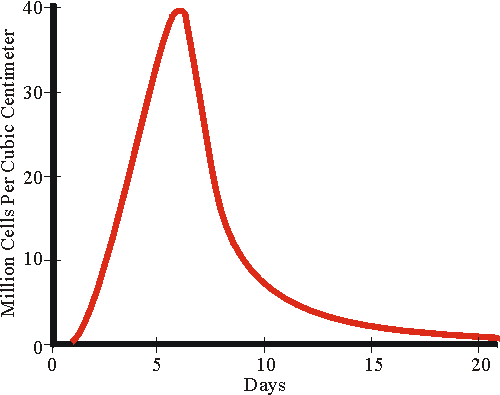
Figure 1. Growth of yeast in a 10% sugar solution (After Dieter, 1962:45). The fall of the curve is slowed by cytolysis, which recycles nutrients from dead cells.
[..] The use of extrasomatic energy, and especially energy from fossil fuels, has made it possible for humans to exploit a wealth of resources that accumulated before they evolved. This has resulted in population growth typical of introduced species (Figure 3).

Figure 3. Growth of worldwide human population (Adapted from Corson, 1990:25).
Note: Price contends that precisely because our population growth is due exclusively to the availability of extrasomatic energy, we are doomed as soon as that availability drops.
[..] For Malthus, the imbalance between the growth of population and means of subsistence might be corrected, from time to time, through natural disasters, but the human species could, in principle, survive indefinitely. Malthus did not know that the universe is governed by the Second Law of Thermodynamics; he did not understand the population dynamics of introduced species; and he did not appreciate that humans, having evolved long after the resource base on which they now rely, are effectively an introduced species on their own planet.
The short tenure of the human species marks a turning point in the history of life on Earth. Before the appearance of Homo sapiens, energy was being sequestered more rapidly than it was being dissipated. Then human beings evolved, with the capacity to dissipate much of the energy that had been sequestered, partially redressing the planet’s energy balance.
The evolution of a species like Homo sapiens may be an integral part of the life process, anywhere in the universe it happens to occur. As life develops, autotrophs expand and make a place for heterotrophs. If organic energy is sequestered in substantial reserves, as geological processes are bound to do, then the appearance of a species that can release it is all but assured. Such a species, evolved in the service of entropy, quickly returns its planet to a lower energy level. In an evolutionary instant, it explodes and is gone.
Price suggests that the chances for human survival are slim at best. But we’re not gone yet. Which means we have a choice between either burning through all resources as fast as we can, or trying to scale down voluntarily, before we are forced to scale down. “Simply” getting used to using much less energy, and adapting to a life, even if that may not be as simple as it sounds, for a myriad of reasons, in which fossil fuels don’t provide each of us in the West with 200+ “energy slaves”
“Today, the extrasomatic energy used by people around the world is equal to the work of some 280 billion men. It is as if every man, woman, and child in the world had 50 slaves. In a technological society such as the United States, every person has more than 200 such “ghost slaves.” to do our work for us.
The way we have built our communities, our towns and cities, is predicated upon maximizing energy use, even if we’re not always aware of that. Most people, to do something as mundane as grocery shopping, need to drive or be driven. Our homes need huge amounts of energy to be heated and cooled. These things are all as unnecessary as they are fixable. As is the transport of millions of tons of goods from all over the planet that we could just as well produce ourselves. And perhaps most importantly, we all surround ourselves with things we don’t need; even if we discount the poorest people, we’re like 5 billion squirrels on steroids. Because once we have access to all those energy slaves, we don’t want to let go of them, we think they make us happy.
Is there really a solid reason, apart from our religious adherence to the equally religious gospel of growth beyond infinity, that would keep us from taking a step back? Are we capable of recognizing the folly of our ideas, and of choosing a different path? That is not an easy question to answer. We certainly are as individuals, but as a group, as a society, different rules apply. Scaling down would collapse our economies, since they depend on ongoing growth – and energy use -. It would also collapse our political systems, which for better or for worse are integral parts of the organization of our societies. This probably means we’re not going to get anywhere in any scaling down efforts if as individuals we stay where we are, if that is a typical American or British or continental European community. Which in turn means most people may switch a light bulb or get a less inefficient vehicle, but that’ll be it, and they’ll stay put. And help David Price’s predictions along.
It’s entirely possible that there is no way out for us. That we are merely a species that evolved to “redress the planet’s energy balance”, and the best we can lay claim to is that we are “an integral part of the life process”. However, again, we’re not gone yet. But we will be if we keep doing what we do. The pinnacle question is whether we can cross the great divide between what we can do as individuals and what we need to do as societies. Cue Sigmund Freud?!

