


Courtesy of Mish.
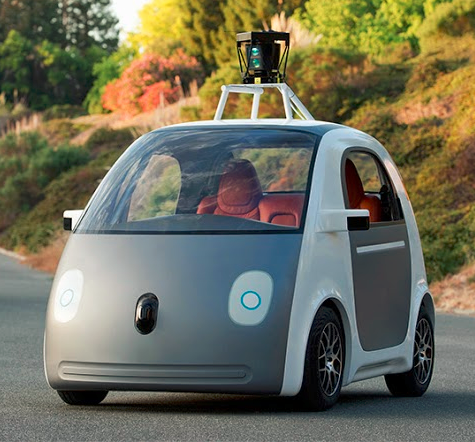
In yet another step towards self-driving vehicles, Google Unveils Steering Wheel-Less Car Prototype.
Ever since we started the Google self-driving car project, we’ve been working toward the goal of vehicles that can shoulder the entire burden of driving. Just imagine: You can take a trip downtown at lunchtime without a 20-minute buffer to find parking. Seniors can keep their freedom even if they can’t keep their car keys. And drunk and distracted driving? History.
We’re now exploring what fully self-driving vehicles would look like by building some prototypes; they’ll be designed to operate safely and autonomously without requiring human intervention. They won’t have a steering wheel, accelerator pedal, or brake pedal… because they don’t need them. Our software and sensors do all the work.
We started with the most important thing: safety. They have sensors that remove blind spots, and they can detect objects out to a distance of more than two football fields in all directions, which is especially helpful on busy streets with lots of intersections. And we’ve capped the speed of these first vehicles at 25 mph. On the inside, we’ve designed for learning, not luxury, so we’re light on creature comforts, but we’ll have two seats (with seatbelts), a space for passengers’ belongings, buttons to start and stop, and a screen that shows the route—and that’s about it.
First Drive
Not a Car, It’s The Future
David Pierce on The Verge writes Google’s Self-Driving Car Isn’t a Car, It’s the Future
On Tuesday night, onstage at the Code Conference in California, Brin revealed an entirely new take on a self-driving car, one decidedly more ambitious than anything we’ve seen before.
Nothing about this car is traditional: it has a front made of compressible foam, a flexible plastic windshield, and a dual-motor system that keeps the car running even if part of its engine fails. It’s easy to imagine executives at GM balking at quite literally reinventing the wheel to help Google X with its latest moonshot.
Self-driving cars are coming. That’s essentially a given: the technology already mostly works, and nearly all automakers believe autonomous vehicles are both a good and feasible idea. They disagree only on the timing, though “by 2020” has become an increasingly popular refrain. The biggest remaining challenges appear to be regulatory rather than technological, as governments start to answer questions like who’s responsible when a self-driving car gets in an accident.
In classic Google fashion, though, Brin talked less about what the Google car could mean for Google and more about how it might change the world. What if we all sold our cars? What if every time we needed a car, we unlocked our smartphones and called for one with a single tap, and as soon as it dropped us off it went off to its next job? We’d need fewer parking lots, reduce our emissions, stop driving drunk, and get in fewer accidents. Those who couldn’t or shouldn’t drive – the blind, the elderly — could still get around. This is the future Brin imagines, one with huge ramifications on everything from the environment to the economy. And the cute little car he’s been developing at Google X is the closest thing we’ve ever seen to making that idea real.
…

